

Bankruptcy might look like a paperwork problem from the outside, but trying to navigate it alone is one of the most financially risky decisions you can make. Pennsylvania residents facing overwhelming debt often underestimate how many moving parts are involved, from choosing the right chapter to protecting their home equity and retirement savings. Experienced legal guidance can be the difference between a clean discharge and a dismissed case that leaves you worse off than before. This guide explains exactly what a bankruptcy attorney does, why it matters, and how local expertise shapes outcomes in Pennsylvania courts.
Table of Contents
- What does a bankruptcy attorney actually do?
- Why success rates are much higher with an attorney
- Critical decisions: Exemptions, means test, and the attorney advantage
- Choosing the right attorney: Local expertise matters
- The overlooked value of a bankruptcy attorney in Pennsylvania
- Connect with a Pennsylvania bankruptcy attorney for your case
- Frequently asked questions
Key Takeaways
| Point | Details |
|---|---|
| Legal expertise increases success | Bankruptcy attorneys in Pennsylvania can drastically improve your chances of a successful outcome and asset protection. |
| Exemption and strategy matters | Choosing the right legal strategy and exemptions is complex—attorneys help you avoid costly errors. |
| Big difference in outcomes | Data shows much higher rates of discharge and lower risk of dismissal when an attorney guides the process. |
| Local experience is key | Pennsylvania's bankruptcy rules differ by district, so local attorney knowledge matters. |
What does a bankruptcy attorney actually do?
Many people assume a bankruptcy attorney simply fills out forms and submits them to a court. The reality is far more involved. From the first consultation to the final discharge, a bankruptcy attorney serves as your legal strategist, advocate, and procedural guide throughout one of the most consequential financial processes of your life.
Here is what a skilled bankruptcy attorney actually handles on your behalf:
- Case evaluation and chapter selection: An attorney reviews your income, assets, debts, and financial history to determine whether Chapter 7 (liquidation) or Chapter 13 (repayment plan) is the better fit. This advice alone can save you thousands of dollars.
- Means test analysis: The means test is a formal calculation that determines whether you qualify for Chapter 7 based on your income relative to Pennsylvania's median. Errors here can result in automatic disqualification.
- Petition preparation and filing: Every document, from schedules listing your assets and liabilities to the statement of financial affairs, must be accurate, complete, and signed. Bankruptcy attorneys prepare and file petitions with all required documentation, including wet signatures where required.
- Exemption planning: Pennsylvania allows filers to choose between federal exemptions and state exemptions. Selecting the wrong set can cost you property you were entitled to keep.
- Representation at the 341 meeting: This is a creditor meeting held by a bankruptcy trustee. Your attorney prepares you for questions and can address legal challenges on the spot.
- Deadline compliance: Bankruptcy involves strict court deadlines for filing documents, completing credit counseling, and submitting a repayment plan. Missed deadlines typically result in dismissal.
- Creditor negotiation: Attorneys can communicate directly with creditors to prevent actions that violate the automatic stay, which is the court order that halts collection efforts once bankruptcy is filed.
"A bankruptcy attorney ensures compliance with deadlines and required courses, negotiates with creditors, and maximizes asset protection using exemptions." — Money.com
For anyone considering rebuilding after bankruptcy, the attorney's work during the case directly shapes the outcome you start with. Pennsylvania has three federal districts, each with its own local rules and trustee practices, which means a generic approach rarely serves you well. If you're also managing any concurrent legal defense in Pennsylvania, the value of coordinated, knowledgeable counsel becomes even clearer.
Why success rates are much higher with an attorney
Understanding what a bankruptcy attorney does is helpful, but the numbers speak for themselves. Let's compare outcomes for those with and without legal counsel.
The difference in outcomes between represented and unrepresented filers is not marginal. It is dramatic. Research consistently shows that people who file without an attorney, called "pro se" filers, face significantly higher rates of case dismissal and failed discharges.
| Filing Type | Chapter 7 discharge rate | Chapter 13 success rate |
|---|---|---|
| Represented filers | 95 to 97% | 33 to 60% |
| Pro se filers | 60 to 70% | Less than 10% (sometimes 2 to 3%) |
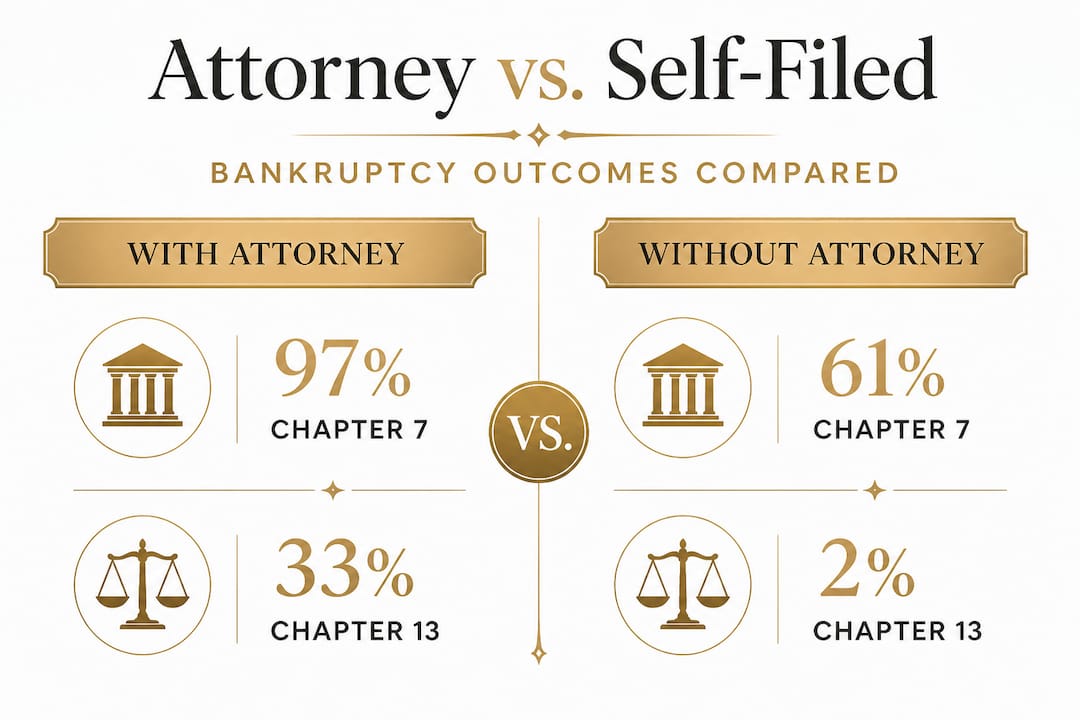
These numbers come from real data on pro se outcomes, and the gap is stark. Chapter 13 in particular requires managing a multi-year repayment plan, negotiating with creditors, and responding to trustee objections. Without an attorney, the odds are strongly against you.
Why do pro se filers fail so often? The most common reasons include:
- Incomplete or inaccurate schedules (the forms listing your debts and assets)
- Failure to complete mandatory credit counseling before filing or debtor education after
- Missed court deadlines that trigger automatic dismissal
- Choosing the wrong chapter based on misunderstood eligibility rules
- Errors in the means test calculation that result in disqualification
Even a small procedural misstep, like submitting a form without a required signature, can get your case thrown out. Courts are not forgiving of technical errors simply because someone lacked legal representation.
Pro Tip: If your bankruptcy case is dismissed due to a procedural error, you may face a waiting period before you can refile and lose the protection of the automatic stay in the meantime, leaving you exposed to wage garnishments and collection lawsuits.
For Pennsylvania filers, local complexity adds another layer of risk. The Eastern, Middle, and Western Districts each have different trustees, filing protocols, and expectations. Working with an attorney who understands means test guidance specific to your district puts you in a much stronger position from day one.
Critical decisions: Exemptions, means test, and the attorney advantage
The data shows attorneys get dramatically better results, but why? Let's explore three decisions where experienced legal advice has the most impact.
Choosing the right exemption set
Pennsylvania is one of the states that allows filers to choose between using the federal bankruptcy exemption system or the Pennsylvania state exemption system. This is not a minor administrative choice. It can determine whether you keep your tax refund, protect your car, or hold onto cash savings.
The federal wildcard exemption, for example, is a particularly valuable tool. It allows you to protect a certain amount of any property, including cash and tax refunds, that Pennsylvania state exemptions do not specifically cover. An attorney evaluates your specific assets and selects the exemption set that protects the most value for you personally.
| Asset type | Federal exemption protection | Pennsylvania state exemption |
|---|---|---|
| Home equity (homestead) | Up to $27,900 | Unlimited for property held as tenancy by entireties with spouse |
| Vehicle | Up to $4,450 | $300 |
| Wildcard (any asset) | Up to $1,475 plus unused homestead | Not available |
| Retirement accounts | Largely unlimited under ERISA | Protected |
The wildcard exemption alone can protect tax refunds and savings accounts that would otherwise be seized in a Chapter 7 liquidation. Missing this option is an expensive mistake that pro se filers commonly make.
Passing the means test accurately
The means test, required for Chapter 7 eligibility, compares your average monthly income over the past six months to Pennsylvania's median income for your household size. If you earn above that median, a second calculation analyzes your allowable expenses to determine whether you have disposable income that should go toward creditors.

An attorney's role here is critical. Allowable expense categories are defined by IRS national and local standards, and Pennsylvania has specific regional amounts for housing and transportation. Miscalculating these numbers, either overestimating or underestimating, can push you into the wrong chapter or trigger a trustee objection. Attorney guidance is critical in Pennsylvania precisely because district trustees apply these standards with varying degrees of scrutiny.
Avoiding preferential transfers and hidden pitfalls
One of the most surprising issues attorneys catch involves preferential transfers. If you paid back a family member or close friend within the year before filing, the trustee can "avoid" (legally reverse) that payment and demand the money back to distribute to creditors. Attorneys identify these transactions in advance and advise on timing to prevent unnecessary complications.
Pro Tip: If you are considering filing bankruptcy in Pennsylvania, avoid paying back personal loans from relatives in the months before filing. A trustee can unwind those transactions and create new debt problems during your case.
The combination of exemption strategy, accurate means test completion, and proactive planning around asset transfers is where experienced attorneys create real, measurable financial value for their clients.
Choosing the right attorney: Local expertise matters
Having covered the attorney's critical role in decision-making, it's time to discuss how to choose the best legal ally for your journey.
Not every bankruptcy attorney is the same. Some firms focus on high-volume filings and may not give each case the individualized attention it deserves. Pennsylvania's three federal districts, Eastern, Middle, and Western, each have distinct local rules, and local district familiarity is a genuine advantage in outcomes, not just a marketing claim.
Here is what to look for when selecting a Pennsylvania bankruptcy attorney:
- District-specific experience: Ask explicitly whether the attorney practices regularly in your district's court and knows that district's trustees and procedures.
- Personalized consultation: Your first meeting should involve a real review of your financial situation, not just a fee quote and a contract.
- Transparent fee structure: Understand upfront what the attorney charges and what services are included. Bankruptcy attorneys are required to disclose fees in the petition itself.
- Communication responsiveness: Your attorney should be reachable and should update you on developments in your case without you having to chase them down.
- Track record with your chapter: If you need Chapter 13, verify the attorney has handled multi-year repayment plans, not just straightforward Chapter 7 cases.
- Honest assessment, not just reassurance: A good attorney tells you what your case actually looks like, including risks and limitations, not just what you want to hear.
"Choosing an experienced local firm familiar with Pennsylvania's districts, rather than a high-volume, low-cost provider, consistently produces better outcomes for complex bankruptcy cases." — Chapter 13 Success Rate by State analysis
If you are located in western Pennsylvania, Ambridge bankruptcy help is available for residents who need local representation with specific knowledge of that region. Similarly, residents in the Lehigh Valley area can find Palmerton bankruptcy advice tailored to the courts and trustees serving that part of the state. Geographic proximity to your attorney matters more than many people realize, because local familiarity with courthouse staff, trustees, and district procedures translates directly into smoother case management.
The overlooked value of a bankruptcy attorney in Pennsylvania
You now know the nuts and bolts. Let's step back and share a bigger-picture lesson that most people miss when evaluating the role of a bankruptcy attorney.
Here is the honest truth: most people researching bankruptcy are focused on cost. They want to know if they can save money by going it alone. This is understandable. You're already under financial pressure. But the framing of "attorney fees as an extra expense" gets it completely backward.
An attorney is not an add-on to the process. An attorney is the process. The decisions made during a bankruptcy filing, which exemptions to claim, how to structure a Chapter 13 plan, which transfers to disclose and which ones need careful timing, are not clerical decisions. They are strategic legal decisions that directly determine how much of your financial life you protect and how quickly you rebuild.
Consider the comparison to managing other legal matters. Someone facing serious criminal charges would not walk into court without a defense attorney, because the stakes are too high and the procedure too complex. Bankruptcy may not carry criminal penalties, but the financial stakes are equally real. The same logic that supports seeking criminal defense strategies applies here: legal expertise is not a luxury, it is a safeguard.
Pennsylvania adds a specific dimension to this. The state's three-district federal court system, its unique exemption structure, and the variation in how individual trustees approach cases all mean that a one-size-fits-all approach produces unpredictable results. The right attorney brings local insight that transforms a confusing, high-stakes process into a manageable path toward genuine financial relief.
The cost of a mistake in bankruptcy, losing a protected asset, having your case dismissed, or selecting the wrong chapter, can far exceed attorney fees. That is the value proposition most people only understand after the fact.
Connect with a Pennsylvania bankruptcy attorney for your case
If you're ready to take the next step toward financial relief, getting a personalized consultation with an experienced local attorney is the most important move you can make right now.

At pennsylvaniadui.attorney, we connect Pennsylvania residents with skilled bankruptcy attorneys who understand the specific rules, trustees, and procedures of your local federal district. Whether you are in the Lehigh Valley and need Palmerton bankruptcy legal support, in the Northampton County area seeking a Pen Argyl bankruptcy attorney, or in Beaver County looking for an Ambridge bankruptcy lawyer, our team is ready to evaluate your situation, explain your options honestly, and represent you through every step of the process. A consultation costs far less than the financial damage a poorly filed case can cause.
Frequently asked questions
What are the most common mistakes made by people who file bankruptcy without an attorney?
The most common mistakes include missed deadlines, incomplete paperwork, misunderstanding exemption rules, and errors that can lead to case dismissal or the loss of valuable assets that could have been protected with proper legal guidance. Pro se discharge rates reflect these issues clearly.
Is it ever a good idea to file bankruptcy without a lawyer in Pennsylvania?
While filing without an attorney is technically permitted, data on unrepresented filers consistently shows much lower success rates, particularly in Chapter 13 cases, and a significantly higher risk of case dismissal or asset loss.
How does an attorney help with protecting assets in a Pennsylvania bankruptcy case?
A Pennsylvania bankruptcy attorney selects the exemption set, federal or state, that protects the maximum value of your specific assets, which is a decision that directly shapes asset protection outcomes and prevents inadvertent property loss.
What is the "means test" and why is attorney guidance necessary?
The means test calculates your Chapter 7 eligibility based on income and allowable expenses. An attorney ensures the calculation is completed accurately, using the correct IRS local standards for Pennsylvania, and helps you select the right chapter for your financial situation, as outlined in bankruptcy attorney guidance resources.
How do Pennsylvania's bankruptcy districts affect my case?
Each of Pennsylvania's three federal districts, Eastern, Middle, and Western, has different trustees, local rules, and procedural expectations. Local attorney familiarity with these district variations is a meaningful advantage that directly influences case outcomes.
Recommended
- Starting Fresh in 2025: How Bankruptcy Law Can Help You Rebuild Your Financial Future — Attorney Sean Quinlan
- Building a Strong Defense Against Criminal Charges in Pennsylvania — Attorney Sean Quinlan
- New Year, New Legal Protections: How Pennsylvania’s Laws Affect DUI and Criminal Defense — Attorney Sean Quinlan
- Navigating the Legal Complexities of Tractor-Trailer Accidents in Pennsylvania — Attorney Sean Quinlan