
A DUI charge in Pennsylvania is not a done deal the moment the handcuffs go on. Many people walk into the process believing the outcome is fixed, that the blood alcohol reading decides everything, and that an attorney is just a formality. That belief costs people dearly. Prosecutors and defense attorneys negotiate based on complex factors that go far beyond what shows up in an arrest report. This guide walks you through exactly how Pennsylvania DUI settlements work, where your attorney's influence is strongest, and what you can do right now to give your case the best possible chance.
Table of Contents
- Why attorney involvement matters in Pennsylvania DUI settlements
- The step-by-step DUI settlement process and your attorney's role
- Key factors attorneys and prosecutors weigh during settlement talks
- How to work most effectively with your DUI attorney
- The overlooked power of legal strategy in DUI settlements
- How to get experienced help for your Pennsylvania DUI case
- Frequently asked questions
Key Takeaways
| Point | Details |
|---|---|
| Attorney advocacy matters | An attorney can dramatically change your DUI settlement through negotiation and tailored defense strategies. |
| ARD rules have changed | A DUI after ARD now counts as a repeat, so legal advice is crucial for long-term impact. |
| Negotiation is complex | Both prosecutors and defense attorneys weigh many factors such as caseload, political pressure, and rehabilitation versus punishment. |
| Client involvement is key | Working closely and honestly with your attorney can lead to better case results. |
Why attorney involvement matters in Pennsylvania DUI settlements
Most people assume DUI cases move on a conveyor belt from arrest to conviction. The truth is that the settlement process involves real negotiation, and the outcome depends heavily on who is doing the negotiating for you. An experienced attorney does not just show up in court. They dig into the evidence, identify weaknesses in the prosecution's case, and open conversations with the district attorney long before a courtroom appearance.
Here is what a skilled DUI attorney typically does on your behalf:
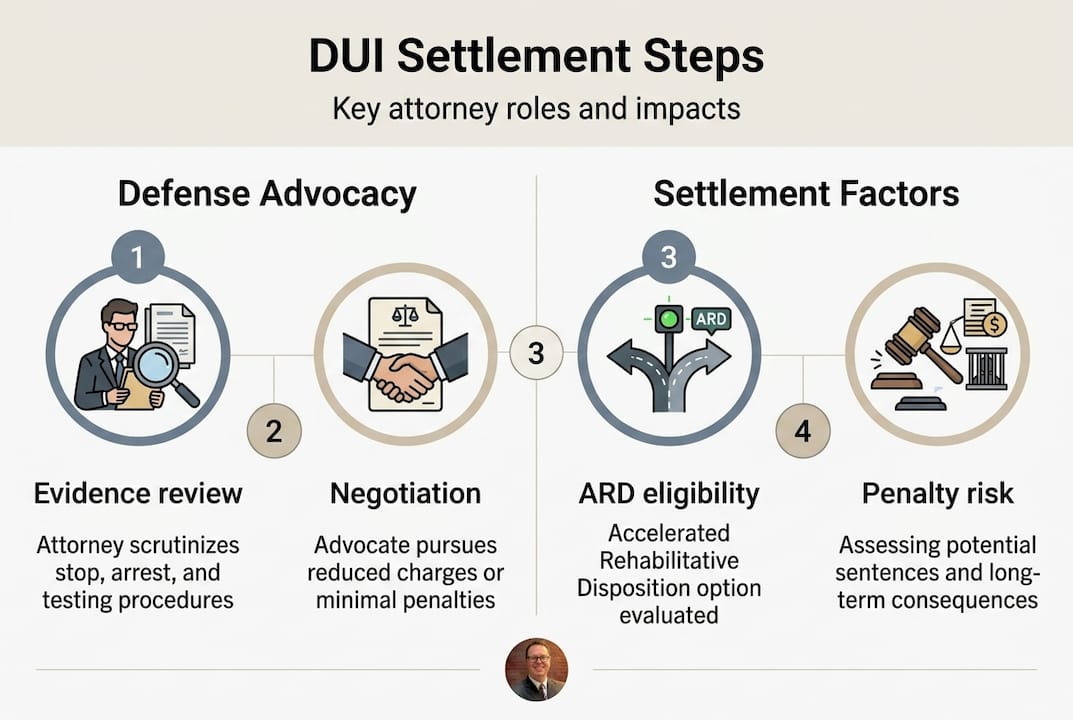
- Reviews all evidence including police reports, field sobriety test records, and breathalyzer calibration logs
- Identifies procedural errors such as improper stops or faulty equipment that could weaken the prosecution's case
- Negotiates directly with prosecutors to pursue charge reductions or alternative resolutions
- Evaluates ARD eligibility, which stands for Accelerated Rehabilitative Disposition, a program that can keep a first offense off your permanent record
- Advises on long-term consequences so you understand what you are agreeing to before signing anything
Without legal representation, you are navigating this alone. Prosecutors are incentivized by caseloads and resources while defense attorneys prioritize rehabilitation and individual outcomes. Those are fundamentally different starting points, and only one side will be in your corner without an attorney.
Some district attorneys are also politically cautious. Offering reductions in DUI cases can attract scrutiny, so not every DA is eager to negotiate. That makes it even more important to have someone who knows how to approach that specific office and build a persuasive case for leniency or alternatives.
"The earlier you secure representation, the more options remain open. Strategic leverage shrinks the longer you wait."
Pro Tip: Do not wait for your first court date to hire an attorney. The window right after your arrest is when the most critical decisions get made, and being prepared to pursue selecting your DUI attorney early gives your defense the strongest foundation.
The step-by-step DUI settlement process and your attorney's role
Understanding where your attorney steps in at each stage removes a lot of the fear that comes with a DUI charge. DUI cases involve a series of negotiations and procedural steps, and attorneys shape outcomes at every one of them.
Here is a simplified look at how the process typically unfolds:
- Arrest and booking — Your attorney advises you on what to say and what not to say immediately after arrest
- Arraignment — You enter a formal plea; your attorney may argue for lower bail or release on your own recognizance
- Evidence review — Your attorney examines every piece of the prosecution's case for weaknesses or violations
- Pre-trial motions — Your attorney may file to suppress evidence, including breathalyzer results or field sobriety tests, if proper procedure was not followed
- Plea negotiations — Your attorney engages the prosecutor to discuss reduced charges, ARD eligibility, or alternative sentencing
- Settlement or trial — If a favorable deal is reached, the case resolves; if not, your attorney prepares for trial
| Stage | Attorney's role | Potential impact |
|---|---|---|
| Arraignment | Enter plea, argue bail | Reduced bail, release conditions |
| Evidence review | Identify procedural errors | Possible dismissal or suppression |
| Pre-trial motions | Challenge breathalyzer or stop | Weakened prosecution case |
| Plea negotiations | Negotiate charges with DA | Reduced penalties or ARD |
| Settlement | Finalize agreement | Minimized long-term consequences |
One area where attorneys frequently make an outsized impact is challenging breathalyzer results. Breathalyzer devices require regular calibration, and the officer administering the test must follow strict protocols. A missed step in that process can make the reading inadmissible.
Pro Tip: Skilled attorneys look at everything, not just the BAC number. The manner in which you were stopped, how the field sobriety test was conducted, and whether your Miranda rights were read correctly all matter in court.
Key factors attorneys and prosecutors weigh during settlement talks
Settlement talks are not a simple exchange of offers. Both sides bring very different motivations to the table, and understanding those motivations helps you see why legal strategy is so important.
What defense attorneys focus on:
- Minimizing penalties and protecting your future
- Qualifying you for rehabilitation programs like ARD
- Protecting your driving privileges and employment
- Assessing how future charges would be affected by the current settlement
What prosecutors focus on:
- Managing their caseload efficiently
- Securing a conviction that satisfies public safety concerns
- Avoiding political fallout from perceived leniency
- Weighing evidence strength before committing to trial
| Factor | Defense perspective | Prosecution perspective |
|---|---|---|
| Evidence strength | Seek weaknesses to exploit | Assess likelihood of conviction |
| Defendant history | First offense = strong ARD case | Repeat = less flexibility |
| ARD eligibility | Push for program entry | May resist for political reasons |
| Legislative changes | Counsel on long-term impact | Apply current law as written |
One of the most significant recent developments involves ARD and repeat offenses. Post-ARD DUIs are now treated as repeat offenses under new Pennsylvania law. That is a game changer. Previously, completing ARD meant a clean slate. Now, if you receive ARD for a first DUI and later get charged again, prosecutors treat that second charge as a second offense with much harsher mandatory penalties.
This shifts how attorneys negotiate. They have to think beyond the immediate case and consider what the settlement means five years from now. Understanding the ARD program differences by county is essential because availability and terms vary significantly across Pennsylvania.
Stat callout: Under 2026 Pennsylvania law, completing ARD no longer shields you from enhanced penalties on a subsequent DUI charge. A second offense after ARD carries mandatory minimum sentences that can include jail time, even if years have passed.
How to work most effectively with your DUI attorney
Your attorney can only work with what they have. The single most powerful thing you can do for your own case is to give your attorney the full picture, every detail, no matter how embarrassing or trivial it might seem.
Here is a checklist to make yourself the most effective partner in your own defense:
- Share everything about the night of the arrest — what you ate, drank, where you were, and exactly what happened during the traffic stop
- Gather any documentation you have — receipts, photos, witness contact information, or anything else from that evening
- Respond to your attorney promptly — delays in communication can close doors in time-sensitive negotiations
- Follow all recommendations carefully — if your attorney suggests enrolling in a substance education class, do it immediately; it signals good faith to prosecutors
- Know your rights — understanding your DUI rights in Pennsylvania means you can have informed conversations with your attorney instead of relying on guesswork
- Be honest, even if facts hurt your case — surprises in court are far more damaging than uncomfortable truths shared privately with counsel
Clients who provide full details and documentation consistently enable stronger negotiation positions. Your attorney cannot anticipate what they do not know.
"Client honesty is not optional. It is the foundation everything else is built on. One hidden detail can unravel a negotiation that took weeks to set up."
Respond to calls and emails quickly. Legal timelines are strict, and a missed window can mean losing the chance to file a motion or accept a deal. Think of your attorney as a co-pilot. They know the route, but you have to keep the plane in the air together.
The overlooked power of legal strategy in DUI settlements
Here is an uncomfortable truth most people never hear: the evidence on paper rarely tells the whole story of a DUI case. We have seen cases where a BAC well over the legal limit still resulted in a favorable outcome because the attorney identified a procedural flaw that made that reading unreliable. No cookie-cutter approach would have caught it.
Conventional wisdom misses the complexity behind every DUI case. People assume that once the numbers are in, the case is over. But the numbers are only part of the story. How those numbers were obtained, who obtained them, and whether every legal safeguard was respected all carry enormous weight.
The attorneys who change outcomes are the ones who treat each case as a unique puzzle, not a form to fill out. A personalized strategy considers your history, the specific county's DA tendencies, the assigned judge, and what how legal guidance changes DUI outcomes in ways that numbers alone never predict. Resist anyone who tells you your case is hopeless or obvious without actually reviewing the specifics.
How to get experienced help for your Pennsylvania DUI case
Every insight in this article points to the same conclusion: legal strategy matters, and timing matters even more. A DUI charge is not the end of the road, but waiting too long to act can close options that were available at the start.

If you are facing a DUI in Pennsylvania, the Pennsylvania DUI attorney services available through this platform are built specifically for situations like yours. Attorney Sean Quinlan brings direct experience navigating the exact negotiations, ARD programs, and county-level nuances this article covers. You can consult Attorney Sean Quinlan to get a case evaluation and understand your real options before making any decisions. Acting now protects your ability to negotiate from a position of strength.
Frequently asked questions
Can an attorney really reduce my DUI charges in Pennsylvania?
Yes. A skilled attorney can often negotiate reduced charges or alternative sentences like ARD by identifying weaknesses in the evidence and negotiating strategically with the prosecution. The ability to secure reductions depends heavily on case specifics and timing.
What is the ARD program, and how does it impact settlements?
ARD is a rehabilitative diversion program for eligible first-time offenders that avoids a conviction on your record, but under current law, a second DUI after ARD is treated as a repeat offense with enhanced penalties.
When should I hire an attorney if charged with a DUI?
Hire an attorney as soon as possible after your arrest. The earlier you have representation, the more options remain available and the stronger your negotiation position becomes.
Do all counties in Pennsylvania offer ARD for DUI settlements?
No. ARD availability and terms vary by county, and some DAs resist reductions for political or resource reasons, making local legal knowledge a significant advantage.
Recommended
- Auto Accidents in Pennsylvania: Know Your Rights and How to Protect Them — Attorney Sean Quinlan
- How a DUI Conviction Could Impact Your Life—and How Legal Representation Can Help — Attorney Sean Quinlan
- Understanding DUI Penalties in Pennsylvania: How Sean Quinlan Legal Services Can Help — Attorney Sean Quinlan
- DUI Defense in Pennsylvania: Why You Need an Experienced Attorney — Attorney Sean Quinlan
- Seek Legal Advice After Accident: 3.5x Higher Settlements