

If you completed ARD after a Pennsylvania DUI and assumed your record was clean, think again. A sweeping update to state law signed in December 2025 has fundamentally changed how prosecutors track prior offenses, how ARD participation is used against defendants, and how license suspension violations are punished. Most people facing DUI charges in Pennsylvania today are operating on outdated assumptions about what their legal situation actually looks like. This guide cuts through the noise and explains exactly what changed, why it matters, and what it means for your case.
Table of Contents
- Recent legislative changes and why they matter
- How prior ARD participation is handled in 2026
- Flat sentences and changes to license suspension violations
- Test refusals and ignition interlock: Where the law stands in 2026
- What most people miss about the 2026 Pennsylvania DUI law landscape
- Get experienced legal help for DUI charges in Pennsylvania
- Frequently asked questions
Key Takeaways
| Point | Details |
|---|---|
| ARD records now count | ARD completions can be used by prosecutors for 12 years, even after expungement. |
| Flat jail sentences | Driving under DUI suspension brings mandatory jail time—no parole, 60-90 days. |
| Test refusal rules clarified | Provisions for refusing breath or chemical tests are now aligned with state and federal rulings. |
| Ignition interlock pending | Further ignition interlock law changes are not yet fully active in 2026. |
Recent legislative changes and why they matter
With the landscape rapidly changing, let's start by understanding exactly what changed in December 2025 and why.
Pennsylvania's DUI laws received their most significant overhaul in years when Act 58 of 2025 was signed into law. Governor Shapiro signed HB 1615 on December 22, 2025, as Act 58, effective immediately. That means anyone facing a DUI charge today is operating under these new rules, whether they know it or not.
The law was triggered largely by Commonwealth v. Shifflett, a 2025 Pennsylvania Supreme Court ruling that exposed gaps in how prior ARD records could be used at sentencing. Prosecutors found themselves unable to prove prior ARD participation in certain cases because records had been expunged. Act 58 was the legislature's direct response to close those gaps and restore prosecutorial power.
Here's a quick snapshot of what the law changed:
| Area | Before Act 58 | After Act 58 (2025) |
|---|---|---|
| ARD record use | Limited after expungement | Admissible for 12 years via certified records |
| Proof of prior ARD | Difficult post-expungement | PennDOT, court, or out-of-state records allowed |
| License suspension violations | Standard sentencing rules | Flat sentences introduced (no parole option) |
| Test refusal alignment | Some gaps with federal law | Aligned with Act 30 of 2017 and U.S. Supreme Court |
"Act 58 closes loopholes that previously allowed defendants to sidestep enhanced sentencing by pointing to an expunged ARD record. The law makes clear that expungement does not erase prosecutorial memory."
These changes affect sentencing outcomes, expungement strategies, and how DUI expungement works in practice. If your attorney is still advising you based on pre-2025 law, that is a serious problem.
How prior ARD participation is handled in 2026
Having set the context, it's crucial to look closer at exactly how your prior record, especially ARD, is treated now.
Accelerated Rehabilitative Disposition, or ARD, is a pretrial diversion program for first-time DUI offenders in Pennsylvania. Complete the program, and the charge gets dismissed. Many people leave ARD believing their record is clean and their future is unaffected. That belief was already shaky before 2025. Now it is outright dangerous.
Under Act 58, prosecutors can prove prior ARD completion using certified PennDOT records, court records, or even out-of-state documentation, and those records survive ARD expungement entirely.

Here's how ARD treatment compares before and after the change:
| Scenario | Before Act 58 | After Act 58 |
|---|---|---|
| ARD expunged, new DUI charge | Prior ARD hard to prove | Provable via certified records |
| Out-of-state ARD equivalent | Unclear admissibility | Now explicitly admissible |
| Sentencing enhancement trigger | Required prior conviction | ARD participation counts too |
What this means in plain terms:
- Completing ARD does not reset your DUI history for sentencing purposes
- Prosecutors have 12 years to use that ARD participation against you
- Even if your record looks clean on a background check, courts can still treat you as a repeat offender
- Out-of-state diversion programs may also count under the new rules
Pro Tip: If you completed ARD in the past 12 years and are now facing a new DUI charge, you could face second-offense penalties even if your record appears clean. Talk to an attorney before assuming your ARD history is invisible.
The ARD program in Pennsylvania remains a valuable tool for first-time offenders. But entering it now requires a much clearer understanding of the long-term consequences. And if you are already on the other side of ARD and facing new charges, you need to understand how second DUI offense penalties could now apply to you even without a formal prior conviction.
Flat sentences and changes to license suspension violations
Beyond ARD, the changes impact what happens if you're caught driving under suspension due to a DUI.
One of the quieter but most impactful provisions in Act 58 addresses what happens when someone drives while their license is suspended specifically because of a DUI. These violations fall under Section 1543 of the Pennsylvania Vehicle Code, and the penalties just got sharper.
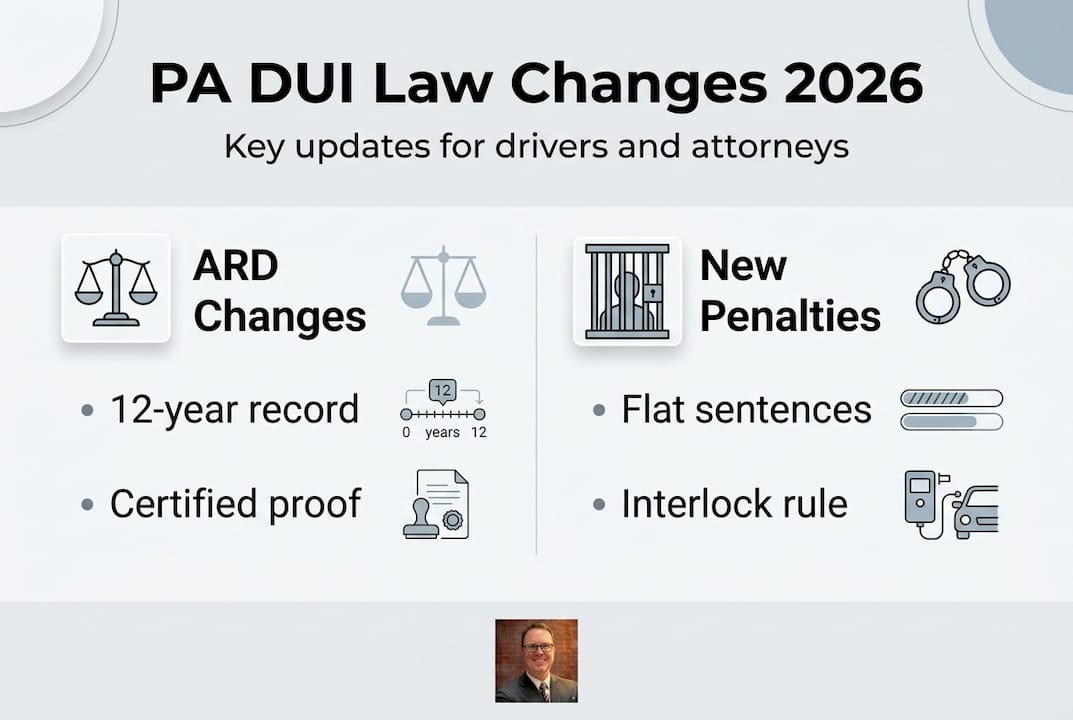
Act 58 introduces flat prison sentences for certain Vehicle Code summary violations, including driving under DUI suspension. A flat sentence means no parole. You serve the time. First violation: 60 days. Second violation: 90 days. These are mandatory minimums with no flexibility built in.
Here is why that matters:
- Before Act 58, courts had more discretion with these violations, and some defendants served little or no jail time through parole mechanisms
- After Act 58, that discretion is gone for DUI-related suspensions. If you are convicted, you are serving the time
- This change corrects what legislators saw as inconsistencies in how courts handled these violations across different counties
Pro Tip: If your license is suspended due to a DUI, do not drive under any circumstances. A single traffic stop can now result in a mandatory jail sentence with no parole path out. It is not worth the risk.
For anyone navigating these charges, understanding the full picture of driving under suspension laws in Pennsylvania is critical. The distinction between a standard license suspension and a DUI-related suspension now carries dramatically different legal consequences.
Test refusals and ignition interlock: Where the law stands in 2026
Test refusals and ignition interlock laws are also points of confusion, and this section makes their status clear.
When a police officer asks you to submit to a breath or chemical test during a DUI stop, refusing has consequences. Pennsylvania operates under implied consent law, meaning that by driving on public roads, you have already agreed to testing. Act 58 did not reinvent this area of law, but it did bring important clarity.
The updated provisions for refusing breath or chemical tests now align state law directly with Act 30 of 2017 and U.S. Supreme Court decisions, resolving gaps that had caused confusion in Pennsylvania courts.
Here is what you need to know about test refusals in 2026:
- Refusing a breath test still triggers an automatic license suspension through PennDOT, separate from any criminal charge
- That refusal can be used as evidence in your DUI prosecution
- Act 58 confirms that the constitutional framework supporting implied consent is now codified more clearly under Pennsylvania statute
- Blood draw refusals are treated differently and may involve a warrant, but the landscape around challenging breathalyzer results remains a viable defense avenue
"Aligning Pennsylvania's implied consent provisions with federal court decisions removes ambiguity that defense attorneys had previously used to challenge test refusal penalties."
On the ignition interlock side, HB 1862 passed the House in 2025 with the goal of streamlining interlock processes, including a single Ignition Interlock Driver's License and faster PennDOT approvals. However, as of mid-2026, the bill's final status remains unclear. If you are dealing with an interlock requirement, confirm the current rules with your attorney before making any assumptions.
What most people miss about the 2026 Pennsylvania DUI law landscape
Now that you understand the legal details, let's step back and consider what these changes really mean for Pennsylvanians facing DUI charges.
Here's the uncomfortable truth: most people arrested for DUI in Pennsylvania think of it as a one-time event with a defined ending point. You pay fines, complete a program, maybe do ARD, and move on. The law used to support that framing. It no longer does.
Act 58 reframes DUI accountability as a 12-year window. Whatever you do today, however your case resolves, sits on a legal ledger for over a decade. That means defense strategy needs to change. It cannot just be about getting through this charge. It has to account for what happens to your record over the next 12 years.
First-timers are especially vulnerable to this gap in understanding. They enter ARD thinking it is a clean exit. It is not. The expungement realities in Pennsylvania are now more complex than ever, and the gap between what clients expect and what the law actually delivers has never been wider.
The defense strategies that worked five years ago may actively harm you today if your attorney doesn't understand how Act 58 interacts with your specific situation. Informed legal counsel is not just helpful. It is the difference between a manageable outcome and a sentence you didn't see coming.
Get experienced legal help for DUI charges in Pennsylvania
If you're navigating these complex changes, don't go it alone. Here's how to get help.
The 2026 DUI legal landscape in Pennsylvania rewards people who act fast and with the right information. Act 58 changed the rules, and your defense needs to reflect that reality from day one.

At pennsylvaniadui.attorney, Attorney Sean Quinlan brings focused experience to every DUI case in Pennsylvania, including cases complicated by prior ARD, license suspension violations, and test refusals. Understanding how the new law applies to your specific record and charges requires legal guidance you can trust. Contact us today for a free consultation and find out exactly where you stand under the 2026 rules.
Frequently asked questions
Does ARD still keep my record clean after a DUI in Pennsylvania?
No. Under Act 58, ARD records are retained for 12 years for prosecutorial use, even after expungement, meaning prosecutors can still use your ARD history to seek enhanced sentencing on a new charge.
What counts as a prior offense for DUI sentencing in 2026?
Any prior conviction or ARD participation within the past 12 years can be used to enhance your sentence. Under Act 58, prior ARD participation is now explicitly admissible even if it was previously expunged.
What are the penalties for driving under DUI suspension now?
Act 58 sets mandatory flat sentences for driving under DUI suspension: 60 days for a first violation and 90 days for a second, with no parole eligibility.
Is there an update on ignition interlock laws for 2026?
HB 1862 aimed to simplify interlock requirements, including a single license and faster approvals, but the bill's status remains unresolved as of mid-2026, so check with your attorney for the latest.
Recommended
- Blog 3 — Attorney Sean Quinlan
- Understanding Pennsylvania DUI Laws in 2025: What Every Driver Needs to Know — Attorney Sean Quinlan
- Act 58 of 2025: What Pennsylvania's New DUI Law Means — Attorney Sean Quinlan
- Your Rights at a Pennsylvania DUI Checkpoint: What Every Driver Should Know — Attorney Sean Quinlan