

A Pennsylvania DUI is not a minor inconvenience you pay off and forget. Many people walk into their first court date expecting a fine and a warning, only to discover they face mandatory license suspensions, ignition interlock requirements, and penalties that can follow them for years. Pennsylvania law sets hard minimums for DUI sentencing, meaning judges often cannot soften the blow even if they want to. This guide breaks down exactly what you could face, from blood alcohol content (BAC) tiers to hidden costs that most people never see coming, and explains why having the right legal counsel in your corner matters more than you might think.
Table of Contents
- How Pennsylvania classifies DUIs and determines penalties
- Core penalties: Fines, license suspension, and jail time
- Ignition interlock and hidden DUI costs
- Alternatives, nuances, and your defense options
- Why expert legal help changes DUI outcomes
- Get help navigating Pennsylvania DUI penalties
- Frequently asked questions
Key Takeaways
| Point | Details |
|---|---|
| DUI penalties escalate fast | Penalties for DUI in Pennsylvania rise steeply with repeat offenses and higher BAC levels. |
| Mandatory ignition interlock | Most offenders with a suspended license must install costly ignition interlock devices to regain driving privileges. |
| County rules can vary | ARD program eligibility and defense options are different in each Pennsylvania county. |
| Expert legal help matters | Knowledgeable attorneys can make a significant difference in case outcomes and minimizing long-term impacts. |
How Pennsylvania classifies DUIs and determines penalties
To navigate the penalties, the first step is understanding how Pennsylvania classifies and scores DUI offenses. The state uses a tiered system based on your BAC at the time of arrest, and each tier carries its own set of minimum and maximum penalties.
Here is how the three tiers break down:
| Tier | BAC Range | Classification |
|---|---|---|
| General Impairment | 0.08% to 0.099% | Lowest tier |
| High BAC | 0.10% to 0.159% | Mid tier |
| Highest BAC | 0.16% and above (or refusal) | Harshest tier |
Your tier determines your starting point. From there, the number of prior DUI offenses within a ten-year lookback period pushes penalties higher. A second or third offense in the same tier carries dramatically steeper consequences than a first offense.
Pennsylvania law under 75 Pa.C.S. § 3804(g) enforces mandatory minimum sentences. This is a critical detail. Unlike many states where a judge has wide discretion, Pennsylvania courts must impose at least the statutory minimum. As PennDOT notes, sentencing guidelines do not override statutory mandates, and counties vary in how they apply ARD eligibility.
Key factors that shape your penalty:
- BAC tier at the time of arrest
- Number of prior DUI offenses within ten years
- Whether a minor was in the vehicle
- Whether an accident or injury occurred
- Refusal of chemical testing (treated as highest BAC tier)
For first vs. repeat offenses, the difference in outcomes is significant. First-time general impairment offenders may qualify for the Accelerated Rehabilitative Disposition (ARD) program, which is a pre-trial intervention that can keep a conviction off your record. However, ARD program eligibility is not guaranteed and depends heavily on the county where you were charged.
Pro Tip: Do not assume your county offers ARD or that you automatically qualify. Some counties have strict policies that exclude certain BAC levels or prior records. Confirm eligibility with an attorney before banking on it.
Core penalties: Fines, license suspension, and jail time
Once classification is clear, it is important to see exactly what punishments are on the table. The range is wide, but the floor is set by law.
| Offense | General Impairment | High BAC | Highest BAC |
|---|---|---|---|
| 1st offense | No jail, $300 fine, 6-mo probation | 48 hrs jail, $500-$5,000 fine, 12-mo suspension | 72 hrs jail, $1,000-$5,000 fine, 12-mo suspension |
| 2nd offense | 5 days jail, $300-$2,500 fine, 12-mo suspension | 30 days jail, $750-$5,000 fine, 12-mo suspension | 90 days jail, $1,500-$10,000 fine, 18-mo suspension |
| 3rd offense | 10 days jail, $500-$5,000 fine, 12-mo suspension | 90 days jail, $1,500-$10,000 fine, 18-mo suspension | 1-5 years jail, $2,500-$10,000 fine, 18-mo suspension |
As PennDOT confirms, fines, suspensions, and jail time vary by tier and repeat offense history, with the harshest outcomes reserved for high BAC or repeat offenders.
Here is what the penalty progression looks like in practice:
- First offense, general impairment: Often resolved with probation, a safety school requirement, and a modest fine. No mandatory jail, but still a criminal record.
- First offense, high or highest BAC: Mandatory minimum jail time kicks in. Even 48 or 72 hours behind bars affects your job, family, and reputation.
- Second offense, any tier: License suspension becomes a certainty. Jail time is mandatory across all tiers.
- Third offense, highest BAC: This is now a felony in Pennsylvania. Prison time of one to five years is on the table.
For a closer look at what happens with a second DUI penalties situation, the jump from first to second offense is steep. And if you are looking at a third charge, understanding felony DUI info is essential before you take any legal steps.

Pro Tip: Even if a judge wants to show leniency, statutory minimums prevent it. Your best chance at a better outcome is challenging the charge itself, not hoping for judicial mercy at sentencing.
Ignition interlock and hidden DUI costs
Beyond the obvious fines and suspensions, penalties often continue to hit long after courtroom sentencing. The ignition interlock device (IID) is one of the most underestimated consequences of a Pennsylvania DUI.
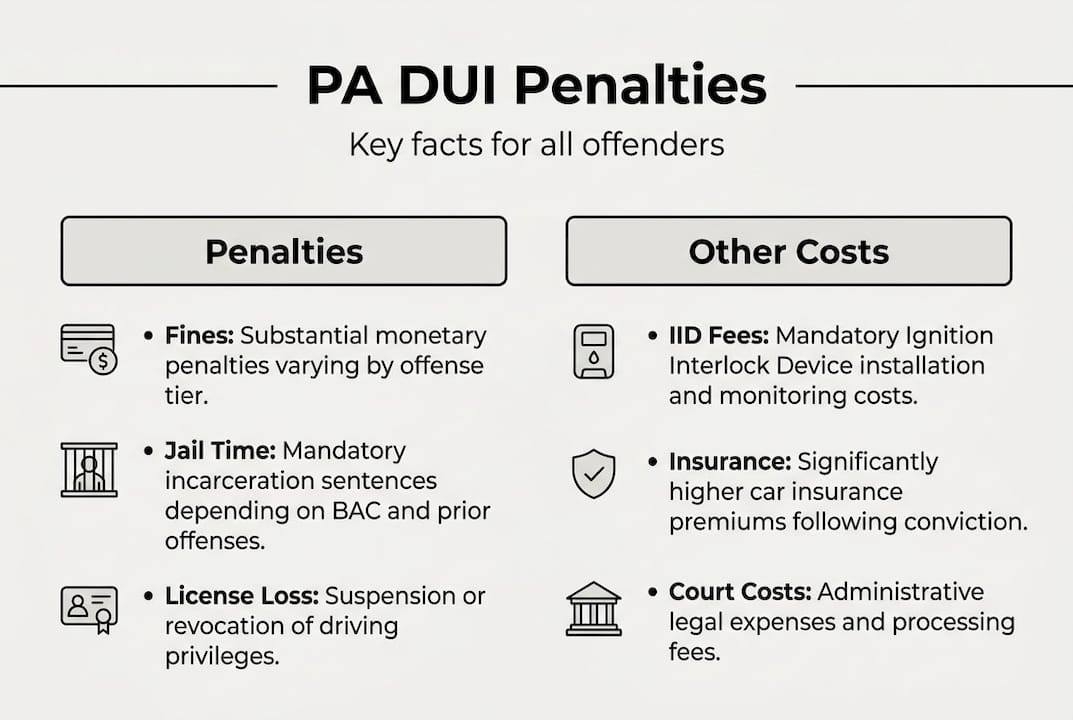
An IID is a breathalyzer installed in your vehicle that requires you to pass a breath test before the car will start. Pennsylvania requires it for license restoration after many DUI suspensions. Specifically, ignition interlock is mandatory for all drivers with suspensions stemming from a first high or highest BAC offense, and for every repeat offender regardless of tier, with annual costs running $900 to $1,300 not counting installation and monitoring fees.
The hidden costs of a DUI conviction stack up fast:
- IID installation: $70 to $150 upfront
- Monthly monitoring fees: $60 to $100 per month
- Auto insurance increases: Premiums can double or triple after a DUI conviction
- DUI safety school fees: Typically $75 to $100
- Attorney fees and court costs: Varies widely
- Lost wages: Time off for court dates, hearings, and mandatory programs
Many people are also surprised to learn that renewing your vehicle registration after DUI can involve additional steps and requirements tied to your IID compliance status.
If you are thinking about what happens after you serve your time, looking into DUI expungement options early is smart. Not every DUI is expungeable, but understanding your options before your case resolves can shape the decisions you make now.
Pro Tip: Factor IID costs into your total financial picture from day one. Many clients focus only on fines and miss the fact that the interlock alone can cost over $1,000 per year for a mandatory period.
Alternatives, nuances, and your defense options
Many people wonder about alternatives and whether a great legal defense can reduce penalties. The honest answer is: sometimes yes, but it depends on factors most people do not fully understand.
ARD is the most well-known alternative for first-time offenders. If you complete the program, the charges can be dismissed and your record expunged. But eligibility is not universal. As PennDOT data shows, counties vary widely in ARD rules, sentencing cannot override statutory minimums, and statewide DUI arrests have dropped from roughly 42,000 to 40,000 annually as enforcement has grown stricter.
Here is what you need to know about your real options:
- ARD eligibility varies by county. What works in one county may be denied in another. Some counties exclude high BAC offenders entirely.
- Statutory minimums are firm. A judge cannot sentence you below the legal floor, no matter how sympathetic your circumstances.
- Plea negotiations still matter. An experienced attorney may negotiate a charge reduction or favorable program placement that changes your outcome.
- Defense strategy is county-specific. Local knowledge of prosecutors, judges, and procedures is not optional. It is essential.
"The difference between a conviction and a dismissal often comes down to who knows the local system and how to work within it."
For a deeper look at how location shapes outcomes, understanding defense strategies by county is one of the most important steps you can take. And if you want a full picture of where the law stands right now, reviewing Pennsylvania DUI laws overview gives you the current legal landscape.
Why expert legal help changes DUI outcomes
Here is a truth most people learn too late: Pennsylvania DUI law is not designed to be navigated alone. The tiered system, mandatory minimums, and county-by-county variations create a maze where a wrong turn costs you years, not just dollars.
We have seen clients walk in convinced their case was minor, only to discover their BAC placed them in the highest tier, making mandatory jail time unavoidable without a strong defense challenge. The law ties judges' hands. That means your leverage exists before sentencing, not during it. It lives in the investigation, the stop, the chemical test procedure, and the paperwork.
Clients who work with experienced DUI attorneys consistently see better results. Not because attorneys bend rules, but because they know where the system has cracks. An improperly administered breath test. A stop without sufficient cause. A chain of custody issue with a blood sample. These are the details that change outcomes. The consequences of repeat offenses are severe enough that even a small procedural error in the prosecution's case can be the difference between prison and probation.
Get help navigating Pennsylvania DUI penalties
Facing DUI charges in Pennsylvania is serious, and the penalty structure is not forgiving. Whether this is your first offense or you are dealing with a repeat charge, the decisions you make in the next few days will shape your outcome for years.

At pennsylvaniadui.attorney, attorney Sean Quinlan brings focused experience in Pennsylvania DUI defense, with a deep understanding of how each county handles charges, ARD eligibility, and sentencing. If you need real answers about your case, explore your DUI legal help options today. A consultation costs you nothing compared to what the wrong outcome could cost you long-term.
Frequently asked questions
How long will a DUI stay on my record in Pennsylvania?
A DUI conviction generally stays on your criminal record permanently in Pennsylvania. However, completing a program like ARD may allow for record expungement, though rules and eligibility vary by county.
Can I drive after a DUI arrest before my trial?
In most cases, you can continue driving after a DUI arrest until PennDOT formally suspends your license. The suspension timing depends on how quickly PennDOT processes the paperwork, which can range from days to several weeks.
Is ignition interlock required for a first DUI offense?
Yes, for certain first offenses. Ignition interlock is mandatory after suspension for first-time high or highest BAC offenders, and it applies to all repeat offenders regardless of their BAC tier.
What is ARD and how does it affect DUI penalties?
ARD is a first-offender diversion program that, when successfully completed, can result in charges being dismissed and your record expunged. However, counties vary in ARD eligibility, so not everyone qualifies.
How much are DUI fines and what other costs should I expect?
Base fines range from $300 to $10,000 depending on your tier and offense number. Beyond fines, you should expect interlock costs of $900 to $1,300 per year, plus higher insurance premiums, program fees, and lost income from mandatory court appearances.
Recommended
- Understanding Pennsylvania DUI Laws in 2025: What Every Driver Needs to Know — Attorney Sean Quinlan
- Field Sobriety Tests in Pennsylvania: Why You Have the Right to Refuse — Attorney Sean Quinlan
- Second DUI Offense in Pennsylvania: Enhanced Penalties and Mandatory Minimums — Attorney Sean Quinlan
- Your Rights at a Pennsylvania DUI Checkpoint: What Every Driver Should Know — Attorney Sean Quinlan