

The aftermath of a tractor trailer accident hits fast and hard. Medical bills stack up, insurance adjusters start calling, and you're left wondering what your legal rights actually are. These crashes are not like ordinary fender benders. A fully loaded commercial truck can weigh up to 80,000 pounds, and the damage it causes, physically and financially, can be life-altering. Pennsylvania law gives you real options for recovery, but the steps you take in the days and weeks after the crash will shape everything that follows. This guide walks you through each stage, from the scene of the accident to filing a claim and securing fair compensation.
Table of Contents
- Assessing the accident and understanding your legal rights
- Identifying liable parties and building your case
- Filing claims and navigating Pennsylvania insurance laws
- Maximizing compensation and common legal mistakes
- What most guides miss: The reality of Pennsylvania tractor trailer accident claims
- Get expert legal help for your tractor trailer accident
- Frequently asked questions
Key Takeaways
| Point | Details |
|---|---|
| Know your rights | Understand legal protections and obligations after a tractor trailer accident in Pennsylvania. |
| Gather evidence early | Timely collection of photos, records, and witness statements is crucial for your claim. |
| Multiple liable parties | Trucking accidents often involve several responsible parties beyond just the driver. |
| Follow Pennsylvania laws | Navigating state-specific insurance rules and deadlines ensures your recovery isn’t delayed. |
| Seek expert help | Professional legal support increases your chances of successful compensation and justice. |
Assessing the accident and understanding your legal rights
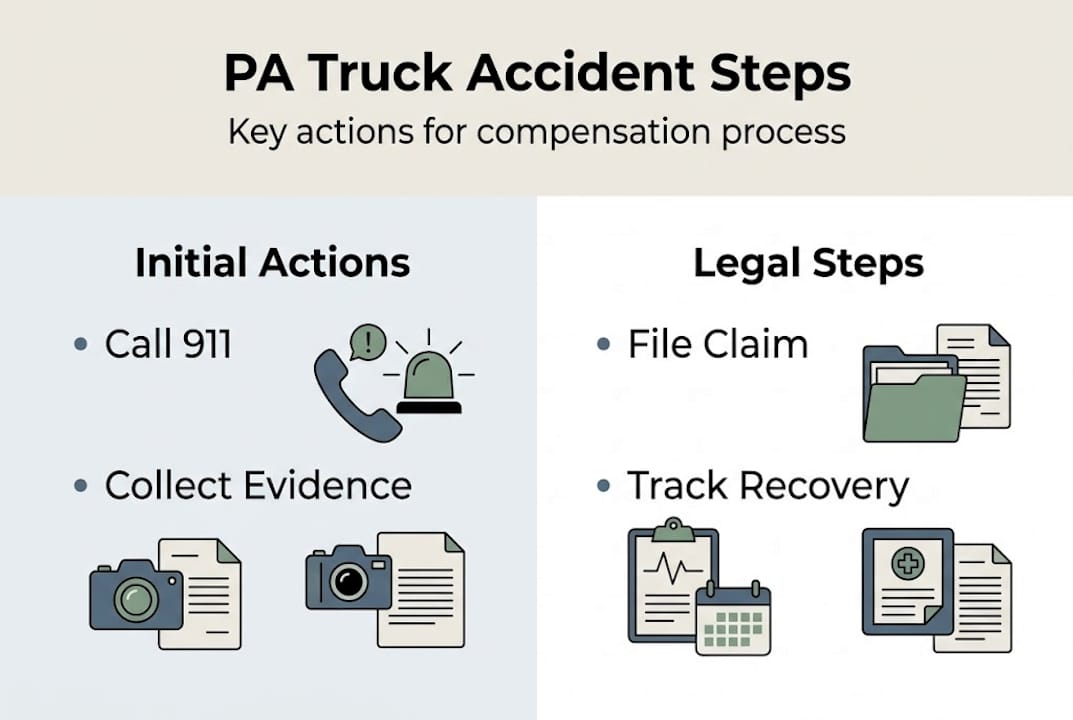
The very first actions you take after a tractor trailer crash can make or break your legal case. Before anything else, move to safety if you can, call 911, and get medical attention even if you feel fine. Injuries like internal bleeding or traumatic brain injuries often show no symptoms for hours or days. Delaying treatment gives insurance companies a reason to argue your injuries were not serious.
Once you are safe, start collecting evidence. This is not optional. Tractor-trailer accidents involve complex liability and require immediate evidence collection before it disappears. Truck black boxes, driver logs, and skid marks can be erased, cleaned up, or lost within days.
Key actions to take at the scene:
- Photograph all vehicle damage, road conditions, skid marks, and signage
- Get the truck driver's name, license number, and employer information
- Collect contact details from every witness
- Note the truck's DOT number and license plate
- Request a copy of the police report as soon as it is available
Pro Tip: Photograph your injuries immediately and again over the next several days. Bruising and swelling often worsen before they improve, and a visual timeline strengthens your claim significantly.
Pennsylvania follows a modified comparative negligence rule. This means you can still recover compensation even if you were partly at fault, as long as your share of fault is 50% or less. Your recovery is reduced by your percentage of fault. Understanding this rule matters because insurance companies will often try to shift blame onto you to reduce what they owe.
"The difference between a strong truck accident claim and a failed one often comes down to what was documented in the first 48 hours." For legal insights for accident victims, early action is the single biggest factor in case outcomes.
| Factor | Tractor trailer accident | Passenger vehicle accident |
|---|---|---|
| Liable parties | Multiple (driver, company, manufacturer) | Usually 1-2 |
| Evidence complexity | High (logs, black box, maintenance records) | Low to moderate |
| Insurance coverage | Commercial policies, often $1M+ | State minimums, often $15,000 |
| Regulatory oversight | Federal (FMCSA) and state rules | State rules only |
| Typical injury severity | Severe to catastrophic | Mild to severe |
Identifying liable parties and building your case
One of the most important things to understand about truck accident claims is that the driver is rarely the only person responsible. Multiple parties, including drivers, trucking companies, and manufacturers, may share liability depending on the facts. Identifying all liable parties is critical because it directly affects how much compensation is available to you.
Here is who may be held responsible:
- The truck driver: Fatigue, distracted driving, speeding, or impairment
- The trucking company: Negligent hiring, inadequate training, pressure to violate hours-of-service rules
- The cargo loader: Improper loading that caused a shift or spill
- The vehicle manufacturer: Defective brakes, tires, or steering components
- Maintenance contractors: Failure to properly inspect or repair the vehicle
Building a case means gathering specific evidence tied to each potential defendant. Here is how the process works:
- Preserve the truck: Your attorney can send a spoliation letter demanding the trucking company preserve all physical evidence, including the vehicle and its data.
- Request driver logs: Federal regulations require truck drivers to keep hours-of-service logs. These records can reveal if the driver was fatigued.
- Obtain maintenance records: These show whether the truck was properly serviced and whether any known defects were ignored.
- Collect witness statements: Independent witnesses carry significant weight with insurance adjusters and juries.
- Hire accident reconstruction experts: In serious cases, experts can recreate the crash using physical evidence and data.
| Liable party | Key evidence needed |
|---|---|
| Truck driver | Driver logs, toxicology reports, phone records |
| Trucking company | Hiring records, training documents, dispatch records |
| Cargo loader | Loading manifests, weight distribution records |
| Manufacturer | Recall history, defect reports, inspection records |
| Maintenance contractor | Service logs, inspection reports |
Understanding the legal complexities of truck accidents is what separates cases that settle well from those that fall apart. Multi-party claims require a coordinated strategy from day one.
For a deeper look at why these cases are different from standard auto accidents, the regulatory framework alone adds layers most victims never anticipate.

Filing claims and navigating Pennsylvania insurance laws
With liable parties identified, the next step is filing your claims correctly and on time. Pennsylvania has specific rules that affect how injury claims work, and missing a deadline or filing the wrong type of claim can cost you everything.
Pennsylvania is a choice no-fault state, which means drivers choose at the time of purchasing insurance whether to retain full tort rights or limited tort rights. If you have full tort coverage, you can sue for pain and suffering regardless of injury severity. Limited tort restricts your ability to sue unless injuries meet a serious injury threshold. Pennsylvania's comparative negligence and minimum liability coverage rules add another layer of complexity to every claim.
Steps to file your claim:
- Notify your own insurance company promptly after the accident
- File a claim with the at-fault party's insurer if applicable
- Gather and organize all supporting documentation
- Submit a formal demand letter outlining your injuries and losses
- Negotiate a settlement or proceed to litigation if needed
Documents you will need:
- Police accident report
- Medical records and bills
- Proof of lost wages (pay stubs, employer letters)
- Photos and video evidence from the scene
- Witness contact information and statements
- Repair estimates or total loss documentation
Pro Tip: Always request a copy of the police report within a few days of the accident. It contains official details about fault, road conditions, and citations issued, all of which support your claim.
The statute of limitations for personal injury claims in Pennsylvania is generally two years from the date of the accident. Missing this deadline means losing your right to sue entirely. For Pennsylvania auto accident rights, acting early is not just smart strategy, it is a legal necessity.
Maximizing compensation and common legal mistakes
Filing a claim is one thing. Recovering everything you are entitled to is another. Victims can maximize compensation by avoiding common pitfalls and documenting all losses thoroughly from the start. Most cases that settle for less than they should come down to preventable mistakes.
Common mistakes that reduce your recovery:
- Giving a recorded statement to the insurance adjuster without legal advice
- Accepting the first settlement offer before understanding your full damages
- Missing filing deadlines or failing to preserve evidence
- Posting about the accident or your injuries on social media
- Failing to follow your doctor's treatment plan consistently
- Not accounting for future medical costs or long-term disability
Compensation may include medical costs, lost wages, pain and suffering, and punitive damages in cases involving gross negligence. Here is how to make sure you capture all of it:
- Document every expense: Keep receipts for medications, medical equipment, transportation to appointments, and home care costs.
- Track lost income precisely: Include overtime, bonuses, and self-employment income you missed, not just base salary.
- Get a life care plan: For serious injuries, a medical expert can project future treatment costs, which can add significant value to your claim.
- Do not rush to settle: Insurance companies move fast because early settlements are almost always lower. Wait until you reach maximum medical improvement before agreeing to any number.
- Work with a specialist: Truck accident cases involve federal regulations, multiple defendants, and commercial insurance policies that general practitioners rarely handle well.
Pro Tip: Keep a daily journal of how your injuries affect your life, including pain levels, activities you cannot do, and emotional impact. This personal record supports your pursue justice and compensation claim in ways that medical records alone cannot.
For a full breakdown of strategies, maximizing your injury claim requires both legal knowledge and disciplined documentation from day one.
What most guides miss: The reality of Pennsylvania tractor trailer accident claims
Most articles tell you to hire a lawyer and document everything. That is true, but it misses the harder reality. The outcome of your case is often decided before you ever speak to an attorney. Tractor-trailer accident claims are often won or lost based on what was collected in the first 48 to 72 hours after the crash.
Trucking companies have rapid response teams. The moment a serious accident happens, their attorneys and investigators are often on the scene within hours. They are not there to help you. They are there to protect their client's interests and control the narrative.
What experienced attorneys wish victims knew sooner is this: the quality of diligent evidence for truck accident claims matters far more than the quantity of legal filings later. A case built on solid, early evidence almost always outperforms one built on legal arguments alone. Real success in these cases is not just about getting a settlement. It is about getting a fair one, and that requires moving faster than the other side.
Get expert legal help for your tractor trailer accident
Dealing with a tractor trailer accident claim on your own puts you at a serious disadvantage against trucking companies and their insurers. You deserve experienced legal representation that understands both Pennsylvania law and the federal regulations that govern commercial trucking.

At pennsylvaniadui.attorney, Attorney Sean Quinlan provides focused, personalized representation for tractor trailer accident representation across Pennsylvania. Whether you need personal injury legal support or targeted auto accident legal help, the team is ready to evaluate your case, protect your rights, and fight for the full compensation you deserve. Contact us today for a consultation.
Frequently asked questions
What should I do immediately after a tractor trailer accident in Pennsylvania?
Immediate safety steps and evidence collection are critical after an accident. Call 911, seek medical attention, photograph the scene and your injuries, gather witness information, and avoid making any statements about fault to anyone at the scene or to insurance adjusters.
Who can be held liable for a tractor trailer accident?
Multiple parties may share liability for tractor trailer accidents. Truck drivers, trucking companies, vehicle manufacturers, cargo loaders, and maintenance contractors can all be held responsible depending on the specific facts of your case.
How long do I have to file a claim after a truck accident in Pennsylvania?
You generally have two years from the date of the accident to file a personal injury lawsuit in Pennsylvania, but acting quickly is essential because critical evidence like driver logs and black box data can disappear fast.
What compensation can I recover after a tractor trailer accident?
Compensation includes medical costs, lost wages, and pain and suffering, and in cases involving gross negligence or reckless conduct, punitive damages may also be available to hold wrongdoers accountable.
Recommended
- Personal Injury Claims: How to Pursue Justice and Compensation — Attorney Sean Quinlan
- Tractor-Trailer Accidents: Understanding Your Rights in Complex Cases — Attorney Sean Quinlan
- Personal Injury Claims: How to Maximize Your Compensation — Attorney Sean Quinlan
- Tractor Trailer Accidents | Seek Justice Today — Attorney Sean Quinlan
- Georgia truck accident settlement timeline: key facts