
A DUI charge in Pennsylvania can feel like a dead end, especially when a breathalyzer reading or a police report seems to tell the whole story. But the reality is far more nuanced. Many people assume these cases are cut-and-dried, that guilt is obvious, and that fighting back is pointless. That assumption can cost you your license, your job, and years of financial hardship. What most people facing DUI charges don't realize is that Pennsylvania's DUI laws are riddled with technical requirements and procedural rules that, when violated, can completely change your outcome. The right attorney doesn't just defend you. They reframe what the evidence actually means.
Table of Contents
- The hidden complexities of Pennsylvania DUI law
- The game-changing impact of skilled legal advocacy
- Common defenses and mistakes: What legal experts look for
- The long-term consequences of going it alone
- Why most people underestimate DUI defense—Our view
- Get legal defense you can trust in Pennsylvania
- Frequently asked questions
Key Takeaways
| Point | Details |
|---|---|
| Legal details matter | A single technical error or violation can dramatically change the outcome of a DUI case. |
| Defense options exist | Skilled attorneys in Pennsylvania use various defenses to reduce or dismiss DUI charges. |
| DIY risks are high | Facing DUI charges without expert legal support increases the chances of lasting, serious consequences. |
| Early action helps | Getting legal help quickly gives you the best shot at finding critical weaknesses in the case against you. |
The hidden complexities of Pennsylvania DUI law
Having previewed the vital role of legal counsel in DUI cases, let's dig into exactly where lawyers make a critical difference.
Pennsylvania's DUI statutes are not simple. They operate on a tiered system based on blood alcohol content (BAC), meaning the penalties you face depend heavily on where your BAC lands. The three tiers are General Impairment (0.08% to 0.099%), High BAC (0.10% to 0.159%), and Highest BAC (0.16% and above). Each tier carries significantly different consequences, from fines and license suspension to mandatory jail time. This alone makes understanding your specific situation complicated without legal training.
But here's where it gets even more layered. The way law enforcement collects evidence in DUI cases is governed by strict procedural rules. These aren't bureaucratic formalities. They exist to protect your constitutional rights, and when police officers fail to follow them, any evidence gathered may be thrown out entirely.
An experienced DUI attorney knows exactly what to look for. Common technical issues that can undermine DUI cases include:
- Improper traffic stop: Police must have a legal reason, called reasonable suspicion, to pull you over. A stop based on a hunch or bias violates your Fourth Amendment rights.
- Breathalyzer calibration failures: The devices used to measure BAC must be regularly calibrated and maintained. An improperly maintained device produces unreliable results.
- Field sobriety test errors: Officers must administer standardized tests in a precise way. Deviating from protocol can invalidate the test entirely.
- Miranda violations: If you were questioned without being informed of your rights, statements you made may be inadmissible in court.
- The two-hour BAC testing rule: Pennsylvania law requires that chemical testing occur within two hours of driving. Testing outside this window creates serious questions about the accuracy of results.
As noted by legal researchers, attorneys identify edge cases such as illegal traffic stops, faulty breathalyzer calibration, improper field sobriety tests, Miranda violations, and the two-hour BAC testing rule, which can lead to evidence suppression or dismissal.
"The difference between a conviction and a dismissal often comes down to a single procedural misstep by law enforcement. Without someone who knows the law inside out, that detail goes unnoticed and unexploited."
Understanding the full scope of Pennsylvania DUI penalties makes it even clearer why identifying these issues early is so critical. The stakes are simply too high to leave any stone unturned.
The game-changing impact of skilled legal advocacy
Understanding Pennsylvania's legal maze is one thing. Here's how expert advocacy can turn knowledge into real-world advantage.

The gap between having a lawyer and not having one isn't just about legal knowledge. It's about strategy, timing, and leverage. Skilled DUI attorneys don't simply show up to court. They begin working from the moment you contact them, filing motions, reviewing police reports, requesting dashcam and bodycam footage, and evaluating every piece of evidence before the prosecution even has time to build their case.
Here's a direct comparison of how outcomes typically differ depending on whether you have representation:
| Situation | Without an attorney | With an attorney |
|---|---|---|
| Traffic stop was questionable | No challenge made | Motion to suppress filed |
| Breathalyzer result near legal limit | Accepted as fact | Calibration records reviewed |
| Field sobriety test administered | Assumed valid | Procedures scrutinized |
| First-time DUI offense | Likely guilty plea | ARD program or reduced charges |
| BAC testing timing unclear | Not flagged | Two-hour rule examined |
The differences are stark. Attorneys who specialize in DUI defense also know how to negotiate with prosecutors, which is a skill that often matters more than anything that happens at trial. Many DUI cases never reach a jury. They're resolved through pre-trial motions or plea agreements that a competent attorney can shape in your favor.
Attorneys identify edge cases including faulty breathalyzer calibration and the two-hour BAC testing rule, evidence that can be suppressed or used to get charges dismissed entirely. For example, if law enforcement used a breathalyzer that hadn't been calibrated within the required maintenance window, your attorney can demand the calibration logs and file a motion to suppress that reading.
When challenging breathalyzer results, attorneys often hire independent forensic experts to review the device's history and operator certification. That level of scrutiny is simply unavailable to someone defending themselves.
Pro Tip: Contact an attorney before you say anything to police or prosecutors. Statements made without counsel present can be used against you in ways that are very difficult to undo later. The earlier you get a lawyer involved, the more options you have.
Knowing what to look for when choosing a top DUI attorney can directly influence which defenses are available to you and how aggressively they can be pursued. Not all DUI lawyers are created equal, and experience in Pennsylvania-specific courts matters enormously.
Common defenses and mistakes: What legal experts look for
Knowing why advocacy matters, let's detail the actual defenses lawyers use and errors they help you avoid.
Pennsylvania DUI attorneys draw from a well-established toolkit of defenses, each rooted in either constitutional law or specific procedural requirements. Here are the most commonly applied defenses in order of how frequently they prove effective:
- Illegal traffic stop: This is often the first thing attorneys investigate. If you were pulled over without reasonable suspicion, everything that follows may be inadmissible.
- Faulty breathalyzer calibration: Devices must meet strict maintenance standards. A machine that hasn't been properly serviced cannot produce legally reliable BAC readings.
- Improper field sobriety test administration: Standardized tests like the walk-and-turn and one-leg-stand must follow exact National Highway Traffic Safety Administration (NHTSA) guidelines.
- Violation of the two-hour BAC testing rule: Results taken outside the legal window are contestable and may not reflect your BAC at the actual time of driving.
- Miranda rights violations: Incriminating statements obtained without proper warnings may be ruled inadmissible.
- Chain of custody issues with blood samples: If blood was drawn and improperly stored or handled, those results can be challenged on scientific grounds.
Now consider the contrast between defendants who go it alone and those backed by counsel:
| Common mistake (unrepresented) | How an attorney helps |
|---|---|
| Missing filing deadlines | Tracks all procedural timelines |
| Accepting evidence at face value | Demands documentation and scrutiny |
| Not requesting police dashcam footage | Subpoenas all relevant video evidence |
| Pleading guilty to avoid court | Explores ARD and charge reductions first |
| Failing to challenge breathalyzer data | Reviews calibration logs and certifications |
As legal researchers have documented, attorneys identify edge cases such as Miranda violations and improper field sobriety tests that can flip the outcome of a case. These aren't rare flukes. Police procedural errors happen regularly, but they only matter if someone with the right training spots them.
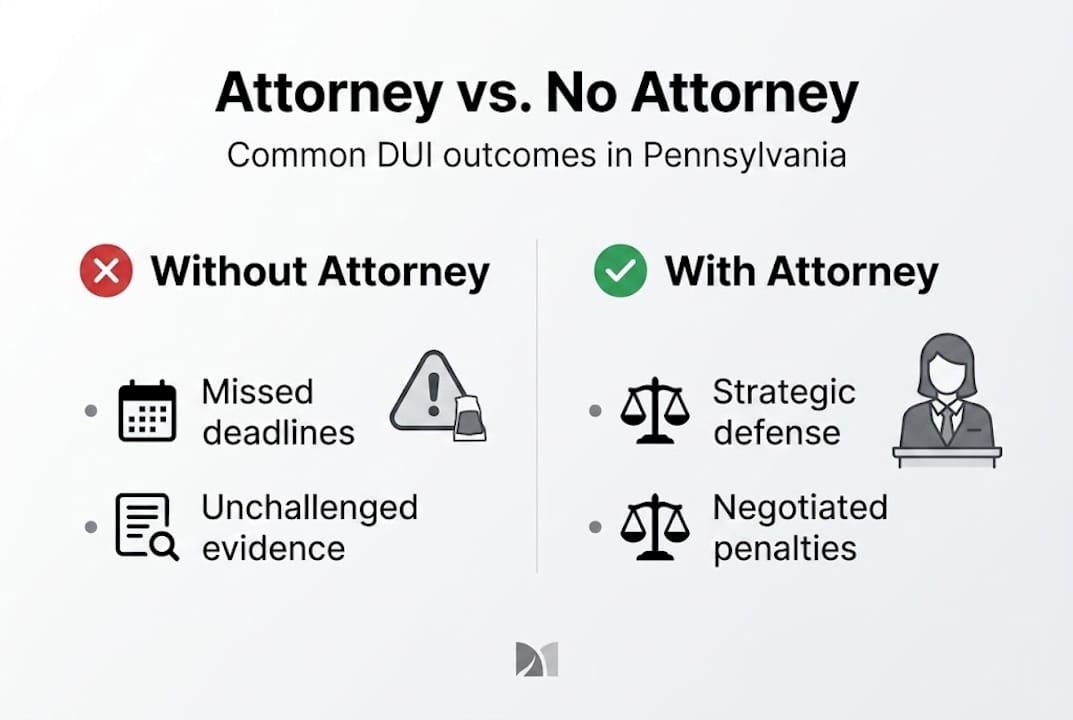
Pro Tip: Missing procedural deadlines is one of the most damaging and avoidable mistakes in a DUI case. Pennsylvania courts have strict filing windows, and once a deadline passes, you may permanently lose the right to challenge certain evidence.
Understanding what to expect at a DUI hearing is something an attorney will walk you through in detail, so you're never caught off guard by what happens in the courtroom. First-time offenders may also qualify for the Pennsylvania ARD program, which can result in charges being dismissed entirely after completing specific requirements. Without a lawyer, many defendants don't even know this option exists.
The long-term consequences of going it alone
With a firm grasp of what representation shields you from, now consider the reality of facing DUI prosecution alone.
The immediate penalties from a DUI conviction get a lot of attention, fines, license suspension, and possible jail time. But the long-term consequences are often far more damaging and far less discussed. People who plead guilty without understanding their options don't just face one bad day in court. They carry the weight of that conviction for years, sometimes decades.
Consider the ripple effects that follow a DUI conviction in Pennsylvania:
- Driver's license suspension: Depending on your BAC tier and prior record, you could lose your license for 12 months or more, making daily life and employment extremely difficult.
- Steep insurance increases: A DUI conviction typically triggers SR-22 insurance requirements and causes premium spikes of 80% to 200% for several years.
- Employment barriers: Many employers conduct background checks, and a DUI conviction can disqualify you from jobs in healthcare, education, transportation, and government.
- Professional license consequences: Nurses, teachers, commercial drivers, and other licensed professionals can face disciplinary action or license revocation.
- Criminal record: A DUI stays on your record and can affect housing applications, loan approvals, and child custody proceedings.
The financial toll alone is staggering. When you add up fines, court costs, insurance increases, potential job loss, and ignition interlock device fees, a single DUI conviction can easily cost $10,000 to $25,000 over several years.
"Evidence suppression isn't a technicality that helps guilty people escape justice. It's the legal system working as designed to ensure that only properly obtained evidence is used against citizens. If that evidence disappears from the record, so can the case."
Attorneys identify edge cases that the average person would never recognize as legally significant. A procedural misstep by a police officer that seems minor to you could be the exact issue that gets your charges reduced or dismissed entirely. Without representation, you have no way to know what you're missing.
Learning about DUI conviction consequences in detail is an eye-opening exercise. Most people dramatically underestimate how much a conviction reshapes their lives. Understanding the importance of early legal action is equally vital because the window for building the strongest possible defense closes quickly once charges are filed.
Why most people underestimate DUI defense—Our view
These facts and figures matter, but why do so many people still underestimate the importance of quality legal counsel? Here's our honest take.
Most people approach a DUI charge the same way they approach a parking ticket. They assume the evidence is fixed, the outcome is decided, and the only question is how much it will cost them. That thinking is exactly why so many people accept consequences they never had to accept.
The truth we've seen through handling these cases is that no two DUI charges are identical. The specific officer, the specific equipment used, the specific conditions of the stop, all of these variables create opportunities that a trained attorney can recognize and act on. A person unfamiliar with the law simply cannot evaluate what they don't know exists.
Even minor errors by police can radically change your outcome if someone qualified is looking for them. The belief that all DUI cases carry the same weight is a myth, and believing it leads people straight into guilty pleas they didn't have to make. Understanding the full range of DUI case penalties should be the starting point for any decision you make about your defense. Your situation deserves individualized attention, not a one-size-fits-all assumption about how it will end.
Get legal defense you can trust in Pennsylvania
Understanding the stakes, your next move is crucial.
Facing a DUI charge in Pennsylvania is serious, but it doesn't have to define your future. Professional Pennsylvania DUI defense can protect your record, your driving privileges, and your livelihood. The legal process moves quickly, and the decisions you make in the earliest days after a charge can have lasting consequences. Waiting to get representation means losing time you can't get back.

Whether you're facing your first offense or a more complex situation involving prior charges, working with expert legal support gives you the best possible chance at a favorable outcome. Sean Quinlan and the team at Pennsylvania DUI Attorney offer case evaluations, personalized strategy, and the kind of local legal knowledge that makes a real difference in Pennsylvania courts. Reach out today to schedule your consultation and take the first step toward protecting what matters most.
Frequently asked questions
What is the most important reason to hire a DUI attorney in Pennsylvania?
An attorney can identify errors and procedural violations that can lead to reduced charges or case dismissal. Legal experts identify edge cases such as illegal traffic stops, breathalyzer calibration failures, and Miranda violations that the average defendant would never catch.
Can a lawyer really help if the evidence seems clear against me?
Yes, lawyers can challenge how evidence was collected or handled, sometimes resulting in suppressed evidence or dropped charges. Attorneys examine whether BAC testing procedures followed Pennsylvania's strict legal requirements, which can fundamentally change what the prosecution is allowed to use against you.
What mistakes do people make without legal representation in Pennsylvania DUI cases?
Common mistakes include missing important deadlines, not challenging faulty evidence, and accepting penalties that could be reduced or avoided. Attorneys know that procedural violations by law enforcement create legal openings that unrepresented defendants routinely walk right past.
Does everyone charged with DUI go to trial in Pennsylvania?
No, many DUI cases are resolved without trial through successful challenges or negotiations by skilled attorneys. Pre-trial motions based on evidence suppression grounds often resolve cases before a judge or jury ever needs to be involved.
Recommended
- How a DUI Conviction Could Impact Your Life—and How Legal Representation Can Help — Attorney Sean Quinlan
- Understanding DUI Penalties in Pennsylvania: How Sean Quinlan Legal Services Can Help — Attorney Sean Quinlan
- DUI Defense in Pennsylvania: Why You Need an Experienced Attorney — Attorney Sean Quinlan
- Auto Accidents in Pennsylvania: Know Your Rights and How to Protect Them — Attorney Sean Quinlan