

A DUI conviction in Pennsylvania is not a minor inconvenience you can shake off in a few months. Pennsylvania's DUI recidivism rate has held steady at around 30% over the past decade, meaning nearly one in three people convicted will face charges again. That number alone should reframe how seriously you treat even a first offense. This guide walks you through the real legal and personal consequences of a DUI conviction, the difference between first and repeat offense penalties, how ARD works under the current law, and what concrete steps you can take right now to protect your future.
Table of Contents
- How a DUI conviction impacts your life in Pennsylvania
- Penalties for first-time and repeat DUI offenses
- ARD: Alternative sentencing and expungement opportunities
- How to respond and protect your future after a DUI
- What most advisors overlook about DUI consequences
- Take action: Get expert DUI guidance today
- Frequently asked questions
Key Takeaways
| Point | Details |
|---|---|
| Consequences go beyond court | DUI convictions in PA carry penalties that impact your life, employment, and reputation long after sentencing. |
| Repeat offenses increase risks | Second and third DUIs can mean mandatory jail, much higher fines, and felony charges—even for ARD program participants. |
| ARD offers a chance | First-time offenders may be eligible for ARD, which can prevent a conviction from appearing on your record if completed successfully. |
| Immediate action matters | Promptly contacting a qualified DUI attorney can make a real difference in outcome and long-term consequences. |
How a DUI conviction impacts your life in Pennsylvania
Most people charged with a DUI focus on the immediate question: will I go to jail? That is a fair concern, but the truth is the ripple effects stretch far beyond a courtroom sentence. A conviction touches nearly every corner of your life, and understanding all of them is the first step toward making smart decisions.
Legal penalties are the most visible. Depending on your blood alcohol content (BAC) and whether it is your first offense, you face fines ranging from $300 to over $10,000, a license suspension of 12 to 18 months for higher tiers, mandatory alcohol treatment, and possible jail time. The PA DUI penalties overview breaks this down tier by tier based on BAC level and offense history.
Professional consequences are often what hurt the most long-term. Many employers run background checks, and a DUI conviction shows up. Jobs that require a commercial driver's license, a security clearance, or a professional license in fields like nursing or law can be lost entirely. Your auto insurance rates will spike, sometimes doubling or tripling, and some carriers will drop you outright.

Social and personal consequences are real but less discussed. Certain countries, including Canada, can deny entry to anyone with a DUI conviction. Personal relationships strain under the weight of court dates, fines, and mandatory programs. The stigma follows you in ways that are hard to quantify but impossible to ignore.
Here is a snapshot of what a conviction can affect:
- Employment background checks and job eligibility
- Auto insurance premiums and coverage availability
- Professional licenses in regulated industries
- International travel, especially to Canada
- Child custody and family court matters
- Student loan eligibility in some cases
| Impact area | First offense | Repeat offense |
|---|---|---|
| Fines | $300 to $5,000 | Up to $10,000+ |
| License suspension | 12 months | 18 months or more |
| Jail time | Up to 6 months | Up to 5 years |
| Ignition interlock | Possible | Mandatory |
| Insurance impact | Significant increase | Severe or policy cancellation |
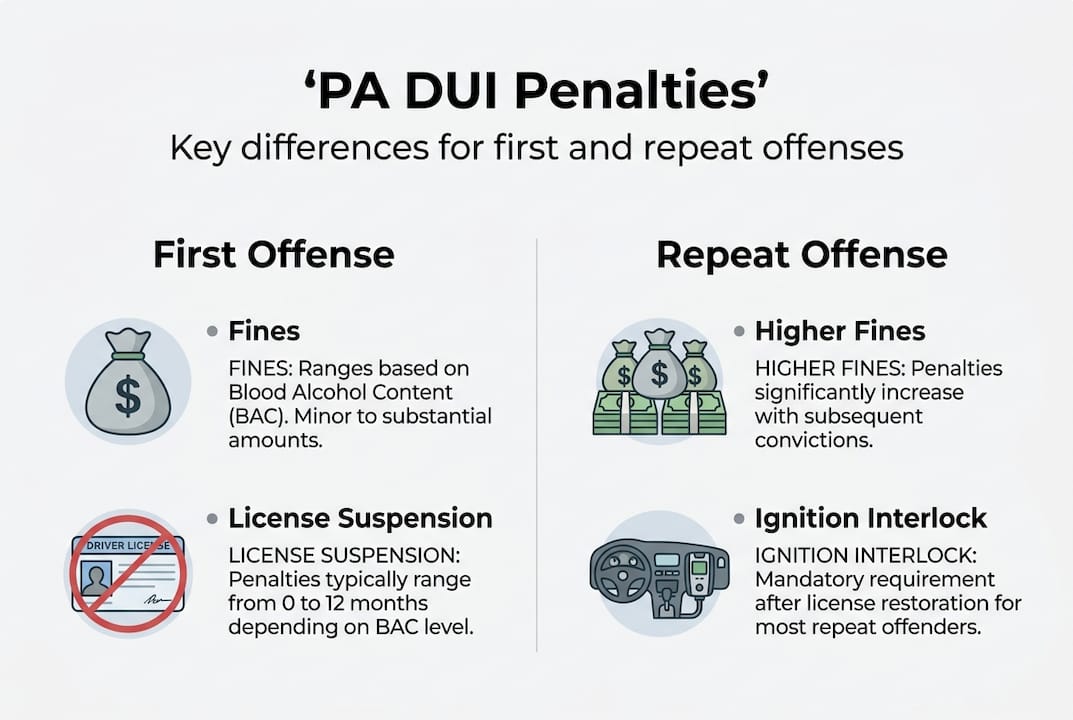
The DUI recidivism rate sitting at 30% in Pennsylvania means that without proper intervention, many people cycle back through the system. That is not a moral judgment. It is a statistical reality that makes early, smart action critical.
Pro Tip: Even a first-time DUI conviction can follow you for ten years under Pennsylvania's lookback period for repeat offense calculations. Treat your first charge like it matters, because legally, it does.
Penalties for first-time and repeat DUI offenses
Pennsylvania organizes DUI penalties across three tiers based on BAC: general impairment (0.08% to 0.099%), high BAC (0.10% to 0.159%), and highest BAC (0.16% and above). The offense tier and whether you are a first, second, or third offender determine your sentence.
| Offense | Tier | Jail | Fine | License suspension | Ignition interlock |
|---|---|---|---|---|---|
| First | General | No minimum | $300 | No suspension | No |
| First | High BAC | 48 hours | $500 to $5,000 | 12 months | No |
| First | Highest BAC | 72 hours | $1,000 to $5,000 | 12 months | Yes |
| Second | General | 5 days | $300 to $2,500 | 12 months | Yes |
| Second | High BAC | 30 days | $750 to $5,000 | 12 months | Yes |
| Third | Any tier | 1 to 5 years | Up to $10,000 | 18 months | Yes |
Here is what typically happens after arrest, step by step:
- Arraignment and bail determination within days of arrest
- Preliminary hearing where the judge reviews evidence
- Pre-trial motions and possible ARD application for eligible first-timers
- Trial or guilty plea and sentencing
- License suspension begins and mandatory programs are assigned
- Ignition interlock installation if required by your tier or offense number
The second DUI offense penalties are significantly steeper, and the third DUI felony charges can include state prison time. These are not theoretical worst-case scenarios. They are the prescribed minimums under Pennsylvania law.
Act 58 of 2025 changed the landscape for repeat offenders. A prior ARD completion, while not a conviction, now flags your record so that prosecutors can pursue enhanced penalties on a subsequent DUI. It is a critical nuance that affects strategy.
Repeat offenders carry a 6x higher crash risk, and national data show ignition interlocks reduce recidivism by 62 to 75%. That is a significant reduction, but interlocks only work if the underlying behavior changes alongside them.
Pro Tip: If you have a prior ARD on your record and face a new DUI charge, your exposure under Act 58 is much greater than it would have been before 2025. You need an attorney who understands these changes specifically.
ARD: Alternative sentencing and expungement opportunities
ARD stands for Accelerated Rehabilitative Disposition. It is a pretrial diversionary program available to certain first-time, non-violent offenders in Pennsylvania. If you complete ARD successfully, the charge is dismissed and you can apply to have your record expunged. That is a powerful outcome compared to a formal conviction.
Who is eligible? The district attorney controls ARD admission in each county. There is no automatic right to the program. Factors the DA weighs include your BAC level, whether an accident was involved, whether minors were in the vehicle, and your overall record. Eligibility is not guaranteed, and the DA can deny admission without explanation.
How ARD protects your record. Completing ARD means no conviction is entered. You avoid the worst professional and personal consequences of a formal guilty finding. After a waiting period, you can expunge your DUI record and legally answer "no" to most questions asking about criminal convictions.
Here is a balanced look at ARD versus a standard conviction:
- ARD pros: No conviction on record, expungement eligible, shorter program duration, lower long-term insurance impact
- ARD cons: Requires DA approval, involves fees and supervision, prior ARD now triggers enhanced penalties under Act 58
- Conviction pros: Predictable resolution if plea deal is favorable
- Conviction cons: Permanent record, employment impact, license suspension, higher insurance costs
The Pennsylvania court ruling on ARD confirmed that ARD cannot be counted as a prior conviction in second DUI cases. However, the Act 58 law changes mean that a prior ARD now flags you for enhanced sentencing on any future DUI. The protection is real but narrower than it used to be.
"ARD is still valuable for first-time offenders, but the strategy around it has shifted. You cannot treat it as a free pass anymore. The law now demands a more careful, long-term view of how ARD fits into the client's overall picture." — DUI defense attorney perspective on post-Act 58 strategy
Research shows first-timers completing ARD have better long-term outcomes, which reinforces the program's value when pursued carefully and with full awareness of its limitations.
How to respond and protect your future after a DUI
Knowing the penalties is useful. Knowing what to do with that knowledge is what actually changes outcomes. Here are the concrete steps you should take after a DUI arrest in Pennsylvania.
- Contact a DUI attorney immediately. Do not wait for your next court date. Early legal involvement can affect everything from bail to evidence review to ARD eligibility.
- Document everything. Write down what happened before, during, and after the stop. Include weather, lighting, officer instructions, and any tests administered. Memory fades fast.
- Understand your court timeline. Pennsylvania DUI cases move through specific stages, from preliminary hearings to trial. Knowing what DUI preliminary hearings look like helps you show up prepared.
- Know your rights at checkpoints. If your arrest involved a checkpoint stop, understanding your DUI checkpoint rights may open defense angles your attorney can use.
- Apply for ARD if eligible. Work with your attorney to assess your eligibility honestly, then decide whether ARD or contesting the charge is the better path given your specific facts.
- Prepare for the financial and logistical fallout. Arrange transportation if your license is suspended, notify your employer if required by your employment contract, and get ahead of insurance notifications.
The Pennsylvania court ruling on ARD illustrates how prosecutors and defense attorneys now approach the post-Act 58 landscape differently. Prosecutors push for stricter ARD terms to deter repeats, while defense attorneys aim for rehabilitation and expungement pathways. A skilled attorney balances both realities on your behalf.
Pro Tip: The window between your arrest and your preliminary hearing is the most important stretch of your entire case. What you do and say in those first days can define the outcome months later.
What most advisors overlook about DUI consequences
Most articles about DUI consequences focus heavily on the punishment: the fines, the jail time, the suspension. That information matters, but it can also push people toward fear-driven decisions rather than strategic ones.
The real challenge after a DUI charge is not surviving the penalty. It is rebuilding. Your employment, your professional reputation, your relationships, and your sense of control over your own life are all in play. An attorney who understands understanding Act 58 and treats your case as genuinely individual is worth far more than one who processes DUI cases like an assembly line.
The law changed significantly in 2025. Strategy that worked two years ago may hurt you today. Individualized legal guidance is not a luxury. Given how much the landscape has shifted, it is the only approach that actually accounts for your specific facts, your record, your county's DA, and your long-term goals. Fear gets people through the courtroom door. Strategy is what gets them out in the best possible position.
Take action: Get expert DUI guidance today
Understanding DUI consequences is only useful if that knowledge leads to action. A conviction in Pennsylvania does not have to define the rest of your life, but that outcome depends largely on how you respond in the days and weeks immediately following your arrest.

Attorney Sean Quinlan and the team at pennsylvaniadui.attorney provide dedicated DUI defense strategies across multiple Pennsylvania counties, with a focus on personalized guidance and realistic outcomes. Whether you are navigating a first offense or facing a repeat charge under the new Act 58 rules, a case evaluation can clarify your options and help you move forward with confidence. Reach out today to start that conversation.
Frequently asked questions
What happens after a first DUI conviction in Pennsylvania?
A first DUI conviction can result in fines, a license suspension, required treatment programs, and increased insurance costs. The severity depends on your BAC tier at conviction and whether aggravating factors were present.
Does ARD count as a conviction for future DUI offenses?
No, ARD does not count as a prior conviction, but under Act 58, a prior ARD flags reoffenders for enhanced penalties on any future DUI charge.
Do ignition interlocks really help prevent repeat DUIs?
Yes, research shows interlocks reduce recidivism by 62 to 75%, making them one of the most effective tools for reducing repeat DUI behavior when combined with treatment.
Can you expunge a DUI record in Pennsylvania?
Expungement is possible after completing ARD or, in limited cases, for summary offenses. The DUI expungement process has specific eligibility requirements and timelines that vary by case.
What should I do immediately after a DUI arrest?
Contact a DUI attorney, write down every detail about the stop and arrest, and avoid discussing your case on social media. The post-arrest strategy under Act 58 has changed enough that early legal advice is more critical than ever.
Recommended
- Second DUI Offense in Pennsylvania: Enhanced Penalties and Mandatory Minimums — Attorney Sean Quinlan
- DUI Expungement in Pennsylvania: Clearing Your Record — Attorney Sean Quinlan
- Third DUI Offense in Pennsylvania: Mandatory Minimums and Felony Charges — Attorney Sean Quinlan
- Pennsylvania DUI Penalties: What Every Offender Must Know