

Most people assume a tractor trailer accident claim works just like a car accident claim. It does not. These cases involve federal safety regulations, multiple liable parties, massive insurance policies, and evidence that can disappear within days. If you were hurt in a truck crash in Pennsylvania, the gap between what you expect and what actually happens in these cases can directly affect how much you recover. This guide breaks down what a tractor trailer accident claim is, how it differs from a standard auto case, what compensation you can seek, and the steps you need to take right now to protect your recovery.
Table of Contents
- What is a tractor trailer accident claim?
- How tractor trailer accident claims differ from car accident claims
- What compensation can you seek after a tractor trailer accident?
- The claim process: Steps to take after a tractor trailer accident
- The role of attorneys and insurance in Pennsylvania tractor trailer claims
- The reality behind tractor trailer accident claims: What most victims overlook
- Get support for your Pennsylvania tractor trailer accident claim
- Frequently asked questions
Key Takeaways
| Point | Details |
|---|---|
| Unique claim challenges | Tractor trailer accident claims involve more complexity than regular car accidents due to multiple parties and regulations. |
| Wide range of compensation | Victims can seek damages for medical costs, lost wages, pain and suffering, and more. |
| Prompt action matters | Quickly gathering evidence and seeking legal help preserves your rights. |
| Legal support is crucial | An experienced attorney can improve your chances of a fair recovery. |
What is a tractor trailer accident claim?
A tractor trailer accident claim is a formal legal action that allows injury victims to seek financial recovery from the parties responsible for a truck crash. In Pennsylvania, these claims arise when a commercial truck, such as an 18-wheeler or semi-truck, causes an accident that results in physical injury, property damage, or both.
At its core, a claim is built on two pillars: fault and damages. You must show that another party acted negligently or recklessly, and that their actions directly caused your losses. Understanding your rights in these situations is the first step toward building a strong case.
Here is what victims typically seek to recover:
- Medical expenses, both current and future
- Lost wages and reduced earning capacity
- Pain and suffering, including emotional distress
- Property damage to your vehicle
- Rehabilitation and long-term care costs
One thing that catches many victims off guard is how many layers these claims have. Unlike a fender-bender between two private drivers, a tractor trailer crash almost always involves a commercial trucking company, a separate insurance carrier, and potentially a cargo loading company or truck manufacturer.
"Victims should never speak with a trucking company's insurance adjuster without first consulting an attorney. These adjusters are trained to minimize payouts, and anything you say can be used to reduce your claim."
Trucking companies carry much larger insurance policies than private drivers, which sounds like good news. But it also means their insurers have experienced legal teams ready to dispute your claim from day one. The higher the potential payout, the harder they fight.
Documentation is everything in these claims. Medical records, accident reports, photos from the scene, and witness statements all form the foundation of your case. Missing even one piece of critical evidence can weaken your position significantly.
Understanding what a claim is and how it works gives you a real advantage. Most victims who struggle in this process do so because they did not know what they were walking into.
How tractor trailer accident claims differ from car accident claims
Defining what a claim is sets the stage. Now it is critical to understand why tractor trailer cases are not like typical auto accident claims.
The differences are not just technical. They are practical and they affect your outcome. Why truck accident cases are unique comes down to size, regulation, and the number of parties involved.

| Factor | Car accident claim | Tractor trailer claim |
|---|---|---|
| Liable parties | Usually 1-2 drivers | Driver, company, cargo loaders, manufacturer |
| Insurance coverage | State minimum limits | Commercial policies, often $1M or more |
| Applicable rules | State traffic laws | State laws plus federal FMCSA regulations |
| Evidence types | Photos, police report | Logbooks, black box data, maintenance records |
| Claim complexity | Moderate | High, often requires expert witnesses |
Federal Motor Carrier Safety Administration (FMCSA) rules govern how long truck drivers can work, how cargo must be loaded, and how vehicles must be maintained. Violations of these rules can become powerful evidence in your favor.
Pro Tip: Request that your attorney send a spoliation letter (a formal legal notice to preserve evidence) to the trucking company immediately after your accident. Truck companies are known to overwrite electronic logging device data and dashcam footage within days.
Here is what makes the evidence collection phase especially demanding:
- Electronic logging devices (ELDs) record driver hours and can show fatigue violations
- Maintenance logs reveal whether the truck had known mechanical problems
- Cargo manifests can show overloading or improper securement
- Driver qualification files may expose prior violations or inadequate training
Trucking insurers also tend to respond faster and more aggressively than personal auto insurers. They may send investigators to the scene before you have even left the hospital. That speed and preparation is exactly why victims need to act just as quickly.
What compensation can you seek after a tractor trailer accident?
Understanding these differences is foundational. Now, turn to what victims in Pennsylvania can actually recover through their claim.
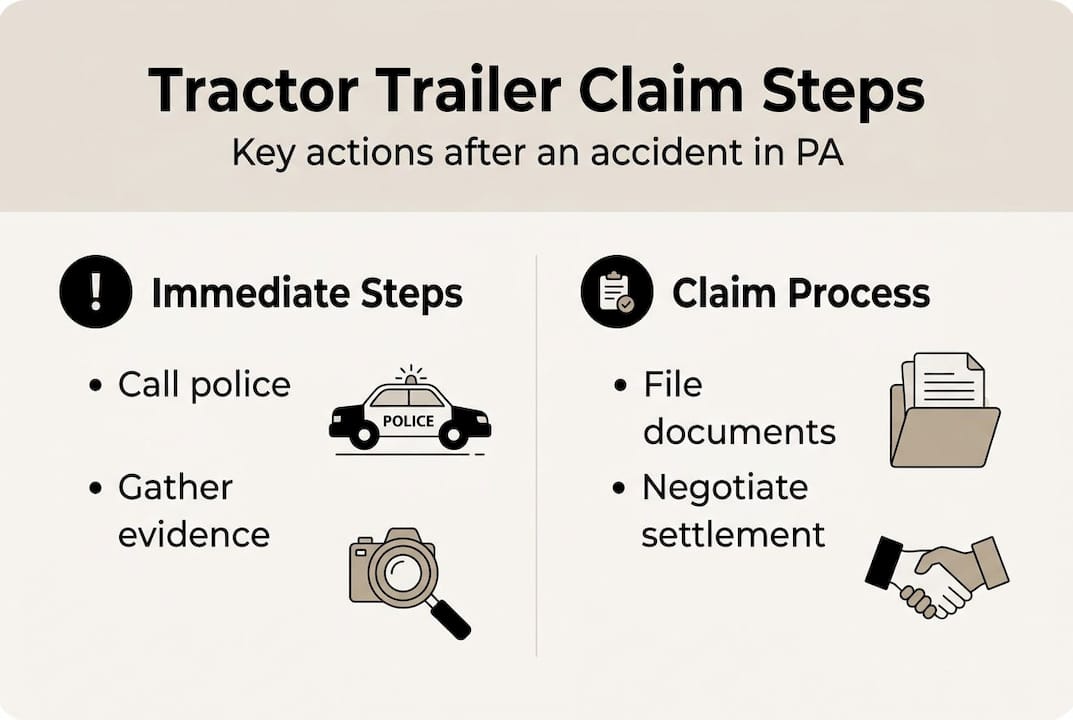
Compensation in a tractor trailer accident claim falls into several categories. The compensation steps for truck accidents in Pennsylvania cover both economic and non-economic losses.
Economic damages are the measurable financial losses:
- Emergency room visits, surgeries, and ongoing treatment
- Physical therapy and rehabilitation
- Lost wages during recovery
- Future lost earning capacity if your injuries are permanent
- Vehicle repair or replacement
Non-economic damages are harder to quantify but equally real:
- Physical pain and suffering
- Emotional trauma and anxiety
- Loss of enjoyment of life
- Damage to personal relationships
In some cases, Pennsylvania courts may award punitive damages. These are not meant to compensate you but to punish the defendant for especially reckless or willful conduct, such as a trucking company that knowingly let a driver exceed legal hours-of-service limits.
| Damage type | Examples | Documentation needed |
|---|---|---|
| Medical expenses | Hospital bills, prescriptions | Bills, treatment records |
| Lost wages | Missed work, reduced hours | Pay stubs, employer letter |
| Pain and suffering | Physical and emotional distress | Medical notes, personal journal |
| Property damage | Vehicle repair costs | Repair estimates, photos |
| Punitive damages | Gross negligence by trucking company | Evidence of willful rule violations |
Strategies for maximizing your compensation always come back to documentation. Every receipt, every medical visit, every day of missed work needs to be recorded. Gaps in your records give insurers room to argue your losses were not as severe as claimed.
The claim process: Steps to take after a tractor trailer accident
With compensation in mind, here are the practical steps to protect your rights after an accident.
The actions you take in the hours and days after a crash can make or break your claim. The legal steps for truck accident claims follow a clear sequence that you should understand before you need it.
- Seek medical attention immediately. Even if you feel fine, some injuries like spinal trauma or internal bleeding are not obvious right away. A medical record created at the scene also links your injuries directly to the accident.
- Call law enforcement. A police report is a foundational document in your claim. Make sure the report accurately reflects what happened.
- Gather evidence at the scene. Take photos of the vehicles, road conditions, skid marks, cargo, and any visible injuries. Get the names and contact information of witnesses.
- Notify your insurance company. You are required to report the accident, but keep your statement brief and factual. Do not speculate about fault.
- Avoid giving statements to the trucking company's insurer. Their adjuster is not on your side. Politely decline until you have legal representation.
- Consult an attorney as early as possible. An attorney can send the spoliation letter mentioned earlier, identify all liable parties, and begin building your case before critical evidence disappears.
- Track all losses. Keep a journal of your pain, limitations, and how the injuries affect your daily life. Save every medical bill and expense receipt.
Pro Tip: Do not post about your accident or injuries on social media. Insurance defense teams routinely monitor claimants' profiles and use posts out of context to argue you were not seriously hurt.
Most tractor trailer claims resolve through negotiated settlements. However, if the insurer refuses to offer fair compensation, your attorney can take the case to litigation.
The role of attorneys and insurance in Pennsylvania tractor trailer claims
Understanding the process makes it clear who supports your case and what obstacles may arise.
An experienced attorney does far more than file paperwork. They identify every liable party, gather and preserve evidence, hire accident reconstruction experts, and negotiate directly with powerful insurance carriers. Truck accident attorney support can mean the difference between a lowball settlement and full recovery.
Insurance disputes are common in these cases. Carriers may argue comparative fault, dispute the severity of injuries, or claim that a pre-existing condition caused your losses. The legal insights for victims in trucking cases consistently show that represented claimants recover more than those who go it alone.
"Insurance companies in trucking cases are not passive. They deploy investigators, legal teams, and medical reviewers quickly. Victims without legal representation are at a serious disadvantage from the start."
Key ways an attorney strengthens your position:
- Identifies all insurance policies, including excess and umbrella coverage
- Challenges unfair liability assignments
- Handles all communication with insurers
- Builds a case for pursuing justice and compensation through litigation if needed
The legal complexities in truck accident cases in Pennsylvania make professional guidance not just helpful but essential.
The reality behind tractor trailer accident claims: What most victims overlook
Here is something most articles will not tell you directly: the biggest threat to your tractor trailer accident claim is not the other driver. It is the assumption that the process will be fair on its own.
Victims routinely underestimate how aggressively trucking insurers defend these cases. A single documentation gap, a statement made too early, or a delay in contacting an attorney can shift the outcome dramatically. We have seen cases where victims with serious injuries walked away with far less than they deserved simply because they waited too long or trusted the wrong people.
The other thing most people miss is that evidence in truck cases is time-sensitive in a way that car accident evidence is not. Black box data, surveillance footage, and driver logs can vanish within days. Prompt legal action is not just smart strategy. It is the foundation of your entire claim.
Your strongest move is finding a knowledgeable advocate who understands truck accident case insights and will fight for every dollar you are owed. The legal system does not automatically favor victims. You need someone in your corner who knows the rules and how to use them.
Get support for your Pennsylvania tractor trailer accident claim
If you were injured in a tractor trailer accident in Pennsylvania, you do not have to figure this out alone. The right legal team can help you understand your options, gather the right evidence, and pursue the full compensation you deserve.

At pennsylvaniadui.attorney, we offer confidential consultations so you can get clear answers about your situation without pressure. Whether you need personal injury claim support or auto accident legal help, our team is ready to guide you through every step. Reach out to expert legal support today and take the first step toward protecting your recovery.
Frequently asked questions
How long do I have to file a tractor trailer accident claim in Pennsylvania?
In Pennsylvania, you generally have two years from the date of the accident to file a personal injury claim, but acting sooner preserves valuable evidence and strengthens your case.
Who can be held responsible in a tractor trailer accident claim?
Multiple parties can be liable, including the truck driver, trucking company, parts manufacturer, or others involved with the vehicle or cargo.
What should I do immediately after a tractor trailer accident in Pennsylvania?
You should seek medical help, call law enforcement, gather evidence like photos and witness information, and contact an attorney before speaking with insurers.
How is compensation calculated in a tractor trailer accident claim?
Compensation includes medical expenses, lost income, pain and suffering, and property damage, all supported by thorough documentation and evidence gathered throughout your case.
Recommended
- Tractor trailer accident guide: Steps to compensation in PA
- Personal Injury Claims: How to Pursue Justice and Compensation — Attorney Sean Quinlan
- Tractor-Trailer Accidents: Understanding Your Rights in Complex Cases — Attorney Sean Quinlan
- Navigating the Legal Complexities of Tractor-Trailer Accidents in Pennsylvania — Attorney Sean Quinlan
- Truck accident claim process guide for South Atlanta