

Picture this: you're driving through Philadelphia on a rainy Tuesday when a truck runs a red light and slams into your car. You're shaken, maybe hurt, and completely unsure what to do next. In the chaos that follows, most Pennsylvanians make costly mistakes without realizing it — mistakes that quietly strip away their legal rights before they ever speak to an attorney. This guide walks you through exactly what to do, step by step, so you can protect your health, your claim, and your future.
Table of Contents
- Understanding your rights after an accident
- Steps to take immediately after an accident
- Managing insurance and legal communications
- Handling personal injury claims and compensation
- Special considerations for trucking accidents
- A hard truth: Fast action matters more than most people realize
- Expert legal support for Pennsylvania accident victims
- Frequently asked questions
Key Takeaways
| Point | Details |
|---|---|
| Act quickly | Immediate documentation and reporting are crucial for protecting your rights after an accident. |
| Know your rights | Pennsylvania law gives you clear protections and benefits if you know how to use them. |
| Manage communications | Be careful what you share with insurers and consult a lawyer to avoid mistakes. |
| Document everything | Photos, reports, and medical records will strengthen your case and help you get fair compensation. |
| Trucking cases differ | Accidents involving trucks are legally complex and require special steps to safeguard your rights. |
Understanding your rights after an accident
Before you can protect your rights, you need to know what they actually are. Pennsylvania law gives accident victims several core protections, but these rights don't enforce themselves. You have to act on them.
Under Pennsylvania law, accident victims have your rights after accidents that include the right to seek compensation for injuries, the right to medical evaluation and treatment, and the right to legal representation at any point in the process. These protections apply whether the accident involved a passenger car, a commercial truck, or a motorcycle.
One major misconception is that insurance automatically covers everything. It does not. Pennsylvania is a "choice no-fault" state, meaning drivers choose between limited tort and full tort coverage when they buy insurance. Limited tort restricts your right to sue for pain and suffering unless injuries are serious. Full tort gives you broader options. Many people don't realize which coverage they chose until after an accident, and that discovery can be a rude awakening.
Rights also differ depending on your role in the accident:
- Drivers must navigate fault determinations and their own policy terms
- Passengers generally have stronger protections and can often claim against multiple parties
- Pedestrians and cyclists typically have the broadest right to seek compensation, since they carry no fault for vehicle operation
"Knowing your rights is the first line of defense after any accident. Too many victims assume the system will protect them automatically — it won't." — Attorney Sean Quinlan
Here's a quick comparison to clarify how rights vary across common accident scenarios:
| Scenario | Right to sue for pain and suffering | Insurance complexity | Common parties liable |
|---|---|---|---|
| Two-car collision | Depends on tort choice | Moderate | Drivers, insurers |
| Trucking accident | Yes (serious injury threshold) | High | Driver, carrier, owner |
| Pedestrian struck | Yes, broadly | Moderate to high | Driver, sometimes municipality |
| Passenger in crash | Yes, broadly | Moderate | Driver(s), insurers |
Understanding where you fall in this table shapes every decision you make going forward. If you've also been stopped at a checkpoint, knowing PA DUI checkpoint rights can be equally important for protecting yourself legally.
Steps to take immediately after an accident
With an understanding of your rights, it's crucial to act decisively after any accident. The first 24 to 48 hours are often the most important window for building a strong legal case.
Follow these steps in order:
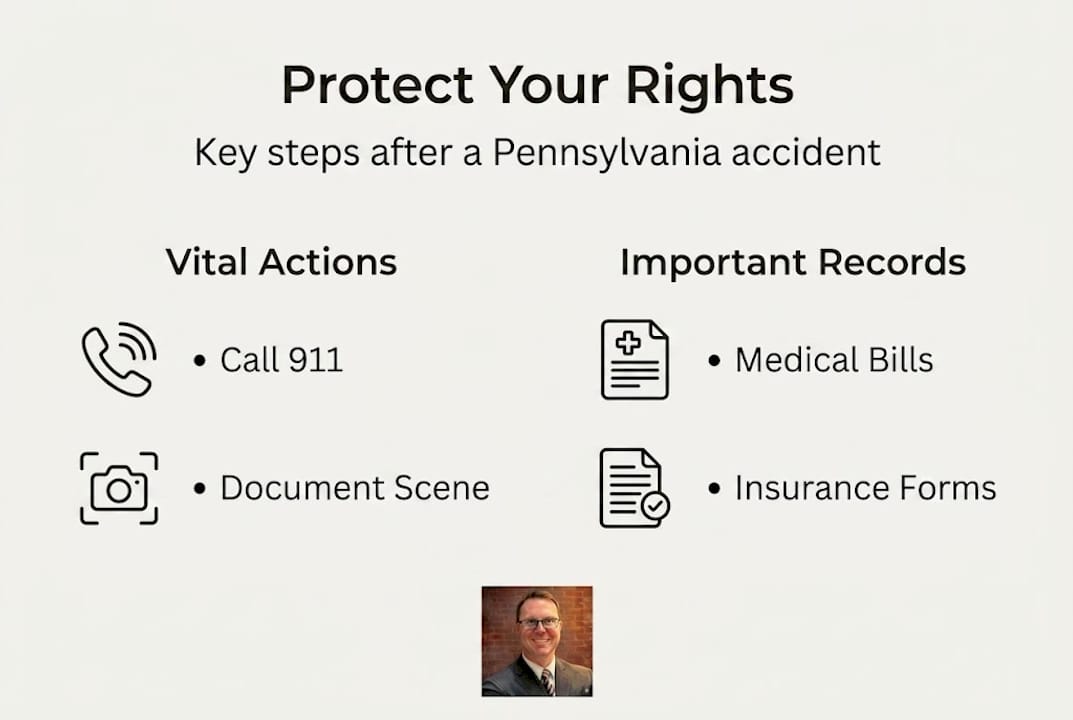
- Ensure safety first. Move to a safe location if possible and check for injuries. Call 911 immediately, even for minor accidents.
- Request a police report. An official report creates an objective record of the incident. Never skip this step.
- Document everything at the scene. Take photos of all vehicles, road conditions, traffic signals, skid marks, and any visible injuries.
- Collect witness information. Names, phone numbers, and brief descriptions of what they saw can be invaluable later.
- Seek medical evaluation. Even if you feel fine, get checked out. Injuries like whiplash or internal trauma often appear hours or days later.
- Notify your insurance company. Report the accident promptly, but keep your statement factual and brief.
The steps after a car accident you take in those first moments directly shape what compensation you may recover. Skipping any of these steps gives the other party's insurer ammunition to reduce or deny your claim.
Critical mistakes to avoid:
- Saying "I'm sorry" or anything that implies fault, even casually
- Leaving the scene before police arrive
- Declining medical treatment at the scene
- Posting about the accident on social media
"Anything you say at the scene can and will be used against you in a claims process. Keep your statement short, factual, and limited to what you know for certain."
Pro Tip: Write down your own account of the accident as soon as you can, ideally within a few hours. Memory fades quickly, and your written notes become a reference point for your attorney and for any legal proceedings. For more on protecting your rights in the aftermath, detailed guidance is available to help you stay on track.
Managing insurance and legal communications
Protecting your rights goes beyond the accident scene. Communications in the days after have major impact on whether your claim succeeds or fails.

When you report to your own insurer, stick to the facts. Give them the date, time, location, and a basic description of what happened. Do not speculate about fault. Do not estimate the extent of your injuries before you've been fully evaluated. Insurers are trained to use your own words to limit payouts, and even well-meaning statements can backfire.
Dealing with the other party's insurance company is a different matter entirely. You are not required to give them a recorded statement, and doing so without legal advice is risky. Their adjuster works for them, not for you. Many personal injury myths debunked revolve around this exact point — people assume cooperation speeds up their claim, when it often just weakens it.
Here's a breakdown of key deadlines and reporting requirements in Pennsylvania:
| Action | Deadline | Why it matters |
|---|---|---|
| Report to your insurer | As soon as possible (within days) | Policy terms often require prompt notice |
| File a police report | At scene or within 5 days for serious accidents | Creates official record |
| File a personal injury lawsuit | 2 years from date of accident | Pennsylvania statute of limitations |
| Preserve vehicle evidence | Immediately | Vehicles can be repaired or scrapped quickly |
When you involve an attorney early, you gain a major advantage. Your lawyer can handle communications with both insurers, preserve your legal options, and prevent you from making statements that hurt your case. Share everything with your attorney — medical records, photos, witness contacts, and any written communications from insurers.
Pro Tip: Keep a dedicated folder (physical or digital) for all accident-related documents. Include every bill, every email, every letter from an insurer, and every medical report. Organization at this stage makes a significant difference when maximize compensation tips are put into practice.
Handling personal injury claims and compensation
Once communications are underway, it's time to focus on the claim process and getting the recovery you deserve. A personal injury claim is your formal request for compensation, and how you build it determines what you receive.
Strong claims are built on strong documentation. The essentials include:
- Medical records and bills showing all treatments related to the accident
- Proof of lost wages if injuries kept you from working
- Photos and video from the accident scene and your injuries over time
- Expert opinions such as medical evaluations or accident reconstruction reports
- A personal injury journal documenting daily pain levels, limitations, and emotional impact
Pennsylvania's personal injury compensation guidance makes clear that the more thorough your documentation, the stronger your negotiating position. Gaps in records give insurers room to argue that injuries were minor or unrelated to the accident.
One of the most common and costly mistakes victims make is accepting the first settlement offer. Insurance companies often extend early offers that sound reasonable but fall far short of covering long-term medical costs, future lost income, and pain and suffering. Never accept a settlement without understanding the full scope of your injuries and future needs.
Trucking accidents add another layer of complexity to compensation. Commercial carriers typically carry much higher insurance policies, which means larger potential payouts, but also far more aggressive legal defense teams. If you're pursuing accident compensation after a truck collision, expect the carrier's legal team to scrutinize every detail of your claim.
Pro Tip: Before signing any settlement agreement, have an attorney review it. Once you sign, you typically waive your right to pursue additional compensation, even if your injuries worsen. Understanding injury claim rights in PA before signing anything can save you from a decision you can't undo.
Special considerations for trucking accidents
Trucking accidents require special steps to ensure your legal standing isn't compromised. These cases are fundamentally different from standard auto accidents, and the stakes are almost always higher.
When a commercial truck is involved, you're not just dealing with a driver. You may be dealing with:
- The trucking company that employs the driver
- The company that owns the truck (which may be different from the carrier)
- The shipper or loader if cargo contributed to the crash
- Maintenance contractors if mechanical failure played a role
This layered liability is why truck accident legal rights require a different approach. Evidence that might seem routine in a car accident becomes critical in a trucking case. Federal regulations require trucking companies to maintain logs, maintenance records, and driver qualification files. These records can be destroyed or altered quickly if you don't act to preserve them.
Key steps specific to trucking accidents:
- Send a preservation letter to the trucking company immediately, demanding they retain all records related to the accident
- Photograph the truck including its DOT number, license plates, and any visible damage or cargo issues
- Request the driver's logs and hours of service records, which show whether the driver was fatigued
- Seek accident reconstruction expertise early, as physical evidence at the scene degrades fast
"In trucking cases, the clock starts ticking the moment the crash happens. Evidence disappears, records get 'lost,' and witnesses move on. Early legal action is not optional — it's essential."
Insurance coverage in trucking cases is also dramatically different. Federal law requires commercial carriers to carry minimum liability coverage of $750,000, and many carry policies of $1 million or more. That's both an opportunity and a challenge, because higher coverage means the insurer will fight harder to minimize your payout.
A hard truth: Fast action matters more than most people realize
Here's something most accident guides won't tell you directly: the legal system does not automatically protect you. It gives you tools, but only if you use them in time.
We've seen cases where victims waited weeks to seek medical care, assuming they'd feel better. By the time they filed a claim, the insurer argued the injuries were unrelated to the accident. We've seen people give recorded statements to the other driver's insurer on day two, thinking they were being cooperative, only to have those statements used to deny their claims entirely.
The most common regret we hear from accident victims is simple: "I wish I had called a lawyer sooner." Not because attorneys are miracle workers, but because early involvement changes the trajectory of a case. Evidence gets preserved. Deadlines get tracked. Insurers get put on notice that they can't play games.
There's also a psychological trap worth naming. After an accident, you're often in pain, stressed, and hoping everything will just work out. That hope is understandable, but it's dangerous when it leads to inaction. The other party's legal team is not hoping. They are working.
Recovering from an accident is not just physical. It's legal, financial, and emotional. The people who navigate it best are the ones who treat their legal rights with the same urgency they give their medical care.
Expert legal support for Pennsylvania accident victims
If you've been in an auto or trucking accident in Pennsylvania, you don't have to figure this out alone. The steps above give you a foundation, but every case has details that matter, and those details require experienced legal eyes.

Attorney Sean Quinlan and the team at pennsylvaniadui.attorney work with accident victims across Pennsylvania to protect their rights from day one. Whether you need auto accident legal help after a collision, guidance from a personal injury expert on building your claim, or even help with DUI cases that intersect with accident charges, the team offers personalized, results-driven representation. Early consultation is free, and it could be the most important call you make after an accident.
Frequently asked questions
What should I do immediately after an auto or trucking accident in Pennsylvania?
Ensure safety, call 911, document the scene with photos, gather witness information, and avoid admitting fault. Prompt medical evaluation and essential protective steps are critical to preserving your legal rights.
How long do I have to file a personal injury claim after an accident in Pennsylvania?
You generally have two years from the accident date to file a personal injury lawsuit in Pennsylvania. Missing this deadline typically means losing your right to maximize your compensation through the courts.
Should I speak with the other driver's insurance company?
You should be very careful and consult a lawyer first. The other party's insurer works against your interests, and common personal injury myths often lead victims to believe cooperation helps when it frequently does not.
What documentation is most important to keep after an accident?
Photographs, the official police report, all medical records and bills, and witness contact information are the most critical. Thorough documentation directly supports your rights after accidents and strengthens any compensation claim.
How are rights different in trucking accidents compared to auto accidents?
Trucking accidents involve more liable parties, federal regulations, higher insurance coverage, and more aggressive legal defense. Understanding truck accident legal rights early is essential to avoiding evidence loss and protecting your full claim.
Recommended
- Auto Accidents in Pennsylvania: Know Your Rights and How to Protect Them — Attorney Sean Quinlan
- What to Do After an Auto Accident: Protecting Your Rights — Attorney Sean Quinlan
- What to Do After a Car Accident: Essential Steps for Protecting Your Rights — Attorney Sean Quinlan
- DUI Checkpoints in Pennsylvania: What Are Your Rights? — Attorney Sean Quinlan