

Most people assume that filing a personal injury claim means heading to a courtroom, facing a jury, and enduring months of legal drama. That picture is mostly wrong. Most personal injury claims settle before ever reaching trial, which changes everything about how you should approach your situation. If you were hurt in an accident in Pennsylvania, understanding how the process actually works gives you a real advantage. This guide covers what a personal injury claim is, how it unfolds step by step, what you could recover, and what factors shape your outcome.
Table of Contents
- What is a personal injury claim?
- Steps in a Pennsylvania personal injury claim
- What can you recover? Damages and average settlements
- Key factors that affect your personal injury claim
- Do most claims settle or go to trial? Myths vs. reality
- The real key: Build your evidence early for the best outcome
- Take the next step: Get reliable legal support for your injury claim
- Frequently asked questions
Key Takeaways
| Point | Details |
|---|---|
| Most claims settle out of court | In Pennsylvania, the majority of personal injury claims are resolved before ever going to trial. |
| Evidence is crucial | Gather and preserve proof early to maximize your claim’s chances of success and higher recovery. |
| Damages vary by case | Compensation depends on your injury’s severity, losses, and the quality of supporting evidence. |
| Time limits apply | You generally have two years from the injury to file your claim in Pennsylvania. |
What is a personal injury claim?
A personal injury claim is not just about being hurt. It is a formal legal action where you hold another party responsible for harm they caused through negligence or wrongdoing. As explained in key injury terms, personal injury claims involve someone holding another party legally responsible for harm from an accident or injury.
Under Pennsylvania law, four core elements must exist for a valid claim:
- Duty of care: The other party owed you a legal obligation to act reasonably.
- Breach: They failed to meet that obligation.
- Causation: Their failure directly caused your injury.
- Damages: You suffered real, measurable losses as a result.
Not every accident automatically creates a valid claim. A slip on your own wet floor does not involve another party's negligence. But a slip in a grocery store that failed to clean up a spill for hours? That is a different story.
Common personal injury cases in Pennsylvania include:
- Car and truck accidents
- Slip and fall incidents on someone else's property
- Medical malpractice
- Dog bites
- Workplace injuries (in some circumstances)
Pennsylvania reality check: Even if you believe the other party was clearly at fault, you still need evidence to prove each element. A belief is not a case. Documentation, witnesses, and medical records are what transform an injury into a recoverable claim.
Understanding these foundations early prevents wasted time and sets realistic expectations from the start.
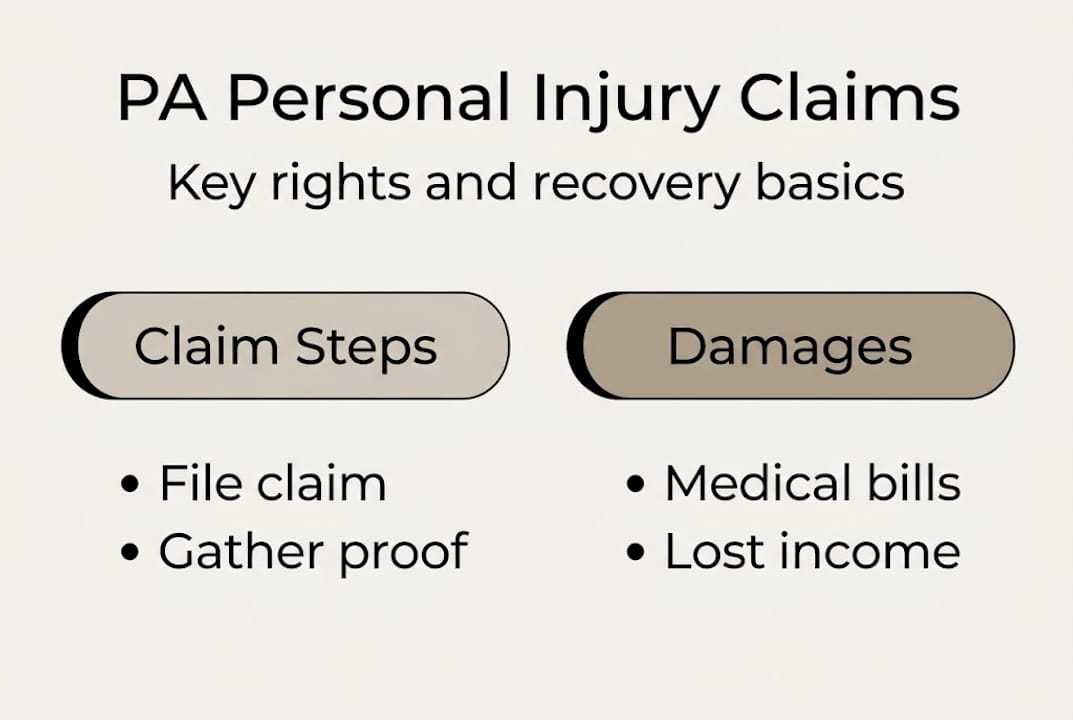
Steps in a Pennsylvania personal injury claim
Knowing the process removes the fear of the unknown. Here is exactly how a claim unfolds after an accident in Pennsylvania, based on steps after an accident and Pennsylvania rights guidance.
- Seek immediate medical treatment. Your health comes first, and medical records also become critical evidence. Gaps in treatment hurt claims.
- Preserve evidence. Take photos of the scene, your injuries, and any property damage. Get names and contact information from witnesses.
- Notify the relevant insurance companies. Report the accident to your insurer. Be cautious about what you say to the other party's insurer.
- Consult a personal injury attorney. Early legal advice helps you avoid mistakes that can reduce or eliminate your recovery. As outlined in steps to pursue justice, process steps are crucial for successful claims in Pennsylvania.
- Investigation and damage calculation. Your attorney gathers evidence, reviews medical bills, calculates lost wages, and documents pain and suffering.
- Negotiation with the insurance company. Most claims resolve here, through back-and-forth offers and counteroffers.
- File a lawsuit if needed. If negotiations fail, your attorney files a civil lawsuit. Many cases still settle during litigation before reaching trial.
Pennsylvania's statute of limitations: You generally have two years from the date of your injury to file a personal injury lawsuit. Miss that deadline and you lose your right to recover, regardless of how strong your case is.
Pro Tip: Do not wait weeks to speak with an attorney. Evidence disappears fast. Surveillance footage gets deleted, witnesses forget details, and physical evidence changes. The earlier you act, the stronger your position.
What can you recover? Damages and average settlements
Once the process starts, the most pressing question is what you might actually walk away with. Pennsylvania law allows injured parties to pursue two main categories of compensation.
Economic damages cover your measurable financial losses:
- Medical bills (past and future)
- Lost wages and reduced earning capacity
- Property damage
- Rehabilitation costs
Non-economic damages cover losses that are real but harder to quantify:
- Pain and suffering
- Emotional distress
- Loss of enjoyment of life
- Loss of consortium (impact on a spouse or family)
No two cases are identical, but averages give you a useful benchmark. For example, average PA malpractice payouts were about $430,000 between 2012 and 2016, with settlements often higher when evidence is strong.
| Injury type | Typical settlement range |
|---|---|
| Minor car accident (soft tissue) | $10,000 to $25,000 |
| Moderate car accident (fractures) | $50,000 to $150,000 |
| Serious accident (surgery required) | $150,000 to $500,000+ |
| Medical malpractice | $200,000 to $1,000,000+ |
| Slip and fall (moderate injury) | $15,000 to $75,000 |
These ranges reflect settlements across Pennsylvania. Your actual recovery depends on your specific facts, injuries, and the strength of your evidence.
Pro Tip: The county where your case is filed matters. Some Pennsylvania counties have juries that historically award higher verdicts, which gives your attorney more leverage during settlement talks. Ask about venue strategy early.
For context on auto accident compensation, Pennsylvania follows a choice no-fault insurance system, meaning your initial coverage options depend on the insurance plan you selected.
Key factors that affect your personal injury claim
Knowing what shapes your claim's value is just as important as knowing what you can recover. Success is driven by evidence strength, comparative negligence, and insurance coverage.

Comparative negligence in Pennsylvania: If you were partly at fault for the accident, your compensation is reduced by your percentage of fault. If you were 20% responsible, you recover 80% of your total damages. However, if you are found more than 50% at fault, you recover nothing. This rule makes it critical to document the other party's fault clearly.
Insurance policy limits: Even with a strong case, you can only recover up to the at-fault party's policy limits unless they have significant personal assets. A driver with minimum liability coverage caps your recovery regardless of your actual losses.
Here is a quick comparison of what separates strong claims from weak ones:
| Factor | Strong claim | Weak claim |
|---|---|---|
| Medical documentation | Complete and consistent | Gaps or delays in treatment |
| Evidence | Photos, witnesses, records | Little to no documentation |
| Fault | Clearly on the other party | Shared or disputed |
| Insurance coverage | Adequate limits | Minimum or no coverage |
| Attorney involvement | Early and experienced | Late or none |
Additionally, understanding liability concepts helps you recognize what the other side will argue and how to counter it.
What helps your claim most:
- Consistent medical treatment from day one
- Detailed records of every expense and missed workday
- Witness statements gathered quickly
- Clear evidence placing fault on the other party
- Experienced legal representation
Do most claims settle or go to trial? Myths vs. reality
Here is the myth that holds many people back: they assume that pursuing a personal injury claim means a long, exhausting trial. That fear keeps some people from filing at all, or causes them to accept lowball settlements out of anxiety.
The reality is different. Most personal injury cases in Pennsylvania settle before reaching a courtroom trial. The American Bar Association confirms this pattern nationally, and Pennsylvania mirrors it.
Why do most cases settle? Trials are expensive, unpredictable, and time-consuming for both sides. Insurance companies prefer certainty. Plaintiffs prefer faster resolution. Settlement gives both parties control over the outcome.
Here is how a productive settlement process typically unfolds:
- Your attorney sends a demand letter outlining your injuries, evidence, and requested compensation.
- The insurer responds with an initial offer, usually lower than your demand.
- Negotiation begins, with both sides exchanging counteroffers backed by evidence.
- A settlement agreement is reached or the case moves to litigation.
- Even during litigation, settlement discussions often continue right up to trial.
Timeline matters too. Settled cases typically resolve in months. Trials can take years. The emotional toll of prolonged litigation is real, and most injured Pennsylvanians are better served by a well-negotiated settlement than a gamble at trial.
That said, some cases genuinely need to go to trial, especially when insurers act in bad faith or refuse to offer fair value. A skilled attorney knows when to push and when to settle.
The real key: Build your evidence early for the best outcome
After working with injured Pennsylvanians across multiple counties, one truth stands out above all the legal theory and settlement averages: the single biggest factor separating strong claims from weak ones is what you do in the first 48 hours after an accident.
Most people focus on finding a lawyer eventually. The smarter move is treating the accident scene itself as your first legal step. Every photo you take, every witness name you collect, and every medical appointment you keep is a brick in your case's foundation. Insurance adjusters are trained to find gaps. Your job is to leave none.
The legal system runs on documented proof, not your memory of what happened. Memories fade. Surveillance footage gets overwritten. Witnesses move on. The urgency is real.
For practical guidance on protecting yourself after an accident, start those steps before you even think about calling an attorney. Then call one fast. Missed deadlines and lost evidence destroy even genuinely strong cases. Early action is not just helpful, it is often the difference between a fair recovery and nothing at all.
Take the next step: Get reliable legal support for your injury claim
You now have a clear picture of how personal injury claims work in Pennsylvania, what you can recover, and what makes or breaks a case. The next move is yours.

If you were hurt in an accident and want to know where you stand, speaking with an experienced Pennsylvania attorney costs you nothing upfront. At pennsylvaniadui.attorney, you can access personal injury legal support and auto accident attorney help tailored to your county and situation. Sean Quinlan and his team offer straightforward consultations, honest assessments, and representation focused on your recovery. Do not let confusion or fear of the process cost you what you are rightfully owed.
Frequently asked questions
How long do I have to file a personal injury claim in Pennsylvania?
You typically have two years from injury to file a personal injury claim in Pennsylvania. Missing this deadline almost always means losing your right to recover compensation entirely.
What types of damages can I recover in a personal injury claim?
You may recover medical costs, lost wages, pain and suffering, and sometimes punitive damages, depending on the facts of your specific case.
Do I need a lawyer for a personal injury claim in Pennsylvania?
While not legally required, legal consultation improves outcomes significantly, helping you avoid mistakes and negotiate a stronger settlement than you would likely reach on your own.
Will my injury claim have to go to trial?
Most claims settle pre-trial in Pennsylvania, meaning the majority of injured residents resolve their cases through negotiation without ever appearing before a jury.
Recommended
- Auto Accidents in Pennsylvania: Know Your Rights and How to Protect Them — Attorney Sean Quinlan
- Personal Injury Claims: How to Pursue Justice and Compensation — Attorney Sean Quinlan
- What to Do After an Auto Accident: Protecting Your Rights — Attorney Sean Quinlan
- Personal injury terms explained: Pennsylvania legal guide