

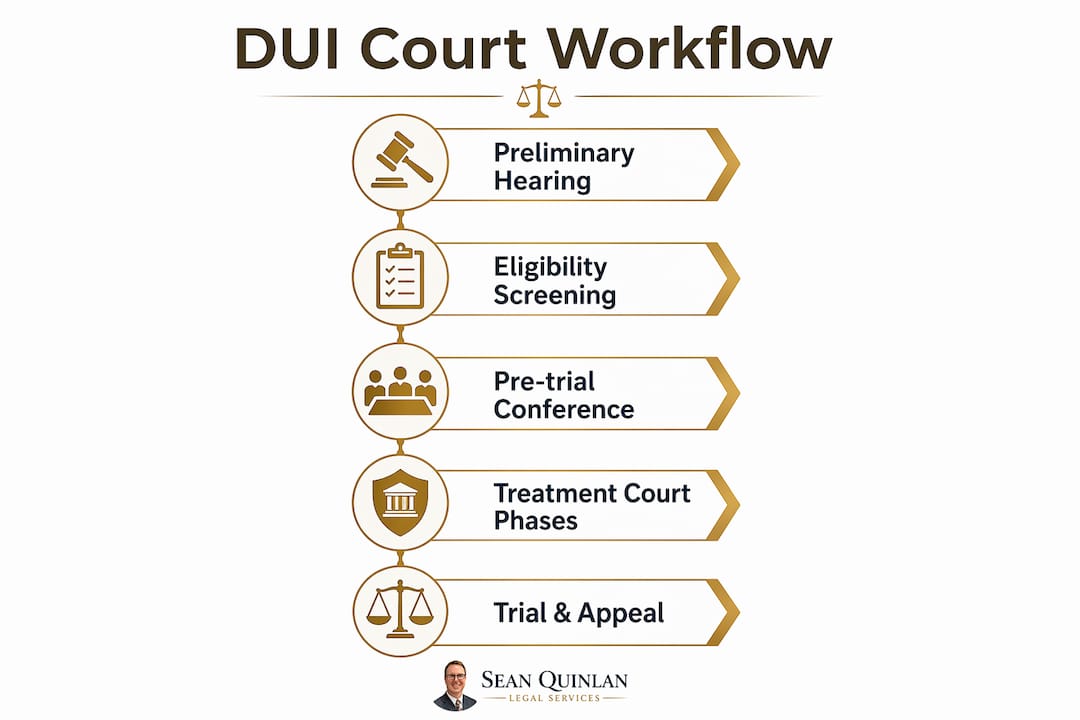
The DUI court workflow in Pennsylvania is defined as a structured, multi-stage legal process that moves from arrest through preliminary hearing, pre-trial conference, trial, and potentially an appeal. Knowing each stage before you walk into a courtroom is not a luxury. It is the difference between reacting to events and managing them. Pennsylvania's system also includes a parallel civil process for license suspensions and an alternative pathway through DUI Treatment Courts, both of which operate on their own timelines and deadlines. This guide breaks down every stage of the Pennsylvania DUI legal workflow so you know exactly what to expect and when.
What happens at the preliminary hearing and eligibility screening in the DUI court workflow Pennsylvania?
The preliminary hearing is the first formal court event in the Pennsylvania DUI process, and it carries more strategic weight than most defendants realize. Its primary purpose is to determine whether the Commonwealth has a prima facie case, meaning enough evidence to send the charges forward to the Court of Common Pleas. Your attorney can cross-examine the arresting officer here, which serves to lock in officer testimony before trial. For a closer look at what this stage involves county by county, Pennsylvaniadui's resource on preliminary hearings in Lancaster County offers specific procedural detail.
Immediately after the preliminary hearing, the Assistant District Attorney conducts a legal screening using your criminal and driver history to determine whether you qualify for DUI Treatment Court. This eligibility screening reviews records and uses the results to direct defendants either toward the traditional criminal track or the treatment court pathway. The decision made at this stage shapes everything that follows, which is why your conduct and record going into the hearing matter.
If you are eligible for DUI Treatment Court, the application process begins immediately. The sequence is time-sensitive and procedurally strict:
- Obtain the DUI Treatment Court application from the court after the preliminary hearing.
- Complete the RANT (Risk and Needs Triage) assessment, which evaluates substance use risk level.
- Complete the TASC (Treatment Alternatives for Safer Communities) assessment, which screens for mental health and substance use treatment needs.
- Submit all materials to the DUI Court team for review before the pre-trial conference deadline.
- Await the team's approval decision, which determines your program entry.
The RANT and TASC assessments do more than screen for eligibility. They directly inform the conditions and monitoring requirements built into your DUI Court program, so accuracy and honesty during these evaluations directly affect the structure of your participation.
Pro Tip: File your DUI Treatment Court application the same day as your preliminary hearing if at all possible. The application timing is one of the most common procedural pitfalls defendants face, and missing the pre-trial conference deadline can close the treatment court door entirely.
How does the pre-trial conference and formal arraignment function in Pennsylvania DUI cases?
The pre-trial conference is a case management hearing that occurs before formal arraignment at the Court of Common Pleas. Its function in the DUI court procedure PA is to confirm whether a defendant is pursuing the treatment court track or continuing through the traditional criminal process. The pre-trial conference also sets the schedule for subsequent proceedings, including the arraignment date and any motion deadlines.
At the formal arraignment, the Court of Common Pleas reads the charges against you officially and asks for your plea. This is where defendants enter a plea of guilty, not guilty, or no contest. Several procedural rights and options become relevant at this stage:
- You have the right to have charges read aloud in open court.
- You may request a continuance, which is a postponement, if your attorney needs additional preparation time.
- Entering a not guilty plea at arraignment does not prevent a later plea agreement. It simply preserves your options.
- If you have been approved for DUI Treatment Court, the arraignment may be structured differently to reflect your program enrollment.
- Bail conditions set at the preliminary hearing remain in effect unless modified at this stage.
The arraignment is not the moment for arguments or evidence. It is a procedural checkpoint. Defendants who arrive without counsel at this stage frequently waive rights they did not know they had, which is why representation from the outset of the Pennsylvania DUI process is critical.
What are the key phases and requirements of DUI Treatment Court participation?
DUI Treatment Court is a non-adversarial model, meaning the judge, probation officer, case manager, and coordinator all function as a multidisciplinary support team rather than adversaries. The goal is treatment and behavioral change, not punishment alone. This structure distinguishes it sharply from the traditional criminal track, where the prosecution and defense operate in opposition throughout.

Participation is divided into five structured phases, each with minimum duration requirements and specific advancement criteria. The table below summarizes the core requirements:
| Phase | Focus | Key Requirements |
|---|---|---|
| Phase 1 | Stabilization | Electronic monitoring, frequent probation contact, daily sobriety meetings |
| Phase 2 | Treatment engagement | Continued monitoring, verified attendance at treatment sessions |
| Phase 3 | Skill building | Reduced monitoring, prosocial activity requirements, employment or education goals |
| Phase 4 | Transition | Minimal supervision, community integration, relapse prevention planning |
| Phase 5 | Graduation preparation | Final compliance review, program completion documentation |
Advancement from one phase to the next requires demonstrated compliance, verified by the DUI Court team. Missed meetings, failed drug screens, or electronic monitoring violations can result in phase regression or sanctions. Graduation from the program typically results in a significantly reduced or dismissed charge, which is the primary incentive for completing all five phases.
Pro Tip: Track every sobriety meeting, probation contact, and prosocial activity with dated documentation. The DUI Court team reviews compliance records at each phase transition, and self-documentation fills gaps when institutional records are incomplete.
How are implied consent laws and license suspensions handled separately from DUI charges?
Pennsylvania's implied consent law establishes that any person who drives on a public road has already consented to chemical testing if lawfully arrested for DUI. This is not a choice made at the time of arrest. It is a legal condition built into the act of driving in the Commonwealth. Refusing a chemical test triggers a separate civil process that runs parallel to, and independent of, the criminal DUI case.
When a driver refuses testing, the arresting officer notifies PennDOT, which then initiates an automatic license suspension independent of any criminal conviction. The suspension periods are specific:
- A first refusal results in a 12-month license suspension.
- A second or subsequent refusal results in an 18-month suspension.
- Reinstatement requires payment of a restoration fee, the amount of which varies based on suspension history.
Challenging a license suspension is a civil judicial review filed in the Court of Common Pleas. This proceeding is entirely separate from the criminal DUI case, meaning you can win your criminal case and still lose your license, or vice versa. For a detailed breakdown of your rights in this process, Pennsylvaniadui's guide on chemical test refusal covers the implied consent law and its consequences in full.
The practical implication is that defendants must manage two parallel legal tracks simultaneously. Missing the deadline to challenge a PennDOT suspension, which is typically 30 days from the notice date, forfeits your right to a civil hearing entirely. An experienced attorney tracks both timelines concurrently.
What should defendants expect during the DUI trial and potential appeal stages?
If your case proceeds to trial, the Court of Common Pleas serves as the venue for all evidence, witness testimony, and legal argument. Most DUI trials in Pennsylvania are bench trials, meaning a judge decides the verdict rather than a jury, though defendants retain the right to request a jury trial. The prosecution presents its case first, including field sobriety test results, chemical test data, and officer testimony. Your defense attorney then challenges the admissibility and reliability of that evidence.
Plea agreements can be reached at any point before or during trial. Many DUI cases in Pennsylvania resolve through negotiated pleas, particularly when the evidence is strong but mitigating factors exist, such as a clean prior record or participation in treatment. The steps from trial through appeal follow a defined sequence:
- The prosecution presents its prima facie case, including all physical and testimonial evidence.
- The defense presents its response, including motions to suppress evidence obtained without probable cause.
- The judge or jury delivers a verdict of guilty or not guilty.
- If convicted, sentencing occurs at a separate hearing, where prior offenses and BAC level determine the tier of penalties.
- If you believe legal errors occurred during trial, an appeal can be filed within specific procedural timeframes after sentencing.
Appeals in Pennsylvania DUI cases are not retrials. They review whether legal errors affected the outcome of the original proceeding. Filing deadlines are strict, and missing them typically eliminates the right to appeal. Defendants considering this option should consult Pennsylvaniadui's overview of DUI defense strategies to understand what grounds support a viable appeal.
Key takeaways
The Pennsylvania DUI court workflow follows a fixed sequence of stages, and missing any single deadline, from the Treatment Court application to the PennDOT suspension challenge, can permanently close off your best options.
| Point | Details |
|---|---|
| Preliminary hearing is strategic | Use it to lock in officer testimony and begin eligibility screening for Treatment Court. |
| Treatment Court deadlines are immediate | Submit your application, RANT, and TASC assessments before the pre-trial conference deadline. |
| License suspension runs separately | Challenge PennDOT's suspension within 30 days or forfeit your right to a civil hearing. |
| Five phases require documented compliance | Track every meeting and contact because the DUI Court team reviews records at each phase transition. |
| Appeals review legal errors only | File within strict post-sentencing deadlines; appeals are not second trials. |
What I've learned about defendants who navigate this process well
After working with clients across Pennsylvania's DUI court system, one pattern stands out clearly. The defendants who manage this process most effectively are not necessarily the ones with the cleanest records or the weakest evidence against them. They are the ones who engage counsel immediately after arrest and treat every procedural deadline as non-negotiable.
The Treatment Court application window is the most commonly missed opportunity I see. Defendants assume they have time to evaluate their options after the preliminary hearing. They do not. The assessment and application process must begin the same day, and the pre-trial conference deadline arrives faster than most people expect. By the time someone realizes they missed the window, the traditional criminal track is the only path remaining.
The parallel license suspension process catches people equally off guard. A client can be focused entirely on the criminal case and completely miss the 30-day window to challenge the PennDOT suspension. These are two separate legal battles, and they require two separate strategies running at the same time.
My honest advice is this: do not try to sequence your response to a DUI charge. The system does not give you that luxury. The criminal case, the treatment court application, and the license suspension challenge all demand attention simultaneously. An attorney who handles DUI cases regularly in Pennsylvania will track all three without you having to manage the coordination yourself.
— Sean
How Pennsylvaniadui can guide you through every stage
Facing DUI charges in Pennsylvania means managing multiple legal tracks at once, and the cost of missing a single deadline can be significant.

Attorney Sean P. Quinlan at Pennsylvaniadui has guided clients through every stage of the Pennsylvania DUI legal workflow, from preliminary hearings and Treatment Court applications to PennDOT suspension challenges and trial defense. Whether you are trying to qualify for a DUI Treatment Court program or preparing for a bench trial, the team provides personalized case evaluation and representation across multiple Pennsylvania counties. Contact Pennsylvaniadui today through the DUI defense services page to schedule a consultation and get a clear picture of where your case stands and what your options are.
FAQ
What is the first step in the Pennsylvania DUI court process?
The first step is the preliminary hearing, where the court determines whether the Commonwealth has enough evidence to proceed. This hearing also triggers the legal eligibility screening for DUI Treatment Court.
How long does DUI Treatment Court take to complete in Pennsylvania?
DUI Treatment Court programs typically span 12 to 18 months across five structured phases, with advancement based on verified compliance with monitoring, treatment, and sobriety requirements.
Can I challenge my license suspension if I refused a chemical test?
Yes. Refusing a chemical test triggers an automatic suspension of 12 to 18 months, but you can file a civil appeal in the Court of Common Pleas, typically within 30 days of the PennDOT notice.
What happens if I miss the DUI Treatment Court application deadline?
Missing the deadline before the pre-trial conference generally closes the treatment court pathway, leaving the traditional criminal process as the only remaining option for case resolution.
Can a DUI conviction in Pennsylvania be appealed?
Yes, but appeals are limited to reviewing legal errors from the original trial and must be filed within strict post-sentencing deadlines. They are not opportunities to re-argue the facts of the case.