

Most drivers assume that if no one was seriously hurt, they can simply exchange information and move on. That assumption has cost people thousands of dollars in denied insurance claims, suspended licenses, and unexpected legal liability. Understanding why report an auto accident is not just about following the law. It is about protecting yourself from consequences that often show up weeks or months after the crash, long after informal agreements have fallen apart and memories have faded.
Table of Contents
- Key takeaways
- Why report an auto accident: the legal obligations you cannot ignore
- Insurance considerations: reporting protects your claim
- Safety and health reasons to report even minor accidents
- How to report an auto accident effectively
- My take on why consistent reporting matters more than most drivers realize
- Get qualified legal support after your accident
- FAQ
Key takeaways
| Point | Details |
|---|---|
| Legal obligations are real | Most states require reporting accidents involving injury, death, or property damage above a set threshold. |
| Missing deadlines has consequences | California requires DMV reporting within 10 days; missing it can result in a one-year license suspension. |
| Police reports protect your claim | Without an official report, insurance companies can dispute or deny claims far more aggressively. |
| Hidden injuries make documentation critical | Symptoms from whiplash and internal injuries often appear days after the crash, not at the scene. |
| Commercial vehicle rules are stricter | DOT-regulated trucks have specific reporting timelines and mandatory drug testing requirements after crashes. |
Why report an auto accident: the legal obligations you cannot ignore
The most immediate reason to file a report is simple: in most states, it is the law. Reporting thresholds typically apply when an accident involves injury, death, or property damage exceeding a specified dollar amount. These thresholds vary by state, but the legal exposure for failing to meet them is real and serious.
Consider two specific examples. In North Carolina, failure to report injury or death, or property damage over $1,000, is classified as a Class 1 misdemeanor. That means potential fines and even jail time, not just a traffic citation. In California, DMV reporting is required within 10 days whenever an accident involves injury, death, or damage exceeding $1,000. Miss that window and the state can suspend your license for a full year.
Many drivers confuse reporting to police with reporting to the DMV and their insurance carrier. These are three separate obligations, and completing one does not satisfy the others. Here is how they differ:
- Police report: Required at the scene when injuries or significant damage are present; documents the incident for law enforcement.
- DMV report: A separate administrative filing required in many states within a specific timeframe, regardless of whether police were called.
- Insurance notification: Required by your policy, usually within 24 to 72 hours, and separate from both government filings.
The consequences of skipping these steps go beyond fines. Failing to report can be used as evidence of negligence in a civil case, which shifts the balance of fault against you. In states with contributory negligence rules, that shift can eliminate your right to compensation entirely. The reasons to report a car accident are not just procedural. They are self-protective.
Insurance considerations: reporting protects your claim
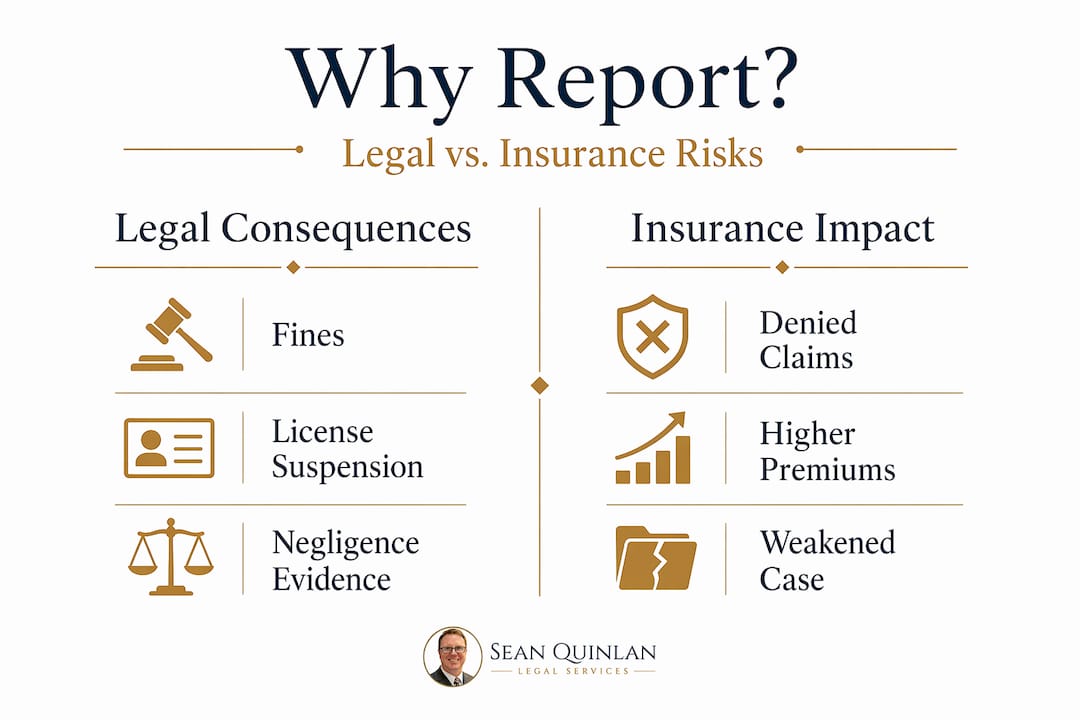
Insurance companies depend on official records to evaluate claims. When you report an accident promptly and a police report exists, the insurer has a neutral, third-party document to anchor their investigation. Without that record, the entire process becomes a credibility contest between two drivers with conflicting accounts.
Without a police report, insurance claims face a higher risk of denial or dispute. Adjusters are trained to look for gaps in documentation, and an absent report is one of the clearest gaps they can find. Even if the other driver was clearly at fault, your claim loses credibility when no official record of the event exists.
The benefits of reporting accidents extend well beyond claim approval. Consider these insurance-specific advantages:
- A dated police report establishes a clear timeline, which matters when injuries surface days later.
- Official documentation of vehicle damage prevents the other driver from denying the extent of impact.
- Prompt reporting deters fraudulent counterclaims, since your version of events is on record immediately.
- Accurate documentation reduces the risk of fraud by creating a reliable, timestamped account of the crash.
One scenario that trips drivers up is the informal agreement. Both parties agree at the scene to handle things privately, no police called, no report filed. Then, weeks later, the other driver files an injury claim against you. Without your own documentation, you have no objective record to counter that claim.
Pro Tip: Notify your insurance company even if you decide not to file a claim. Most policies require prompt notification of any accident, and failing to report can void coverage for that incident entirely.
Knowing how to protect your rights after an accident in Pennsylvania includes understanding that your legal rights depend heavily on the documentation you create in the hours after the crash.
Safety and health reasons to report even minor accidents
The phrase "minor accident" is one of the most misleading terms in the post-crash experience. A collision that looks minor at the scene can involve spinal compression, internal bruising, or traumatic brain injury, all of which may not produce obvious symptoms for 24 to 72 hours.

Medical documentation on the same day as the crash is the strongest evidence linking your injuries to the accident. Once time passes, insurers and defense attorneys will argue that your injuries came from something else entirely. Filing a report and seeking medical attention immediately closes that argument before it starts.
Beyond individual health, accident reporting serves a broader public safety function. When agencies receive reports, they can investigate whether a road hazard, faulty traffic signal, or defective guardrail contributed to the crash. That investigation protects future drivers. Timely reporting supports safety analysis that allows agencies to address the conditions that caused the accident in the first place.
Failing to report a seemingly minor accident can create a documentation gap that, months later, makes it nearly impossible to prove what happened, who was responsible, and what injuries resulted.
The importance of reporting accidents is not just a legal talking point. It is a practical safeguard that protects your health, your finances, and other drivers who may encounter the same conditions on that same road.
How to report an auto accident effectively
Knowing the reasons to report a car accident is only half the picture. The other half is knowing exactly how to do it well. Here is a step-by-step approach:
- Secure the scene first. Move vehicles out of traffic if possible and check for injuries before doing anything else.
- Call 911. Request police and medical assistance. Even if injuries appear minor, having an officer on scene creates an official record immediately.
- Gather scene information. Photograph all vehicle damage, the road and intersection, license plates, driver licenses, and insurance cards. Photographs of damage and road conditions are critical evidence for claims and investigations.
- Collect witness information. Names and phone numbers from bystanders can be decisive if the other driver later changes their account.
- File your DMV report. Check your state's deadline and submit the required form online, by mail, or in person.
- Notify your insurance company. Do this within the timeframe specified in your policy, typically within 24 hours.
- Follow up with medical care. Even without immediate symptoms, a same-day or next-day evaluation creates a documented baseline.
Pro Tip: When speaking with police at the scene, stick to the facts. Describe what happened without assigning blame. Statements like "I didn't see them" can later be interpreted as admissions of fault.
For commercial vehicle crashes, the process involves additional layers. Drivers and carriers operating under DOT authority must report fatalities, injuries, and disabling damage within strict federal timelines. Understanding how to report a tractor trailer accident also requires awareness of post-accident drug and alcohol testing windows. The table below summarizes key differences.
| Accident Type | Reporting Authority | Key Deadline | Additional Requirements |
|---|---|---|---|
| Standard auto accident | Police and insurance | Policy-specific, often 24 hours | State DMV report if threshold met |
| California auto accident | Police, insurance, and DMV | 10 days for DMV report | Applies when damage exceeds $1,000 |
| DOT-regulated truck crash | FMCSA and carrier records | Immediate for fatal/injury crashes | Drug and alcohol testing required |
| North Carolina accident | Police and DMV | Immediate at scene | Misdemeanor charge for non-reporting |
For trucking companies, why report a truck accident goes even further. DOT-recordable crashes affect a carrier's CSA score, which triggers regulatory scrutiny and can impact operating licenses. Missing these obligations is not just a fine. It can end a commercial driving career.
My take on why consistent reporting matters more than most drivers realize
I have worked with drivers across Pennsylvania who skipped reporting because the accident seemed small, the other driver seemed reasonable, or they simply did not want the hassle. In almost every case where a dispute arose later, the absence of an official report was the single biggest obstacle we faced in building a defense or recovering compensation.
What I have seen repeatedly is this: the driver who files the report controls the initial narrative. That first official account, documented while details are fresh and before anyone has spoken to an attorney, carries enormous weight with insurance adjusters and in court proceedings. The driver who skips reporting starts every subsequent conversation from a defensive position with no paper to stand on.
The other misconception I encounter is that formal reporting escalates a situation. In reality, it de-escalates it. An official record gives both parties a shared baseline. Without it, you are relying on the goodwill of someone you met five minutes ago on the side of a road.
The importance of reporting accidents is not about bureaucracy. It is about giving yourself the documentation needed to be treated fairly. Every case I have seen where a driver said, "We agreed to handle it ourselves," has eventually required far more time, money, and stress than a simple report would have cost at the outset. Proper accident documentation is the cornerstone of avoiding long-term legal and financial problems, and I have yet to see an exception to that rule.
— Sean
Get qualified legal support after your accident

Filing a report is the right first step, but it is rarely the last one. If you were injured, if fault is disputed, or if you are dealing with an insurance company that is pushing back on your claim, having experienced legal representation changes your position significantly. Pennsylvaniadui connects Pennsylvania drivers with Attorney Sean Quinlan, who handles auto accident cases across multiple counties with a focus on protecting your rights and building the strongest possible claim. If personal injury is part of your situation, dedicated personal injury legal help is also available. Reach out for a consultation and get a clear picture of where you stand.
FAQ
Is reporting a minor accident legally required?
It depends on your state's threshold for damage or injury. In California and North Carolina, damage over $1,000 triggers a mandatory reporting requirement, even if injuries appear minor.
What happens if I don't file an accident report?
You risk fines, license suspension, and in some states, misdemeanor charges. You also weaken your insurance claim and give the other party an advantage if a dispute arises later.
Should you report a minor accident to your insurance company?
Yes. Most insurance policies require you to notify the carrier promptly regardless of whether you intend to file a claim. Failing to do so can void coverage for that incident.
How do I report a tractor trailer accident?
Commercial vehicle drivers must report to their carrier and comply with FMCSA requirements, which include strict reporting timelines and mandatory post-accident drug and alcohol testing for qualifying crashes.
Does filing a report mean I am admitting fault?
No. A report documents the facts of the incident. Stick to observable details when speaking with police and avoid statements that could be interpreted as admissions of responsibility.