

If you've been charged with an impaired driving offense in Pennsylvania, you may be searching for information about "DWI" charges only to find that the term doesn't appear anywhere in state law. That confusion is entirely understandable. Across the country, states use a patchwork of terminology for impaired driving, and many people arrive in a Pennsylvania courtroom with assumptions drawn from other states or popular culture. PA's impaired driving resources confirm that the Commonwealth uses only the DUI designation. This guide will clarify what that means for your case and your defense.
Table of Contents
- Understanding DUI and DWI: Key definitions
- Why Pennsylvania uses only DUI: The legal perspective
- Penalties for DUI in Pennsylvania: Severity and impact
- Making informed defense decisions: What to do if charged
- Why DUI vs. DWI distinctions matter more than you think
- Get experienced help for your Pennsylvania DUI case
- Frequently asked questions
Key Takeaways
| Point | Details |
|---|---|
| DWI is not used in PA | Pennsylvania law classifies all impaired driving charges as DUI, not DWI. |
| DUI covers alcohol and drugs | DUI in Pennsylvania applies to both alcohol- and drug-related offenses. |
| Penalties depend on specifics | DUI penalties vary by substance, repeat offenses, and other circumstances. |
| Correct terminology protects you | Using Pennsylvania’s DUI terminology helps prevent legal missteps. |
| Legal help is critical | A qualified attorney ensures your rights and best possible outcome in DUI cases. |
Understanding DUI and DWI: Key definitions
The abbreviations DUI and DWI each stand for distinct phrases in states that use both terms. DUI means Driving Under the Influence, while DWI typically stands for Driving While Intoxicated or Driving While Impaired. In states like New York, New Jersey, and Maryland, courts draw meaningful legal lines between those two labels. New York, for example, treats a DWI as a more serious offense than a DWAI (Driving While Ability Impaired), with steeper penalties attached to the DWI designation.
Pennsylvania takes a fundamentally different approach. The Commonwealth uses only one term: DUI. There is no separate DWI charge on the books, no "Driving While Impaired" category, and no parallel statute that mirrors what neighboring states call DWI. All impaired driving offenses, whether caused by alcohol, controlled substances, prescription medications, or any combination thereof, fall under the single DUI label. PennDOT's official guidance reinforces this, referring exclusively to DUI and impaired driving without any mention of DWI.
Understanding this distinction matters practically. If you research DWI defense strategies written for New Jersey residents and try to apply them in a Pennsylvania courtroom, you may find that the procedural rules, BAC thresholds, and statutory citations simply don't match. Effective DUI defense strategies are jurisdiction-specific, and that starts with knowing the correct terminology.
How Pennsylvania compares to neighboring states
The table below shows how Pennsylvania and its neighbors handle impaired driving terminology:
| State | Primary term used | Secondary term used | Notes |
|---|---|---|---|
| Pennsylvania | DUI | None | Single unified statute |
| New Jersey | DWI | DUI (informal) | DWI is the legal standard |
| New York | DWI | DWAI, DUI | Multiple tiers with distinct penalties |
| Maryland | DUI | DWI | Both used; DUI is more severe |
| Ohio | OVI | DUI (informal) | Operating a Vehicle Impaired |
| Delaware | DUI | None | Similar to Pennsylvania |
The comparison makes clear that Pennsylvania is unusual in its streamlined approach. While neighboring states use two or more terms to create legal tiers, Pennsylvania consolidates everything under DUI and instead uses BAC levels and other factors to determine penalty severity.
"Impaired driving, whether caused by alcohol or drugs, is charged and prosecuted the same way in Pennsylvania: as a DUI. There is no secondary label, no lesser 'DWI' category, and no distinction in the statute based on which substance caused the impairment."
Why Pennsylvania uses only DUI: The legal perspective
Pennsylvania's decision to use a single term reflects a deliberate legislative choice to treat all forms of impaired driving as equally serious under the law. The relevant statute, 75 Pa. C.S. § 3802, defines DUI broadly to cover alcohol, controlled substances, metabolites of controlled substances, and situations where a driver is incapable of safely operating a vehicle regardless of the substance involved. This breadth means the same legal label applies whether a driver tested above the legal alcohol limit or was impaired by marijuana, heroin, prescription opioids, or even over-the-counter antihistamines.

The practical effect is significant. In states with tiered terminology, a defense attorney might argue that a client's conduct fits a lesser charge. That particular argument simply does not exist in Pennsylvania. There is no lesser "DWI" to plead down to, which makes understanding your actual exposure under Pennsylvania's DUI tiers all the more important.
Pennsylvania structures its DUI penalties around three tiers based on BAC and substance type:
- General impairment (BAC of 0.08% to 0.099%): The lowest tier, carrying the least severe penalties for a first offense, though consequences are still serious.
- High BAC (0.10% to 0.159%): A middle tier with mandatory minimum sentences even for first-time offenders.
- Highest BAC (0.16% and above, or any controlled substance): The most severe tier, with the steepest fines, longest mandatory minimums, and longest license suspensions.
Pennsylvania's unified approach becomes especially relevant when you consider second DUI consequences. A second offense within ten years carries dramatically higher mandatory minimums at every tier, and the absence of a lesser "DWI" charge means there is no procedural shortcut to avoid those enhanced penalties.
The scale of Pennsylvania's impaired driving problem underscores why these laws are enforced aggressively. In 2023, PA had 40,823 DUI arrests, with 28,020 of those arrests involving drugged driving, not alcohol. That figure represents more than 68% of total DUI arrests, which directly illustrates why Pennsylvania's unified DUI statute matters: a law written only around alcohol would miss the majority of impaired drivers the statute actually captures.
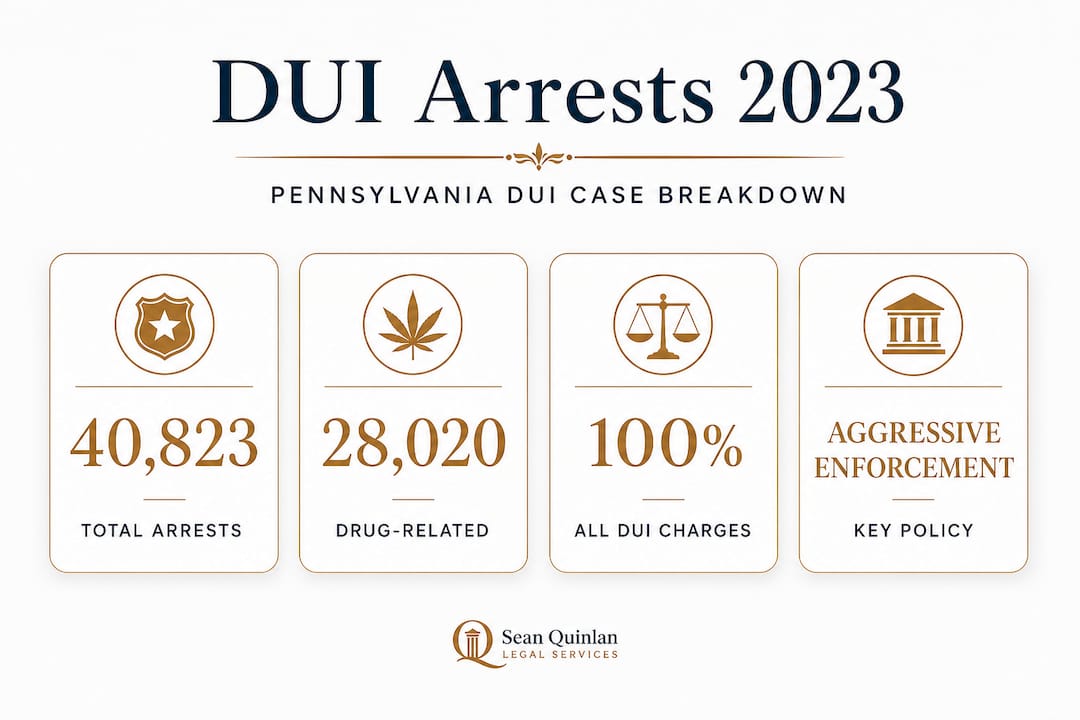
Here is a breakdown of 2023 Pennsylvania DUI arrest data:
| Category | Number of arrests | Percentage of total |
|---|---|---|
| Total DUI arrests | 40,823 | 100% |
| Drug-related DUI | 28,020 | 68.6% |
| Alcohol-related DUI | 12,803 | 31.4% |
Pro Tip: If someone gives you advice about your impaired driving case based on experience in another state, treat it as a starting point only. Pennsylvania's statute is distinct, and what applies in Maryland or New York may actively mislead you here. Always verify against Pennsylvania law or consult an attorney licensed in the Commonwealth.
Penalties for DUI in Pennsylvania: Severity and impact
Because Pennsylvania uses a single DUI statute, all penalties flow from that one framework. There is no set of "DWI penalties" sitting alongside a lighter DUI penalty structure. Every impaired driving conviction is a DUI conviction, and the penalties attached to it depend on the tier, the driver's history, and the specific circumstances of the offense. PennDOT's classification of all impaired driving under the DUI label confirms that no alternative penalty framework exists.
Understanding Pennsylvania DUI penalties in detail is essential before you decide how to respond to a charge. Here is what a conviction can mean:
- Fines: Range from $300 for a first-offense general impairment DUI to $10,000 or more for highest-tier or repeat offenses.
- License suspension: A first general impairment DUI may result in no license suspension, while higher tiers and repeat offenses carry suspensions of 12 to 18 months or longer.
- Jail time: Mandatory minimums apply even at the first-offense level for high and highest BAC tiers. A first highest-tier offense carries a mandatory 72-hour minimum; repeat offenses can mean years of incarceration.
- Ignition interlock device (IID): Required for most DUI offenders upon license restoration. The IID requires the driver to pass a breath test before the vehicle starts.
- ARD program: Accelerated Rehabilitative Disposition is available to some first-time, low-tier offenders. It is a diversionary program that, if completed successfully, can result in the charges being dismissed. ARD is not available for all offenders, and acceptance is at the prosecutor's discretion.
- Drug and alcohol treatment: Courts routinely require participation in treatment programs as part of sentencing.
- Criminal record: A DUI conviction becomes part of your permanent criminal history, which can affect employment, housing, and professional licensing.
For a more thorough breakdown, understanding DUI penalties specific to your tier and situation is one of the first things you should do after an arrest.
Pro Tip: Even a legal prescription does not protect you from a DUI charge in Pennsylvania. If a controlled substance or its metabolite is found in your blood, you can be charged under the highest tier of Pennsylvania's DUI statute, regardless of whether you took the medication as prescribed. Talk to an attorney before assuming your prescription is a defense.
Making informed defense decisions: What to do if charged
Knowing that Pennsylvania uses only DUI terminology is not just an academic point. It has direct consequences for how you approach your defense. Searching for legal strategies under the "DWI" label will return information that may not apply, and going into any legal proceeding with the wrong framework can cost you options you actually have. PennDOT's consistent use of DUI terminology throughout all official communications reinforces that there is no parallel system waiting to be discovered.
The value of hiring a DUI attorney who is experienced specifically in Pennsylvania law cannot be overstated. Pennsylvania's DUI statute has procedural nuances that only come with years of working in the state's courts. An attorney familiar with the local prosecutor's office, the evidentiary requirements for blood draws, and the eligibility rules for ARD will navigate your case very differently than a general criminal defense attorney.
Here are the critical steps to take after a DUI arrest in Pennsylvania:
- Document everything immediately. Write down every detail you can recall about the stop, the field sobriety tests, what the officer said, and the conditions at the time. Memory fades quickly, and those details can be valuable to your attorney.
- Request legal counsel before making statements. Do not answer questions beyond basic identification without speaking to an attorney. Anything you say can and will be used in the charging process.
- Attend all required hearings. Missing a preliminary hearing or arraignment can result in a bench warrant for your arrest. Every appearance is mandatory until your case is resolved.
- Obtain and review all evidence. Your attorney can request the officer's dashcam footage, body camera footage, blood test records, calibration logs for breathalyzer equipment, and police reports. Defects in this evidence have resulted in charges being reduced or dismissed.
- Understand your timeline. Pennsylvania has specific deadlines for filing motions to suppress evidence and challenging the admissibility of test results. Missing a deadline can waive rights you otherwise had.
The importance of legal representation extends beyond just navigating the courtroom. An experienced attorney can also help you understand whether ARD is available to you, how a conviction would affect your driver's license, and what steps you can take now to demonstrate responsibility to the court.
Why DUI vs. DWI distinctions matter more than you think
Many people facing their first DUI charge arrive at their attorney's office having done research online, and a surprising portion of that research involves DWI defenses that have no application in Pennsylvania. The impact of this is more serious than it might appear. A client who believes their charge can be negotiated down to a lesser "DWI" will misunderstand their actual legal exposure from the outset. That misunderstanding shapes how they evaluate plea offers, whether they push for trial, and how urgently they take the situation.
From a defense attorney's perspective, the terminology a client uses signals how well they understand the landscape. A client who arrives knowing that Pennsylvania uses only DUI, and who has read up on the three-tier structure and the ARD eligibility rules, is a client who can actively participate in their own defense. That engagement matters at every stage: in how well the client prepares for hearings, in how realistically they assess the prosecutor's offer, and in how they present themselves to the court.
There is also a broader point here about legal precision as a defense advantage. Courts operate within very specific statutory language, and prosecutors build their cases around exact definitions. A defense that understands the statute as well as the prosecution does is better positioned to identify weaknesses, challenge procedural errors, and find the arguments most likely to succeed. Understanding how attorneys shape DUI cases through precise legal knowledge is part of understanding why the DUI vs. DWI distinction is more than a vocabulary lesson. It reflects a deeper readiness to engage with Pennsylvania law on its own terms, which is the only way to defend against it effectively.
Get experienced help for your Pennsylvania DUI case
Navigating a DUI charge in Pennsylvania requires more than a general understanding of impaired driving law. It requires knowledge of how Pennsylvania's specific statutes, tiers, and procedural rules apply to your exact situation.

If you've been charged, the next step is speaking with an attorney who knows Pennsylvania's DUI laws from the inside. Sean Quinlan and the team at pennsylvaniadui.attorney offer case evaluations specifically for Pennsylvania residents facing impaired driving charges. Whether you need help understanding your tier, exploring ARD eligibility, or building a strong defense, Pennsylvania DUI legal help is available now. For clients dealing with related legal matters, personal injury resources are also accessible through the same platform. Reach out today to protect your rights and your future.
Frequently asked questions
What is the difference between a DUI and a DWI in Pennsylvania?
In Pennsylvania, there is no legal distinction because DWI does not exist as a charge. All impaired driving offenses are classified and prosecuted as DUI under state law, regardless of the substance involved.
Does Pennsylvania charge people with DWI for drug-related driving offenses?
No. Pennsylvania prosecutes all drug- and alcohol-related impaired driving under a single DUI statute. With 28,020 drug-related arrests out of 40,823 total DUI arrests in 2023, drug impairment is clearly treated as a DUI, not a separate DWI offense.
Will an out-of-state DWI impact my Pennsylvania DUI case?
A prior out-of-state impaired driving conviction may be counted as a prior offense when determining penalties for a Pennsylvania DUI, but Pennsylvania courts will apply only Pennsylvania's DUI framework and terminology throughout the proceeding.
Can prescription drugs lead to a DUI charge in Pennsylvania?
Yes. Driving while impaired by a prescription drug, or even having a controlled substance metabolite in your blood above the statutory threshold, falls squarely under Pennsylvania's DUI statute. The 2023 arrest data showing that most PA DUI arrests involve drugs rather than alcohol reflects just how broadly this applies in practice.
Recommended
- Understanding Pennsylvania DUI Laws in 2025: What Every Driver Needs to Know — Attorney Sean Quinlan
- Pennsylvania DUI Penalties: What Every Offender Must Know
- Effective DUI Defense Strategies in Pennsylvania
- Second DUI Offense in Pennsylvania: Enhanced Penalties and Mandatory Minimums — Attorney Sean Quinlan