

A step by step accident consultation is a structured meeting between an accident victim and a legal or insurance representative designed to document facts, assess claim viability, and protect the victim's legal rights from the earliest possible moment. Most people in Harrisburg, Camp Hill, Cumberland County, and across Central Pennsylvania do not realize that what they say, gather, and do in the hours and days after a crash directly determines the strength of their claim. This guide walks you through every stage of the accident claim process, from pre-consultation preparation to post-meeting follow-up, so you can approach your attorney meeting with confidence and clarity.
What you need to prepare before your accident consultation
Preparation separates a productive consultation from a wasted one. Attorneys at firms like Pennsylvania DUI Attorney need specific documents and facts to assess your case accurately, and arriving without them forces a second meeting or delays your claim.
Here is what to gather before you sit down with any legal representative:
- Police report or incident report number. If law enforcement responded to the scene in Dauphin County or York County, request the report number immediately. The full report may take several days, but the number allows your attorney to retrieve it.
- Photos and videos of the scene, vehicle damage, and visible injuries. Capture multiple angles. If you did not photograph the scene, check whether nearby businesses have security cameras. Dashcam footage is often overwritten within 24 to 72 hours, so act quickly to preserve it.
- Medical records, bills, and prescriptions. Bring every document related to treatment you received after the accident. Emergency room records establish causation, which is the legal link between the crash and your injuries.
- Prior medical records for the same body parts. This is a detail most victims overlook. Prior records for injured areas help refute defense arguments about pre-existing conditions and strengthen your causation argument.
- Insurance information and communications. Bring your own policy, the other driver's insurance details, any claim numbers assigned, and the name and contact information of any adjuster who has contacted you.
- A written personal timeline. Write down what happened before, during, and after the crash in your own words. Include how your injuries have affected your daily life, work, and sleep.
Legal professionals prefer digital copies organized in a single cloud folder, such as Google Drive or Dropbox, for efficient review. Scan or photograph every paper document and label each file clearly before your appointment.
Pro Tip: Create a folder on your phone named with your accident date and drop every photo, document scan, and screenshot of insurance communications into it. This single habit saves hours during the consultation and prevents lost evidence.

Step by step process of the accident consultation meeting
The first consultation is primarily fact-finding and client education, not immediate strategy formulation. Understanding this prevents the common frustration of expecting a settlement number in the first meeting.
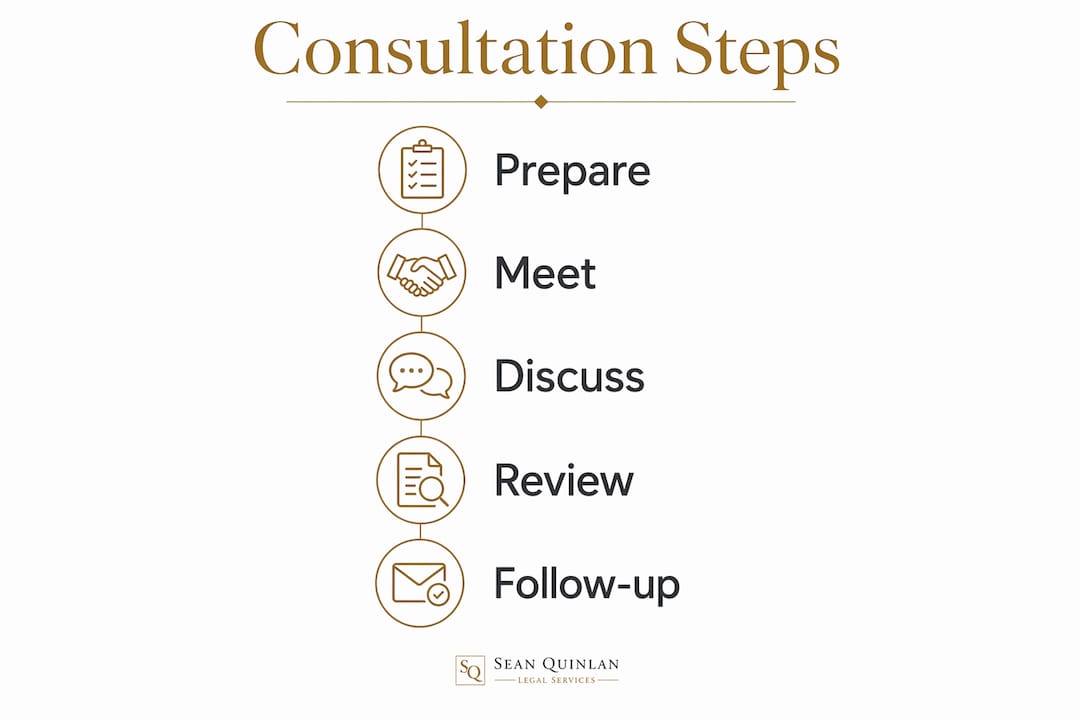
Here is how a typical accident consultation unfolds:
-
Arrive with your documents and a prepared list of questions. Review your written timeline the night before. Bring printed or digital copies of every document from your preparation checklist. Having questions written down signals to your attorney that you are engaged and helps you remember what to ask under stress.
-
Share your account of the accident clearly and factually. Your attorney will ask you to describe what happened in your own words. Stick to facts you observed directly. Avoid speculation about fault or the other driver's intent, as those assessments belong to the legal process.
-
Respond to the attorney's follow-up questions. The attorney will probe for details about the sequence of events, road conditions, witness presence, and the timeline of your medical treatment. These questions build the factual foundation of your case. Answer honestly, including details that seem unfavorable to you.
-
Listen to the attorney's initial case assessment. After gathering facts, the attorney will explain whether your situation presents a viable claim, what legal theories apply, and what the realistic range of outcomes looks like. This is not a guarantee of results. It is an informed professional opinion based on the facts you have provided.
-
Discuss the legal process, timelines, and next steps. Pennsylvania's statute of limitations for personal injury claims is two years from the date of the accident. Your attorney will explain what needs to happen within that window and what immediate actions are most urgent.
-
Review and understand the fee agreement. Most personal injury attorneys in Central Pennsylvania work on a contingency fee basis, meaning you pay nothing unless you recover compensation. Confirm the percentage, what expenses are deducted, and under what circumstances the agreement can be terminated.
-
Ask every question you have about claim value and process. Review the questions to ask before hiring an attorney so you leave the meeting with a clear picture of what comes next.
Common mistakes to avoid during accident consultations and claims
Errors made in the days surrounding a consultation can permanently reduce your compensation. These are the most damaging mistakes accident victims in Cumberland County and across Pennsylvania make:
- Giving a recorded statement to the opposing insurance company without legal advice. Adjusters are trained to ask questions that produce answers they can use to minimize your payout. You are not legally required to give a recorded statement to the other driver's insurer.
- Admitting fault or speculating on liability. Even a casual "I'm sorry" at the scene can be used against you. Liability is a legal determination, not a conversational one.
- Failing to notify your own insurance company promptly. Insurance notification deadlines typically run from 24 hours to 7 days depending on your policy. Missing this window can complicate or void your own coverage.
- Skipping or delaying medical evaluation. Gaps in medical care give insurers grounds to argue your injuries are not serious or are unrelated to the accident.
- Accepting an early settlement offer without legal review. Early settlement offers frequently undervalue claims, sometimes significantly. Once you accept and sign a release, you cannot pursue additional compensation regardless of how your injuries progress.
- Poor document organization and missed deadlines. Losing a receipt, missing a filing deadline, or failing to respond to an insurer's request can derail an otherwise strong claim.
"Insurance adjusters often seek early quick settlements that undervalue claims. An attorney can help evaluate the true worth of your claim before you sign anything."
Pro Tip: Do not post anything about the accident, your injuries, or your recovery on social media. Defense attorneys and insurance investigators routinely monitor claimants' profiles, and a single photo or comment can contradict your stated injuries.
How to follow up after an accident consultation to maximize your claim
The work does not stop when the consultation ends. What you do in the days and weeks following your meeting shapes the credibility and value of your claim.
-
Schedule a medical evaluation within 24 to 72 hours if you have not already done so. Medical evaluation within this window is the standard recommendation even when injuries are not immediately apparent. Delayed symptoms, particularly for whiplash, concussion, and soft tissue injuries, are common after crashes.
-
Notify your insurance provider. Contact your insurer promptly after the consultation if you have not already reported the accident. Confirm the claim number and the adjuster assigned to your file.
-
Preserve and organize all correspondence. Save every email, letter, and text message related to the accident. Create a physical or digital log of every phone call, including the date, time, caller name, and summary of the conversation.
-
Attend every scheduled medical appointment. Missing medical appointments gives insurers grounds to argue your injuries are less severe than claimed. Consistent treatment is both medically necessary and legally protective.
-
Monitor your claim status and follow your attorney's instructions. Check in with your legal team at agreed intervals. If an adjuster contacts you directly after you have retained an attorney, refer them to your attorney immediately.
The table below summarizes the critical post-consultation timeline:
| Action | Recommended timeframe |
|---|---|
| Medical evaluation | Within 24 to 72 hours of the accident |
| Insurance notification | Within 24 hours to 7 days per policy terms |
| Evidence preservation (footage) | Within 24 to 72 hours before overwrite |
| Attorney follow-up communication | Within 48 hours of consultation |
| Ongoing medical treatment | Continuous until discharge |
For a broader overview of what to do immediately after a crash, the post-accident step guide from WreckMatch covers the immediate scene response in detail.
Key takeaways
A successful accident claim depends on preparation before the consultation, disciplined follow-through after it, and avoiding the documentation and communication errors that insurers exploit.
| Point | Details |
|---|---|
| Prepare documents in advance | Gather police reports, medical records, photos, and insurance communications before your consultation. |
| Understand the consultation's purpose | The first meeting is fact-finding and education, not immediate strategy or settlement negotiation. |
| Avoid recorded statements | Never give a recorded statement to the opposing insurer without attorney guidance. |
| Seek medical care promptly | A medical evaluation within 24 to 72 hours establishes causation and protects claim credibility. |
| Follow up consistently | Attend all medical appointments and maintain organized records to prevent insurers from reducing your compensation. |
What I've learned from watching clients walk into consultations unprepared
After years of working with accident victims across Harrisburg, Camp Hill, and York County, the pattern is consistent. The clients who walk in with a cloud folder of organized documents, a written timeline, and a list of questions leave the consultation with a clear plan. The clients who arrive with a vague memory of the crash and no paperwork leave with uncertainty and more work to do before the case can move forward.
The most common surprise I see is the reaction when clients learn that the first consultation is not the moment their attorney files the case or calculates a settlement number. The consultation is a two-way exchange of information. Your attorney needs facts from you before they can give you anything useful in return. Clients who understand this dynamic contribute better information and ask sharper questions.
The second surprise is how often clients have already damaged their claim before they arrive. A recorded statement given to the opposing insurer, a social media post about the accident, or a gap in medical treatment can all reduce what you recover. None of these mistakes are irreversible, but they all require additional work to address.
Treat the consultation as a professional meeting where your preparation directly determines the quality of the advice you receive. The accident consultation guide for Pennsylvania victims outlines exactly what to bring and what to expect. Use it before you walk in the door.
— Atry. Sean Quinlan
Get expert accident consultation help in Central Pennsylvania
If you were involved in an auto accident in Harrisburg, Camp Hill, Cumberland County, Dauphin County, or York County, Pennsylvania DUI Attorney provides free initial consultations with attorney Sean P. Quinlan, who handles auto accident and personal injury claims on a contingency fee basis. You pay nothing unless your case results in a recovery.

Sean Quinlan's team understands the local court systems, insurance practices, and legal timelines specific to Central Pennsylvania. Whether you are dealing with a disputed liability claim, a lowball settlement offer, or injuries that appeared days after the crash, the firm offers the auto accident legal representation and personal injury claim guidance you need to protect your rights. Contact Pennsylvania DUI Attorney today to schedule your consultation and take the first concrete step toward fair compensation.
FAQ
What is an accident consultation?
An accident consultation is a structured meeting between an accident victim and an attorney or insurance representative to review the facts of a crash, assess claim viability, and explain the legal process. The primary purpose of the first meeting is fact-finding and client education, not immediate strategy or settlement calculation.
What documents should I bring to my accident consultation?
Bring your police report or report number, photos of the scene and injuries, medical records and bills, insurance policy documents, claim numbers, adjuster contact information, and a written personal timeline of the accident and its effects on your daily life.
How soon should I see a doctor after a car accident?
Seek a medical evaluation within 24 to 72 hours of the accident, even if you feel no immediate pain. Delayed symptoms are common with soft tissue injuries and concussions, and early medical records establish the causal link between the crash and your injuries.
Can I talk to the other driver's insurance company before consulting an attorney?
You are not legally required to give a recorded statement to the opposing insurer, and doing so before consulting an attorney carries significant risk. Insurance adjusters are trained to ask questions that can minimize your claim value. Consult an attorney first.
How long do I have to file an accident claim in Pennsylvania?
Pennsylvania's statute of limitations for personal injury claims is generally two years from the date of the accident. Missing this deadline forfeits your right to seek compensation, so consulting an attorney promptly after a crash is critical.