

After a car accident in Pennsylvania, your financial recovery depends less on what happened at the scene and more on how well you build and present your claim. Most accident victims assume that having a police report and a few medical bills is enough. It isn't. Insurance adjusters and defense attorneys are trained to find gaps, inconsistencies, and missing evidence that reduce what you receive. This guide walks you through every preparation step needed for a successful accident case evaluation, from the first documents you gather to the expert opinions that can make or break your claim.
Table of Contents
- What you need before an accident case evaluation
- Step-by-step guide to preparing your Pennsylvania accident case
- Causation: The critical factor in Pennsylvania accident claims
- How expert testimony and clinical proof affect your case
- Troubleshooting common mistakes and ensuring a solid claim
- Our perspective: What most accident case guides don't tell you
- Get expert help with your accident evaluation
- Frequently asked questions
Key Takeaways
| Point | Details |
|---|---|
| Gather evidence early | Collect every document, bill, and record related to the accident for strong claim preparation. |
| Show clear causation | Your materials must prove a direct link between the accident and your injuries to succeed in Pennsylvania. |
| Timeline matters | Include a detailed timeline of events, symptoms, and treatments to support your claim’s credibility. |
| Expert input strengthens claims | Professional opinions and clinical data often determine the outcome of tough accident evaluations. |
| Avoid common errors | Missed documentation or unclear narratives can lead to delays or lower compensation. |
What you need before an accident case evaluation
A strong accident case evaluation begins with one thing: organization. Before you sit down with an attorney or face an insurance adjuster, you need a complete file that addresses every dimension of the incident.
According to checklist guidance from FindLaw, providing detailed information about the accident, injuries, medical treatment, insurance, and financial losses is essential for any attorney evaluation. Medical bills, treatment records, and insurance policy details are specifically called out as foundational materials. That advice reflects what experienced Pennsylvania attorneys consistently see missing when clients arrive unprepared.
Here are the core categories of materials you should gather:
- Accident documentation: Police or crash report, location details, weather and road conditions, photos from the scene, and any dashcam footage
- Medical records: Emergency room reports, physician notes, imaging results (X-rays, MRIs), physical therapy records, and specialist consultations
- Financial loss evidence: Medical bills, prescription receipts, vehicle repair estimates, rental car costs, and lost wage verification from your employer
- Insurance information: Your own policy (including whether you selected limited or full tort coverage in Pennsylvania), the other driver's insurance details, and any correspondence with insurers
- Witness information: Names, phone numbers, and written or recorded statements from anyone who saw the crash
Understanding why each document matters is just as important as collecting it. Medical records don't just prove you were injured. They establish a timeline between the accident and your diagnosis, which is central to proving causation. Financial records quantify your damages, and without them, even a strong liability case can result in a low settlement.
For additional context on protecting your rights from the very beginning, reviewing legal tips after a car accident is a smart early move.
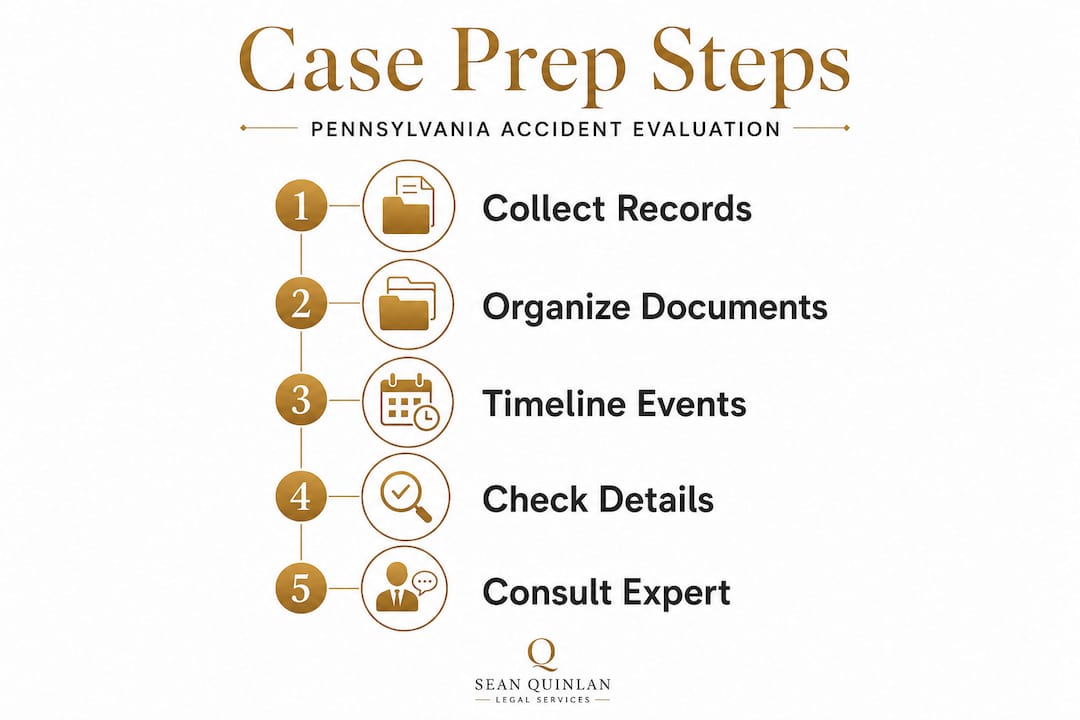
Pro Tip: Create a dedicated folder, either physical or digital, the same day as your accident. Label subfolders by category: medical, financial, accident facts, and correspondence. Every time a new document arrives, it goes straight in. This habit saves hours of scrambling later and signals to your attorney that you are a reliable, organized client.
Key documents at a glance
| Document type | What it proves | Why it matters |
|---|---|---|
| Police report | Fault, scene details | Establishes official accident record |
| Medical records | Injury and treatment | Links injuries directly to the accident |
| Medical bills | Economic damages | Quantifies compensation needed |
| Lost wage proof | Income disruption | Supports lost earnings claim |
| Insurance policies | Coverage limits | Identifies available compensation sources |
| Witness statements | Third-party corroboration | Strengthens liability narrative |
Getting guidance early on choosing an accident attorney can help you understand what a Pennsylvania lawyer will look for when they review your file.
Step-by-step guide to preparing your Pennsylvania accident case
With documentation gathered, the next step is structuring your materials in a way that makes the attorney's job easier and your case stronger. Here's a practical walk-through.
-
Obtain the official police crash report. In Pennsylvania, you can request this from the investigating law enforcement agency or through PennDOT. The report contains critical facts including fault notations, witness names, and the officer's narrative.
-
Request all medical records promptly. Contact every provider who treated you and request complete records, not just summaries. Include imaging reports, operative notes if applicable, and any referrals. Gaps in treatment records are frequently used by insurers to argue that injuries weren't serious.
-
Document every expense related to the accident. Keep a running spreadsheet. Include co-pays, medication costs, transportation to appointments, home care expenses, and any assistive devices. Nothing is too small to document.
-
Gather proof of lost income. A letter from your employer confirming missed workdays and your hourly rate or salary is standard. Self-employed individuals need tax returns and client invoices showing income disruption.
-
Compile photos and videos. Ideally you captured these at the scene, but accident scene photos can also come from traffic cameras, business surveillance, or witnesses. Vehicle damage photos taken shortly after the crash are especially useful.
-
Record witness contact information. If witnesses have not already given statements, reach out and ask them to put their observations in writing. Even a simple email summarizing what they saw can carry evidentiary weight.
-
Create a medical treatment log. Note every appointment, the provider's name, what was discussed, and any changes in your condition. This personal log fills gaps between formal records and helps establish a continuous treatment narrative.
The auto injury compensation process in Pennsylvania has several unique features, including the tort election system, that affect how your claim is valued. Knowing those rules before your consultation puts you ahead.
Preparing for your attorney vs. the insurance adjuster

| Preparation element | Attorney consultation | Insurance adjuster meeting |
|---|---|---|
| Goal | Build your strongest legal claim | Assess liability and minimize payout |
| Key focus | Causation, damages, legal strategy | Policy limits, fault allocation |
| What they examine first | Timeline, injury severity, documentation gaps | Inconsistencies, pre-existing conditions |
| What helps most | Organized records, clear narrative | Consistent, documented statements |
| Risk if unprepared | Weak case, reduced compensation | Recorded statements used against you |
Pro Tip: Attorneys look at your packet within the first few minutes and notice three things immediately: whether the timeline is clear, whether medical treatment was continuous, and whether any obvious losses lack documentation. If you can answer those three questions with organized paperwork, you are already ahead of most claimants.
Causation: The critical factor in Pennsylvania accident claims
Gathering documents is necessary but not sufficient. The real battleground in many Pennsylvania accident cases is causation, meaning whether the accident directly caused your injuries.
Courts and insurance companies don't simply accept that a car crash caused your back pain or shoulder injury. They probe whether the injury existed before the accident, whether something else could have caused it, and whether the claimed severity is consistent with the mechanics of the crash. As causation analysis in orthopedic injury cases demonstrates, Pennsylvania claim evaluation places strong emphasis on causation proof, especially where injuries may be degenerative or multi-factor, often requiring expert analysis to bridge the evidentiary gap between clinical findings and the crash timeline.
The core legal test: To prove causation in a Pennsylvania personal injury claim, you must show that the accident was a substantial contributing factor to your injuries. This is a higher bar than simply showing the accident and the injury occurred around the same time.
Several factors are examined closely:
- Timing of symptom onset: Did you report pain at the scene or shortly after? Delayed onset can invite skepticism, even though it's medically common.
- Consistency of complaints: Did you report the same symptoms throughout treatment, or did new injuries appear much later?
- Anatomical plausibility: Are your injuries consistent with the forces involved in the crash? A low-speed fender-bender and a claimed severe spinal injury will face greater scrutiny.
- Pre-existing conditions: If you had prior injuries or degenerative conditions, insurers may argue the accident merely "aggravated" an existing problem rather than causing harm.
- Diagnostic imaging: MRI and X-ray results that correspond to the accident mechanism significantly strengthen the causation argument.
Understanding these factors is part of building your claim intelligently. Reviewing key personal injury legal terms before your evaluation will help you communicate clearly with your attorney about these concepts.
How expert testimony and clinical proof affect your case
When causation is genuinely in dispute, expert testimony often becomes the deciding factor. Courts and insurance companies don't just weigh the expert's conclusion. They evaluate the reliability of the methodology used to reach it.
A credible expert opinion must be anchored in objective clinical evidence and recognized clinical methods. As expert causation reliability standards confirm, expert medical causation opinions are assessed for reliability based on methodology and fit to the specific facts of the case. An expert who simply says "the accident caused this injury" without connecting imaging results, exam findings, and symptom timelines will be challenged and potentially disqualified.
Here is what makes expert testimony credible and useful in your case:
- Methodology transparency: The expert explains clearly how they reached their conclusion, not just what it is.
- Objective anchoring: Opinions grounded in MRI findings, clinical examination results, and documented symptom progression are far harder to attack.
- Timeline alignment: The expert's narrative must match the documented sequence of events from accident date through diagnosis and treatment.
- Consistency with peer-reviewed standards: Experts who rely on recognized clinical guidelines and published research carry more weight with judges and adjusters.
- No overreach: An expert who claims certainty beyond what the evidence supports often does more harm than good. Measured, well-supported conclusions are more persuasive.
Statistic to consider: Research consistently shows that when expert medical causation is clearly and credibly presented, claim values increase substantially compared to cases where causation is disputed without expert support. Linking injuries to an accident with precision often determines not just whether you receive compensation, but how much.
Knowing how that compensation is calculated is equally important. The details are covered in the accident compensation calculation guide, which walks through economic and non-economic damages specific to Pennsylvania claims.
Troubleshooting common mistakes and ensuring a solid claim
Even well-intentioned claimants make errors that cost them. Knowing the most frequent mistakes helps you avoid them before they affect your outcome.
The most common problems include:
- Missing or incomplete documentation: Failing to obtain all medical records, especially from specialists or facilities where you received imaging, leaves gaps that insurers exploit.
- Unclear injury timelines: If your records don't clearly show when each symptom appeared and how it progressed, insurers argue the injury predates the accident.
- Inconsistent statements: Giving a recorded statement to an insurance adjuster before consulting an attorney can result in being locked into an account that conflicts with your later medical records.
- Gaps in treatment: Extended periods where you didn't seek medical care are interpreted as evidence that your injury wasn't as serious as claimed.
- Unreported losses: Many claimants forget to claim out-of-pocket transportation costs, home assistance expenses, or losses related to cancelled life events.
As causation timeline methodology makes clear, building a defensible causation narrative requires using a detailed timeline that compares early complaints, imaging results, and exam findings with later diagnoses. This process, which attorneys call timeline reconstruction, is as important as any legal argument.
Pro Tip: Build a visual timeline on a single page that plots the accident date, every medical visit, every diagnosis, every treatment, and every expense. When an attorney or insurer sees this, they immediately understand your claim. It also reveals gaps you can address before the evaluation.
If you're unsure whether your situation warrants professional assistance, the guidance on seeking legal advice after an accident is worth reviewing before you make any decisions.
Our perspective: What most accident case guides don't tell you
Most accident guides focus on documentation checklists, and those lists are genuinely useful. But in practice, what separates claims that settle well from claims that stall or fail isn't the volume of paperwork. It's the clarity and internal consistency of the story your evidence tells.
Insurers and judges are looking for the same thing: a coherent, plausible narrative where every piece of evidence points in the same direction. The moment a record contradicts your account, even in a minor way, the entire claim loses credibility. That's not a legal technicality. It's human nature applied to adversarial evaluation.
The hardest lesson we've seen Pennsylvania accident victims learn is this: regular medical follow-up matters as much as legal strategy. Clients who attend every appointment, follow treatment plans, and document their progress consistently create a record that is almost impossible to attack. Clients who skip appointments or stop treatment when they feel slightly better create the impression that they weren't seriously injured.
Your PA accident recovery guide should emphasize this point, because no attorney, no matter how skilled, can fully compensate for a fragmented or inconsistent medical record. The strongest legal arguments are the ones supported by clear, continuous, well-documented evidence.
Build that record from day one. It is the single most valuable thing you can do for your claim.
Get expert help with your accident evaluation
Following these steps significantly improves your chances of a successful claim. But even the most organized claimant can miss critical legal nuances specific to Pennsylvania. Professional legal guidance prevents costly errors and ensures your claim reflects its full value.

If you were injured in a Pennsylvania auto accident, an experienced attorney can review your documentation, identify causation gaps, and guide you through negotiation or litigation. At pennsylvaniadui.attorney, you can access Pennsylvania personal injury law services tailored to your situation, including a full case evaluation. The team also handles auto accident legal help for victims facing complex liability disputes or serious injury claims. Whether your case involves a traffic collision, an injury dispute, or related DUI and traffic defense matters, the attorneys here are equipped to assess your situation and fight for the outcome you deserve.
Frequently asked questions
What documents do I need for an accident case evaluation in Pennsylvania?
You need your accident report, medical treatment records, proof of income loss, insurance policies, and receipts for all related bills or repairs. As confirmed by attorney checklist guidance, detailed information across all these categories is essential for an effective evaluation.
Why is causation often disputed in Pennsylvania accident claims?
Causation is critical because insurance companies and courts require clear proof that your injuries were directly caused by the accident, not by pre-existing or unrelated factors. Causation analysis standards in Pennsylvania often require expert analysis when injuries involve degenerative conditions or complex timelines.
How can expert witnesses help my accident case?
Experts link your medical findings to the accident, explain symptom timing, and use objective clinical evidence, making your claim more credible and defensible. Their reliability and methodology are assessed carefully by courts and insurers.
What common mistakes delay or weaken accident claims?
Missing documentation, unclear injury timelines, and incomplete expense proof often slow claims or reduce potential compensation. Building a detailed causation timeline that aligns early complaints with later diagnoses is the most effective way to counter these weaknesses.
Can I prepare my claim without an attorney?
You can organize all required evidence and build a timeline yourself, but an attorney helps ensure nothing is missed and substantially improves your chances of receiving full compensation for your losses.