

After an accident, the pain, confusion, and financial pressure can hit all at once, leaving you unsure where to even begin. Walking into a legal consultation without preparation only adds to that stress, and it can slow down the attorney's ability to help you. This guide walks you through exactly what documents to gather, how to tell your story clearly, what questions to ask, and what to expect from start to finish, so you can show up confident, informed, and ready to get the legal support you deserve.
Table of Contents
- Why preparation matters for your first consultation
- Essential items and information to bring
- How to share your story accurately and completely
- What to expect during and after your consultation
- A tested approach: What really makes a consultation successful
- Connect with experienced personal injury support in Pennsylvania
- Frequently asked questions
Key Takeaways
| Point | Details |
|---|---|
| Preparation is key | Gather your documents and organize accident details to maximize your consultation's value. |
| Bring essential records | Medical reports, insurance papers, and accident details help your attorney assess your case efficiently. |
| Ask clear questions | Be ready to discuss your needs and ask anything you don't understand to get the best support. |
| Honesty matters | Tell your story as accurately as possible for a fair evaluation and strong legal representation. |
Why preparation matters for your first consultation
Many people assume the attorney handles everything from the first minute. In reality, the quality of guidance you receive depends heavily on what you bring to the table. When you arrive prepared, your attorney can spend time on strategy and legal analysis rather than filling in basic gaps about what happened.
"Attorneys in Pennsylvania can best evaluate your case and advise you if you provide full details and key documents." This principle shapes every effective consultation.
Understanding why legal advice protects your rights after an accident is the first step. When you know what's at stake, the motivation to prepare becomes clear. A well-prepared client signals to the attorney that the case is worth investing time in, and it sets a cooperative, focused tone for everything that follows.
Here is why preparation makes a measurable difference:
- It allows the attorney to focus on the strength and weaknesses of your case immediately
- It reduces the number of follow-up meetings needed before moving forward
- It gives your attorney a clearer picture of damages, liability, and evidence
- It helps you feel more in control during what is often a stressful meeting
What a personal injury attorney does goes well beyond filing paperwork. They evaluate evidence, assess liability, calculate damages, and negotiate with insurers. Each of these tasks becomes faster and more accurate when you come ready.
Pro Tip: Write down a brief timeline of your accident before you arrive. Include the date, time, location, what you were doing, how the incident happened, and what immediate steps you took. Even rough notes are more useful than relying on memory alone during a stressful meeting.

Now that you understand the value of proper preparation, let's review what you'll need to bring to your consultation.
Essential items and information to bring
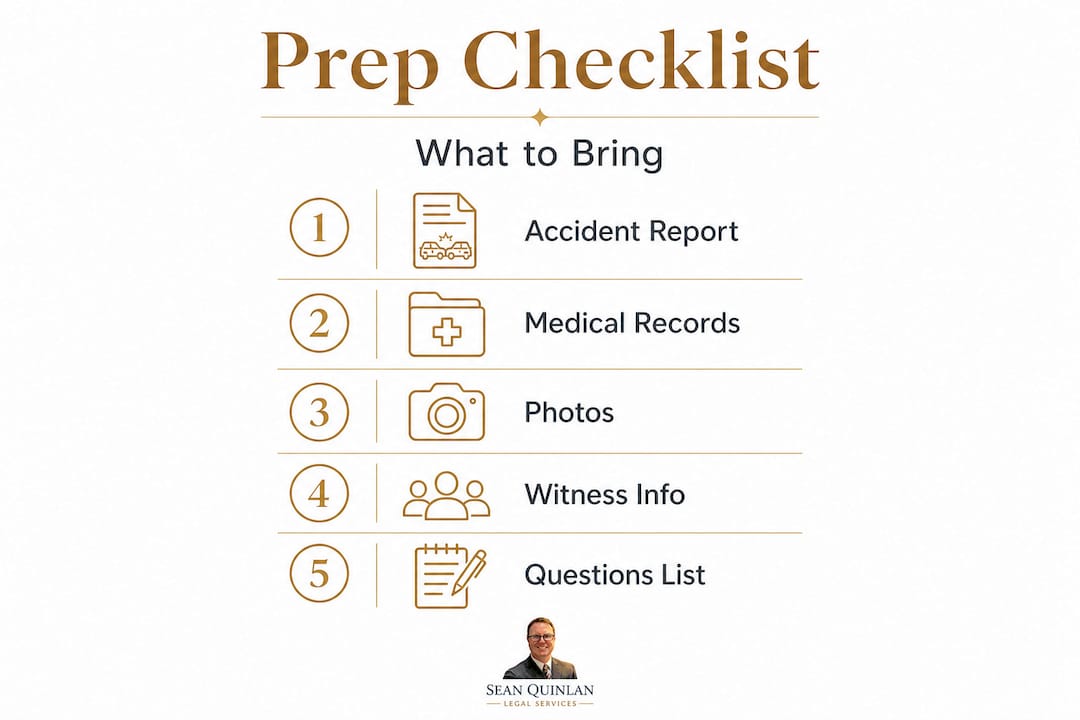
Gathering the right documents before your consultation is one of the single most impactful things you can do for your case. Bringing medical records, accident reports, witness contact info, and insurance documents helps your attorney start your case on solid footing from the very first meeting.
Below is a practical reference table for what to bring and why each item matters.
| Document or item | What it is | Why it matters |
|---|---|---|
| Accident or police report | Official record of the incident | Establishes basic facts and any citations issued |
| Medical records and bills | Treatment notes, diagnoses, invoices | Proves injury causation and quantifies damages |
| Photographs of the scene | Images of vehicles, injuries, road conditions | Visual evidence supports your account of events |
| Insurance documents | Your policy and any correspondence | Shows coverage, claim status, and communication trail |
| Witness contact information | Names, phone numbers, addresses | Allows attorney to follow up with supporting testimony |
| Employment and wage records | Pay stubs, employer letters | Documents lost income due to injury |
| Written communications | Texts, emails with insurers or other parties | Can reveal admissions or dispute facts |
| Prescription records | Pharmacy receipts or records | Supports ongoing medical treatment claims |
Review legal tips after a car accident for additional guidance on what steps to take in the days immediately following an incident, including preserving evidence before it disappears.
Here is a quick checklist you can use before your appointment:
- Police or accident report
- All medical records and bills related to the injury
- Photos and videos from the scene or afterward
- Insurance policy documents and claim correspondence
- Witness names and contact details
- Pay stubs or income records if you missed work
- Any written communications about the accident
- A personal written summary of the incident timeline
Using the personal injury legal guide can help you understand common legal terms you may encounter during your consultation, so nothing catches you off guard.
Pro Tip: Organize all documents in a labeled folder or three-ring binder before your appointment. Arrange them in the order listed above, with the accident report on top. This small step saves real time during the consultation and shows your attorney you are serious about your case.
With your essentials in hand, you're almost ready. Now let's explore how to prepare your case story and details for your attorney.
How to share your story accurately and completely
Even with a full folder of documents, how you communicate what happened is just as important. Attorneys rely on a clear, factual account to identify legal theories, spot liability issues, and evaluate what your case may be worth. Giving your lawyer a detailed sequence of events, symptoms, and damages helps them evaluate your legal options with confidence.
Follow these steps to organize your account before the consultation:
- Before the incident: Describe where you were going, what you were doing, and the conditions at the time, such as weather, lighting, and road conditions.
- During the incident: Explain exactly what happened, step by step. Stick to what you saw, heard, or felt. Avoid speculation about what the other party was thinking.
- Immediately after: Note what was said, who arrived at the scene, whether police were called, and any first aid or medical attention you received.
- In the days and weeks following: Document all medical appointments, symptoms you experienced, work you missed, activities you could no longer do, and how the injury affected your daily life.
- Ongoing impact: If you still have symptoms or limitations at the time of the consultation, describe them clearly. Ongoing pain, reduced mobility, or emotional distress are all legally relevant damages.
Your attorney will likely ask questions such as:
- Were there any witnesses present?
- Did you receive a diagnosis from a doctor, and if so, what was it?
- Have you already spoken with the other party's insurance company?
- Did you sign any documents or provide a recorded statement to an insurer?
- Are you still receiving medical treatment?
Knowing your rights in a personal injury case is essential before answering questions from insurance adjusters on your own. Speaking to an attorney first, before making statements to insurers, protects your position. Understand your options for protecting your rights after an accident in Pennsylvania before taking any action that could affect your claim.
Pro Tip: Avoid exaggerating symptoms or guessing at facts you are not sure about. Overstating your case, even unintentionally, can damage your credibility later. Stick to what you know, and if you are unsure about something, say so. Attorneys respect honesty far more than a polished but inaccurate account.
Once your story is clear and documented, you'll want to know what happens next in the consultation and how to make the most of it.
What to expect during and after your consultation
For many people, the consultation itself is an unknown, and uncertainty breeds anxiety. Understanding the consultation process can help clients feel more confident and ready to engage productively. Here is a direct comparison of two consultation experiences.
| Scenario | Unprepared client | Prepared client |
|---|---|---|
| Time spent | Much of the meeting filling in basic facts | Focused on legal strategy from the start |
| Attorney assessment | Incomplete, may require follow-up meeting | Thorough, based on full picture of facts |
| Next steps | Delayed while gathering missing documents | Clear action plan outlined during the meeting |
| Client confidence | Often leaves feeling more confused | Leaves with specific direction and answers |
| Case momentum | Slow to build | Immediate progress toward filing or settlement |
"Walking into a consultation prepared is not just about impressing your attorney. It is about making sure you walk out with real answers and a clear path forward."
During the meeting, the role of your attorney is to listen, ask targeted questions, and assess whether you have a viable claim. They will not promise outcomes, but they will give you an honest read on the strength of your case.
Here are key questions you should ask your attorney during the consultation:
- What is your assessment of the strength of my case?
- What damages can I potentially recover, including medical bills, lost wages, and pain and suffering?
- What is the statute of limitations for my type of claim in Pennsylvania?
- What are the likely next steps if we move forward?
- How do you communicate with clients throughout the case?
- Do you handle cases on a contingency fee basis, meaning no fees unless you win?
After the consultation, expect the attorney to request additional documents, review what you provided, and follow up within a few days. Some cases move toward a demand letter or settlement negotiation quickly, while others require further investigation. Be responsive, stay organized, and ask questions whenever something is unclear.
Understanding what to expect can set your mind at ease. Here is our candid take on what works and what does not.
A tested approach: What really makes a consultation successful
Here is something most legal guides will not tell you directly: over-preparation is almost never a problem. In years of working with injured Pennsylvanians, the cases that stall early are not the ones with too much information. They are the ones where critical details were never documented, where the client waited too long to seek counsel, or where important questions went unasked out of fear or uncertainty.
Honesty is the single most underrated quality a client can bring to a consultation. Attorneys are not judges. Their job is to understand what happened and build the strongest possible case from the actual facts. If there are complicating details, such as a prior injury, a gap in medical treatment, or a statement already made to an insurer, tell your attorney upfront. Surprises discovered later are far more damaging than uncomfortable truths shared early.
Another pattern worth noting is that clients who bring up tough questions early, including questions about liability, comparative negligence, or prior accidents, actually make the attorney's job easier. It signals that you are engaged, realistic, and ready to participate in your own case. That kind of client legal empowerment builds the attorney-client relationship from a foundation of trust, not guesswork.
Most people walk into a consultation thinking they need to present a perfect story. What you actually need is a complete and honest one.
Pro Tip: Make two lists before your meeting. The first is your "must know" list: answers you absolutely need from the attorney before you leave. The second is your "want to ask" list: questions that are important but less urgent. This keeps the meeting focused and ensures nothing you truly need gets skipped.
Connect with experienced personal injury support in Pennsylvania
If you have been injured in an accident and want to make sure your first consultation counts, the right legal team can make all the difference.

At pennsylvaniadui.attorney, Sean Quinlan and the team offer personalized support for injured Pennsylvanians across multiple counties. Whether you need help with personal injury representation after a car accident or need guidance on complex tractor trailer accident claims, the office provides free case evaluations so you can get real answers without financial pressure. Reach out today and take the first concrete step toward protecting your rights and your recovery.
Frequently asked questions
What questions will the lawyer ask during my consultation?
The lawyer will likely ask about the details of the accident, your injuries, the treatment you received, and what evidence you brought. Attorneys gather facts and documents to evaluate your legal options and determine the viability of your claim.
Are personal injury consultations free in Pennsylvania?
Most personal injury consultations are free, but confirm this with the attorney's office when scheduling.
How long does a first consultation usually last?
A first consultation typically lasts between 30 minutes and one hour, depending on case complexity.
Should I bring witnesses or have them available?
It is best to bring contact information for witnesses so your attorney can follow up if needed. Witness information is critical for your attorney's initial case review and can significantly strengthen your claim.
Can I have a family member attend my consultation?
Yes, you can bring a family member for support, but be sure to share the details of your case directly with the attorney to maintain clear and accurate communication.