

If you've been charged with a DUI in Pennsylvania, you may assume the breathalyzer reading sealed your fate. That assumption leads many people to give up before the fight has even started. The role of evidence in DUI defense is far more layered than a single test result. Chemical tests, officer conduct, video footage, witness accounts, and procedural compliance all shape what the prosecution can actually prove. Understanding how evidence works gives you the power to participate meaningfully in your own defense rather than leave everything to chance.
Table of Contents
- Key takeaways
- The role of evidence in DUI defense cases
- Evidence types commonly used in Pennsylvania DUI cases
- How evidence quality and handling affect your case
- DUI defense strategies built around evidence
- Working with your attorney on evidence
- What I've seen defendants get wrong about DUI evidence
- Let an experienced attorney review your DUI evidence
- FAQ
Key takeaways
| Point | Details |
|---|---|
| Evidence goes beyond breath tests | Chemical results are just one piece; video, witness statements, and officer conduct all matter. |
| Procedural errors can suppress evidence | Unlawful stops or mishandled samples can make key prosecution evidence inadmissible. |
| Timing is critical in evidence defense | Early discovery requests and suppression motions protect your rights before opportunities close. |
| Medical factors affect test accuracy | Conditions like acid reflux or diabetes can produce false positives on chemical tests. |
| Attorney involvement changes outcomes | A skilled DUI attorney can identify evidence weaknesses you would never spot on your own. |
The role of evidence in DUI defense cases
The role of evidence in DUI cases operates on two levels simultaneously. The prosecution uses it to build what lawyers call a prima facie case, meaning enough proof on its face to support a conviction. Your defense uses it to find gaps, procedural failures, and factual inconsistencies that create reasonable doubt. Pennsylvania DUI law operates under Title 75 of the Vehicle Code, and prosecutors typically need to establish that you were operating a vehicle while impaired or while exceeding the legal blood alcohol concentration (BAC) threshold.
What most people don't realize is that the prosecution rarely wins on evidence alone. They win when the defense fails to scrutinize that evidence. Every piece of documentation, every recorded test, and every officer action taken during your stop is a potential point of challenge.
Evidence types commonly used in Pennsylvania DUI cases
Pennsylvania prosecutors draw from several categories of evidence, and knowing each one helps you understand where a defense can take hold.
Chemical test results are the most recognized form of evidence in DUI cases. Pennsylvania uses a tiered BAC system. A reading of 0.08% qualifies as a general impairment charge, 0.10% triggers a high rate of alcohol charge, and 0.16% or above constitutes the highest rate. Breath, blood, and urine tests each carry different reliability concerns. Blood tests are considered the most accurate but are also the most vulnerable to chain of custody challenges.
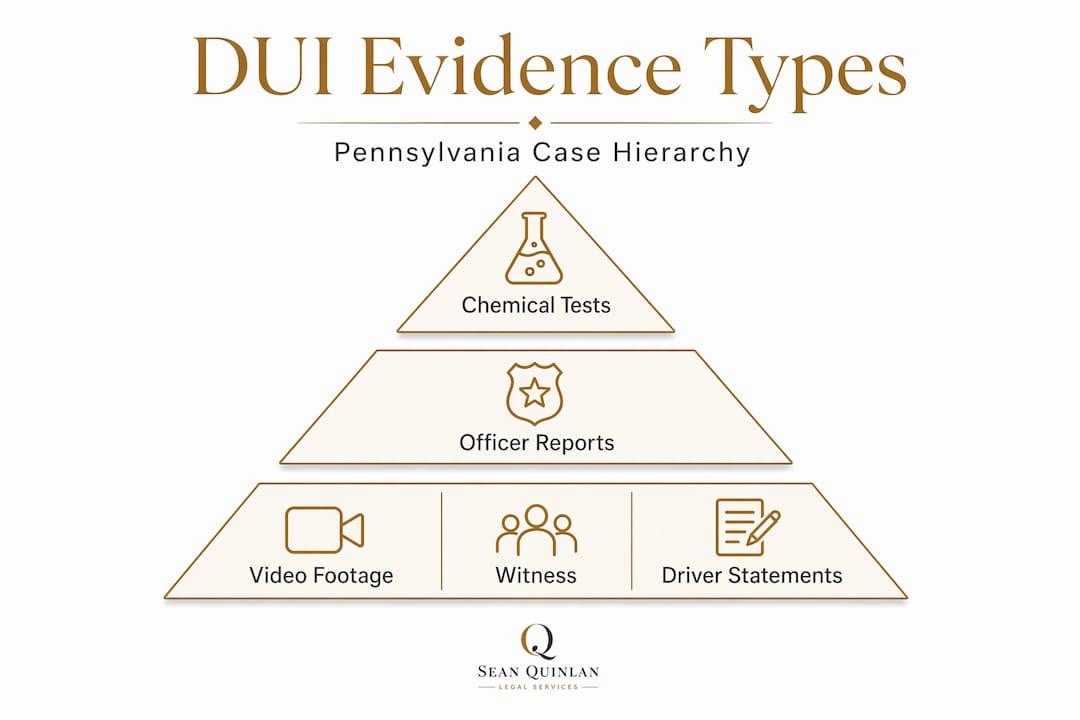
Officer observations are more subjective than most people expect. The arresting officer's report will describe slurred speech, bloodshot eyes, the odor of alcohol, and any other signs of impairment. These notes become the narrative the prosecution builds around the chemical results. But officer observations are recorded from memory, often after the fact, and can be contradicted.
Video evidence has changed DUI defense significantly. Dashcam and body camera footage can either corroborate or directly contradict officer testimony about impairment. Cases where officers report visibly unsteady walking or slurred speech, but the footage shows nothing of the sort, have led to charges being reduced or dismissed.
Here is a comparison of common evidence types and their defense vulnerability:
| Evidence type | Prosecution use | Common defense challenge |
|---|---|---|
| Breathalyzer result | Establish BAC level | Calibration errors, mouth alcohol, medical conditions |
| Blood/urine sample | Confirm chemical impairment | Chain of custody, lab handling errors |
| Field sobriety test | Show physical impairment | Environmental conditions, officer training |
| Dashcam/bodycam footage | Support officer account | May contradict officer narrative |
| Witness statements | Corroborate stop and behavior | Credibility, limited vantage point |
| Driver's own statements | Establish admissions | Miranda violations, coercion |
Witness statements from passengers, bystanders, or establishment staff can provide context the prosecution did not anticipate. Witness testimony can establish a timeline, confirm what you consumed and when, or contradict the officer's characterization of your behavior. The role of witness testimony in DUI cases is often underestimated by defendants.
Driver statements are powerful and frequently misunderstood. Statements made during a stop can significantly affect both charge severity and defense options. If those statements were taken without a proper Miranda warning or after an unlawful detention, they may be excluded from trial entirely.
How evidence quality and handling affect your case
Not all evidence arrives in court with equal credibility. How evidence was gathered, stored, and documented determines whether it can legally be used against you.
The lawfulness of the traffic stop matters more than most people know. Officers must have reasonable suspicion, meaning specific and articulable facts, not just a feeling, before pulling you over. If reasonable suspicion did not exist, every piece of evidence collected after that stop, including the breathalyzer result, may be suppressed.
Breathalyzer calibration is not automatic. These devices require regular maintenance, and breathalyzer calibration records are subject to scrutiny in court. If the device was out of calibration or the officer failed to follow the required observation period before administering the test, the result can be challenged. Beyond calibration, conditions like acid reflux, diabetes, or even mouthwash use can produce false positives on breath testing devices.
Blood and urine samples require an unbroken chain of custody. Every individual who handles your sample must be logged. Chain of custody errors create contamination concerns that defense attorneys can use to argue the sample does not reliably represent your actual BAC.
Field sobriety tests are far from foolproof. Environmental and medical factors such as uneven pavement, weather, nervousness, and pre-existing medical conditions can all produce false positives. Officers must also follow standardized procedures precisely. Any deviation is documented and challenged.
Pro Tip: Request a preservation letter for all video footage immediately after your arrest. Dashcam and bodycam footage is often deleted on a rolling schedule within 30 to 90 days. Your attorney needs to act fast to secure it before it disappears.
DUI defense strategies built around evidence
With a clear picture of the evidence against you, an experienced DUI attorney in Pennsylvania can deploy targeted strategies. Here are the most effective approaches:
-
Motion to suppress unlawfully obtained evidence. If the traffic stop lacked reasonable suspicion or if your rights were violated at any point, your attorney files a motion to suppress. A successful suppression motion can remove the breathalyzer result, field sobriety observations, and any statements you made from the prosecution's case entirely.
-
Challenging chemical test accuracy. This means obtaining calibration logs, maintenance records, and operator certifications for the device used on you. It also means documenting any medical condition, dietary factor, or substance that could explain an elevated reading without actual impairment.
-
Using video to contradict the officer's account. If footage shows you walking steadily, speaking clearly, and complying calmly, but the officer's report describes the opposite, that contradiction speaks directly to the reliability of the prosecution's narrative. Explore DUI defense strategies in Pennsylvania that build on this kind of evidentiary conflict.
-
Highlighting medical or situational factors. Conditions like GERD, hypoglycemia, or neurological disorders can affect both chemical test results and physical performance on field sobriety tests. Your attorney can introduce medical records and expert testimony to provide an alternative explanation for the evidence.
-
Questioning witness credibility. If the prosecution relies on bystander testimony, your attorney will examine the witness's vantage point, sobriety, relationship to the situation, and consistency across statements. Inconsistencies weaken the prosecution's case without requiring you to present your own witnesses.
Pro Tip: Early discovery requests are as important as the technical challenges themselves. Delays allow evidence to degrade, disappear, or become harder to contest. The moment you are charged, your attorney should be requesting everything.
Working with your attorney on evidence
Understanding the evidence in your case allows you to be a more active participant in your defense. That collaboration can make a tangible difference.
Here is what you can do to help your attorney build the strongest possible case:
- Write down everything you remember about the stop as soon as possible. Details fade quickly, and your recollection of officer conduct, road conditions, and the sequence of events is valuable.
- Disclose any medical conditions, prescription medications, or dietary habits that could affect chemical test results. Your attorney cannot challenge what they do not know about.
- Collect contact information for any witnesses who were present during the stop or who spent time with you beforehand. Witness testimony can establish context that chemical tests simply cannot provide.
- Preserve any physical evidence you have access to, including receipts from restaurants or bars, which can help establish a credible timeline of consumption.
- Understand that evidence matters in both criminal proceedings and the administrative license suspension hearing through PennDOT. These are separate proceedings, and evidence strategy applies to both.
Learning about DUI evidence types in Pennsylvania before your first attorney meeting allows you to ask better questions and provide more useful information. That preparation shortens the time it takes to build your defense.
What I've seen defendants get wrong about DUI evidence
Over the years, I've watched a lot of defendants walk into their cases believing the breathalyzer result was the whole story. It's the most costly assumption in DUI defense. The cases I've seen turn most dramatically in a client's favor were rarely about the chemistry. They were about a dashcam that told a completely different story than the officer's report, a calibration log that hadn't been updated in months, or a blood sample that changed hands without proper documentation.
I've also seen the damage that comes from waiting. When clients come to me weeks or months after their arrest, video footage is often gone. Calibration records are harder to obtain. Witnesses have moved on or their memories have faded. Delays in discovery genuinely hurt cases in ways that no amount of legal skill can fully correct.
What I find encouraging is how much more prepared clients are now than they were ten years ago. Body cameras and dashcams have created objective records that didn't exist before, and defense attorneys know how to use them. If you are facing a DUI charge, don't assume the evidence is locked in. Get an attorney involved early, give them the full picture of your medical history and the circumstances of your stop, and let them find what the prosecution is hoping you won't notice.
— Sean
Let an experienced attorney review your DUI evidence
Understanding the role of evidence in DUI cases is one thing. Knowing how to act on that understanding is where an experienced attorney becomes indispensable.

At Pennsylvaniadui, Attorney Sean Quinlan reviews every piece of evidence in your case with one goal: finding what can be challenged, suppressed, or contradicted. From breathalyzer calibration records to dashcam footage to the legality of your traffic stop, no detail is too small when your license, your record, and your future are on the line. Early consultation gives your attorney the time needed to secure evidence before it disappears and to file suppression motions before critical deadlines pass. If you are facing a DUI charge anywhere in Pennsylvania, visit the DUI defense services page to schedule your case evaluation and start building your defense today.
FAQ
What types of evidence are used in Pennsylvania DUI cases?
Pennsylvania DUI cases involve chemical test results (breath, blood, or urine), officer observations, dashcam and bodycam footage, field sobriety test performance, witness statements, and any statements made by the driver during the stop.
Can a breathalyzer result be challenged in court?
Yes. Breathalyzer results can be challenged based on device calibration records, the officer's adherence to testing protocols, and medical conditions or substances that cause false positives, such as acid reflux or diabetes.
What happens if my traffic stop was unlawful?
If an officer lacked reasonable suspicion to stop your vehicle, your attorney can file a motion to suppress all evidence gathered during and after that stop, which may include the breathalyzer result, field sobriety observations, and your statements.
How does chain of custody affect DUI blood test evidence?
Every person who handles a blood or urine sample must be documented. Breaks in that chain create contamination concerns, and courts may find the sample inadmissible if proper procedures were not followed throughout the process.
Why does timing matter so much in DUI evidence defense?
Video footage is typically deleted within 30 to 90 days, and suppression motions have procedural deadlines. Acting quickly allows your attorney to preserve critical evidence and challenge the prosecution's case before those opportunities close.