

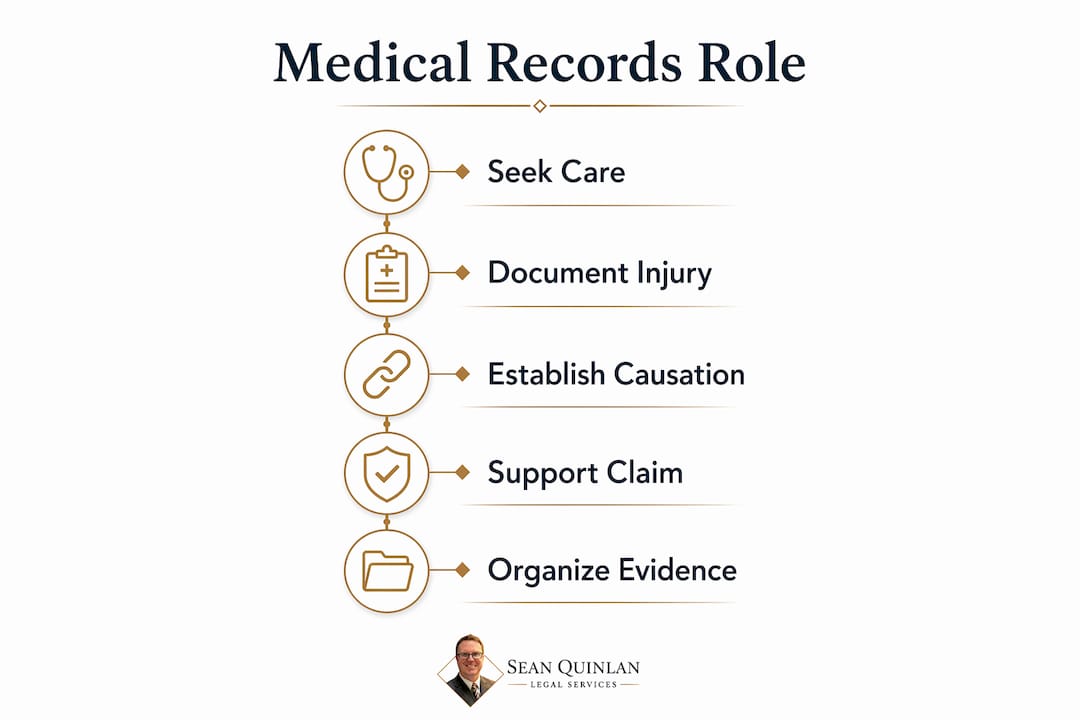
Medical records are the primary evidentiary foundation of any personal injury claim, providing objective, clinical documentation that links your injuries directly to the incident that caused them. Without this documentation, an insurance adjuster or defense attorney has every reason to dispute the severity of your injuries, question their cause, or argue that a pre-existing condition is to blame. For claimants in Cumberland County, Dauphin County, York County, and across Central Pennsylvania, understanding the role of medical records in injury claims is not optional. It is the difference between a well-supported case and one that collapses under scrutiny.
What role do medical records play in injury claims?
Medical records serve as the factual source of truth in legal injury claims, and accurate documentation protects claimants' rights at every stage of the process. This means that what your doctor writes in the days and weeks following an accident carries more legal weight than your own verbal account of events. Courts and insurance companies treat clinical notes, diagnostic imaging, and treatment plans as objective evidence precisely because they are created by licensed professionals with no financial stake in your claim outcome.
The importance of medical records extends beyond simply proving you were hurt. They establish a timeline, quantify your economic losses through billing statements, and document non-economic damages such as pain levels and functional limitations. A claimant who seeks treatment immediately after an accident and maintains consistent care throughout recovery builds a record that is far harder to challenge than one with gaps or delays.

What types of records matter and why
Medical records include multiple categories, each serving a distinct evidentiary purpose in an injury claim. Understanding what each type contributes helps you and your attorney identify what to request and what to prioritize.
| Record type | Role in your claim |
|---|---|
| Emergency room records | Establish the immediate post-incident diagnosis and injury severity |
| Diagnostic imaging (X-rays, MRIs) | Provide objective, visual proof of fractures, soft tissue damage, or spinal injuries |
| Primary care and specialist notes | Document ongoing symptoms, referrals, and treatment progression |
| Physical therapy records | Quantify functional limitations and recovery trajectory |
| Billing statements | Calculate total economic damages for settlement or trial |
| Pharmacy records | Corroborate prescribed treatment and pain management history |
Diagnostic imaging deserves particular attention. An MRI showing a herniated disc or a CT scan revealing a traumatic brain injury is far more persuasive to an insurance adjuster than a written description of pain. These records provide objective evidence that is difficult to dispute. Billing records, meanwhile, translate your physical suffering into concrete dollar figures, which is exactly what settlement calculations require.
Pain-level reporting and functional limitation descriptions in therapy notes also matter significantly. When a physical therapist documents that you cannot lift more than ten pounds or that you experience a seven out of ten pain level during routine activities, that language directly supports claims for non-economic damages such as loss of enjoyment of life.
How medical records establish causation and affect claim value
Records taken immediately after accidents carry more legal weight than delayed documentation, and this principle shapes how insurance companies and courts evaluate your claim. Contemporaneous documentation, meaning records created at or near the time of the incident, creates a causal chain that is difficult for a defense attorney to break. If you wait two weeks to see a doctor after a car accident in Harrisburg, the insurer will argue that something else caused your injuries during that gap.
Pre-existing conditions present a related challenge. Insurers routinely argue that your injuries predated the accident. However, under the eggshell skull principle, a defendant is liable for the full extent of harm caused even if the claimant was more vulnerable due to prior conditions. Proper documentation differentiates accident-related injuries from prior conditions, allowing your attorney to argue that the incident aggravated or accelerated a pre-existing issue rather than being unrelated to it.
Treatment progression also affects claim value directly. Records showing a consistent course of care, from emergency treatment through specialist consultations and physical therapy, support the argument that your injuries required ongoing medical attention. They also justify claims for future medical expenses when a physician documents that additional surgery or long-term therapy is likely.
- Seek medical attention on the day of the incident, not days later
- Describe all symptoms to your provider, including pain that seems minor
- Attend every scheduled appointment and follow prescribed treatment plans
- Request that your provider document functional limitations in writing
- Never exaggerate symptoms, as inconsistencies will surface during record review
Pro Tip: Keep a personal handwritten journal starting the day of your accident. Record your pain levels, activities you cannot perform, and how your injuries affect daily life. This timeline helps your attorney identify inconsistencies in clinical notes early, before they become problems at trial.
How to obtain, review, and organize your records
Patients have a federal right under HIPAA to request their full Designated Record Set within 30 days of a written request, which includes clinical notes, imaging, billing records, and correspondence. Providers can charge a reasonable fee for copies but cannot withhold records because of an unpaid balance. Many claimants in Camp Hill and across Central Pennsylvania delay this step, which creates critical bottlenecks in legal proceedings.
Follow these steps to secure and organize your records efficiently:
- Submit a written records request to every provider you have seen since the incident, including emergency rooms, urgent care centers, specialists, and physical therapists.
- Request your full Designated Record Set, not just a summary. This distinction matters because summaries omit billing codes, imaging reports, and correspondence that attorneys need.
- Set a calendar reminder for the 30-day response deadline. If a provider requests a 30-day extension, confirm it in writing.
- Organize records chronologically once received, grouping them by provider and date of service.
- Review each record for accuracy. Look for incorrect dates, missing diagnoses, or notes that contradict your recollection of symptoms you reported.
- Share the organized file with your attorney before any legal proceedings begin.
Electronic patient portals and apps are increasingly useful for managing and accessing records, and combining digital access with paper copies is the most reliable approach. Many Pennsylvania hospital systems, including those serving Harrisburg and York County, now offer portal access to imaging and lab results within days of your visit.
Pro Tip: Ask your attorney to create a medical chronology, which is a structured summary of all relevant medical events and dates. Legal professionals use these chronologies to prepare expert reports and identify treatment gaps before the opposing side does.
Common pitfalls that can undermine your claim
Gaps in treatment or vague documentation give insurers direct leverage to dispute claims or reduce settlement offers. This is one of the most preventable problems in personal injury cases, yet it remains one of the most common. Missing a follow-up appointment, switching providers without transferring records, or failing to report a symptom to your doctor can all create openings for the defense.
Several specific issues arise repeatedly in injury claims across Dauphin County and York County courts:
- Missing records: Records from a treating provider that were never requested or transferred can leave a gap in your treatment timeline that the insurer will exploit.
- Illegible or incomplete notes: Poor-quality notes, missing signatures, or illegibility increase the risk of claim denial or undervaluation. If you notice this in your records, ask the provider to issue an addendum.
- Delayed treatment entries: Some providers batch-enter notes days after a visit. This creates timestamps that look like gaps in care even when treatment was continuous.
- Inconsistent symptom reporting: If you told your doctor your pain was a three out of ten but told your attorney it was an eight, that discrepancy will surface and damage your credibility.
The 2026 CMS final rule mandates standardized electronic exchange of medical record attachments using X12N 275 and HL7 standards, replacing manual faxing. This modernization reduces delays in legal claim documentation, which means records requested today should reach your attorney faster than they would have even two years ago.
How medical records affect outcomes in Central Pennsylvania
In Cumberland County, Dauphin County, and York County courts, medical documentation functions as the backbone of both settlement negotiations and trial preparation. Pennsylvania follows a modified comparative negligence standard, meaning the quality and completeness of your medical evidence directly affects how much compensation you can recover. Judges and juries in Harrisburg and Camp Hill evaluate medical records with the same scrutiny as any other form of evidence, and insurance companies request records to verify injury extent and legitimacy before authorizing any settlement.
Local attorneys who handle personal injury claims in Central Pennsylvania consistently use medical chronologies and expert medical testimony to counter insurer arguments. A well-documented record set allows your attorney to walk a jury through your injury progression from the emergency room visit on the day of the accident through your most recent physical therapy session. That narrative is persuasive precisely because it is grounded in clinical fact.
"The strength of a personal injury claim in Pennsylvania is almost always proportional to the quality of the medical documentation behind it. Claimants who understand this early and act on it give their attorneys the tools to negotiate from a position of strength."
Consulting a local personal injury attorney early, before you have even finished treatment, gives your legal team the opportunity to identify record gaps while they can still be addressed. Understanding how county courts handle injury cases in Pennsylvania also helps you anticipate the evidentiary standards your records will need to meet.
Key takeaways
Medical records are the single most determinative factor in whether an injury claim succeeds or fails, because they provide the objective clinical evidence that courts and insurers cannot dismiss.
| Point | Details |
|---|---|
| Seek care immediately | Records created on the day of the incident carry the most legal weight and establish causation. |
| Request your full record set | Under HIPAA, you are entitled to your complete Designated Record Set within 30 days of a written request. |
| Eliminate treatment gaps | Consistent care documentation prevents insurers from disputing injury severity or causation. |
| Address pre-existing conditions | Proper documentation separates prior conditions from accident-related injuries under the eggshell skull principle. |
| Organize and share early | Chronological organization and early attorney review prevent surprises during negotiations or trial. |
What I have learned about records and claims after years in Pennsylvania courts
After working with injury claimants across Harrisburg, Camp Hill, and Cumberland County for years, the pattern I see most often is this: claimants underestimate how early the medical record battle begins. Most people assume the legal fight starts when they file a claim. It actually starts the moment a treating physician writes the first note.
The misconception I encounter most is that medical records are just paperwork. They are not. They are the only version of events that an insurance company or defense attorney cannot easily contradict. Your memory of the accident can be challenged. Your pain description can be dismissed. A radiologist's report of a herniated disc cannot.
What I tell every client is to treat their medical care as both a health priority and a legal responsibility. That means attending every appointment, reporting every symptom honestly, and never minimizing pain to appear stoic. I have seen claims significantly undervalued because a claimant told their doctor they were "doing fine" at a follow-up visit, and that phrase ended up in the record. The insurer used it to argue the injury had resolved.
The other lesson is timing. Claimants who prepare their records early and bring an organized file to their first attorney consultation give their legal team a genuine advantage. Those who wait until litigation is underway are always playing catch-up. In Pennsylvania courts, that delay has a cost.
— Atry. Sean Quinlan
Get experienced legal support for your injury claim in Pennsylvania

Medical records are only as powerful as the attorney who knows how to use them. At Pennsylvania DUI Attorney, Attorney Sean P. Quinlan reviews medical documentation as part of every personal injury case evaluation, identifying gaps, inconsistencies, and opportunities to strengthen your claim before negotiations begin. Whether your case involves a car accident in Harrisburg, a truck collision in York County, or a slip and fall in Cumberland County, thorough record review is the foundation of every strategy. Contact Pennsylvania DUI Attorney today for a case evaluation and put your medical documentation to work for your recovery.
FAQ
What are medical records used for in an injury claim?
Medical records document the diagnosis, treatment, and progression of injuries caused by an accident, providing objective evidence that links the incident to your physical harm. Courts and insurers treat them as the primary factual basis for determining both liability and the value of damages.
How soon should I seek medical care after an accident?
Seek medical attention on the day of the accident whenever possible. Records created immediately after an incident carry significantly more legal weight than documentation obtained days or weeks later, because contemporaneous notes establish a direct causal connection between the event and your injuries.
Can a pre-existing condition hurt my injury claim?
A pre-existing condition does not automatically defeat your claim. Under the eggshell skull principle, a defendant is liable for the full extent of harm caused even if you were more vulnerable due to a prior condition, provided your records clearly differentiate accident-related injuries from pre-existing ones.
How do I request my medical records in Pennsylvania?
Submit a written request to each treating provider for your full Designated Record Set, which includes clinical notes, imaging, billing, and correspondence. Under HIPAA, providers must respond within 30 days and cannot withhold records due to an unpaid balance.
What happens if my medical records have gaps or inconsistencies?
Gaps in treatment or vague documentation give insurers leverage to dispute your claim or reduce the settlement offer. If you identify errors or missing entries, ask your provider to issue a written addendum, and share all discrepancies with your attorney before any legal proceedings begin.