

Most people assume that filing a personal injury lawsuit means heading straight to a high-stakes courtroom packed with attorneys and a full jury. In reality, the role of county courts in injury cases is far more central and accessible than that. For a significant portion of personal injury claims, county courts serve as the primary venue where evidence is presented, liability is decided, and compensation is awarded. Understanding how these courts operate, what authority they hold, and how the process unfolds can meaningfully affect the outcome of your claim.
Table of Contents
- Key takeaways
- Role of county courts in injury cases
- How county courts compare to other courts
- The personal injury court process step by step
- How local court dynamics affect your outcome
- Special considerations and filing deadlines
- My perspective on county courts and injury claims
- Ready to move forward with your injury claim?
- FAQ
Key takeaways
| Point | Details |
|---|---|
| County courts handle most claims | Most personal injury claims fall within county court jurisdiction based on monetary and case-type thresholds. |
| Jurisdiction determines your venue | Where the injury occurred or where the defendant resides typically determines which county court handles your case. |
| Local knowledge changes outcomes | Attorneys familiar with local judges, dockets, and insurers consistently achieve better results in county court settings. |
| Deadlines are non-negotiable | Missing statutory filing deadlines, including government tort claim windows, can permanently end your right to recover. |
| Trial type affects your strategy | Whether your case goes to a judge or jury shapes how evidence and arguments should be prepared from day one. |
Role of county courts in injury cases
County courts are courts of general civil jurisdiction that handle a broad range of disputes, including personal injury claims arising from car accidents, slip-and-fall incidents, workplace injuries, and more. They occupy a middle tier in most state court systems, positioned above small claims courts and below courts of appeals or supreme courts.
The functions of county courts in personal injury matters include receiving and docketing filed claims, conducting pretrial hearings, managing evidence exchange between parties, overseeing settlement conferences, and presiding over trials. These are not passive administrative duties. County court judges make substantive legal rulings that can determine whether your case survives to trial or gets dismissed.
Most personal injury cases fall within county court jurisdiction because of how these courts are structured around claim value and case complexity. Here is what typically falls within their reach:
- Monetary thresholds: Most county courts handle civil claims ranging from a few thousand dollars up to $75,000 or more, depending on the state.
- Case types: Automobile accidents, premises liability, medical negligence at lower damages levels, and product liability cases are common.
- Procedural access: County courts offer more accessible procedures than appellate or specialty courts, with structured timelines suited to most litigants.
- Jury availability: Many county courts offer jury trials for civil personal injury claims, though this varies by jurisdiction and claim value.
When a claim exceeds the county court's jurisdictional cap or involves particularly complex legal questions, such as multi-party mass torts or constitutional issues, it moves to a higher court. For most people dealing with county court injury claims, however, the county court is both the starting point and the finish line.
How county courts compare to other courts
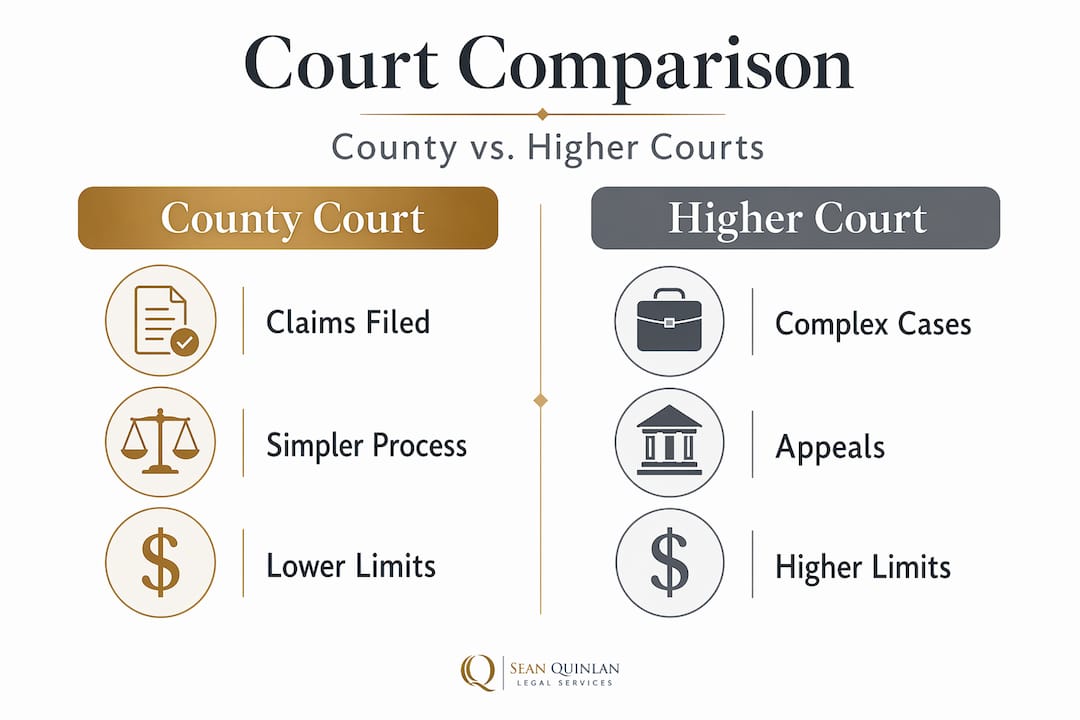
Understanding where county courts fit within the broader judicial structure helps you make better strategic decisions about your case. Not every personal injury claim belongs in the same courtroom, and the differences between court tiers are significant.
| Court type | Monetary range | Jury available | Discovery scope | Typical timeline |
|---|---|---|---|---|
| Small Claims / Minor Injury Track | Under $10,000 | No | Minimal | 60 to 120 days |
| County Court (civil division) | $10,000 to $75,000+ | Yes (varies) | Standard | 6 to 18 months |
| Circuit / District Court (complex) | Over $75,000 | Yes | Full | 1 to 3 years |
| Federal District Court | No minimum; specific grounds | Yes | Extensive | 2 to 4 years |
In Maryland, for example, District Courts handle claims up to $30,000 in personal injury cases, while more complex or higher-value claims are transferred to Circuit Courts. The practical effect is that District Courts prefer smaller claims because the absence of formal jury trials and limited depositions makes the process faster and less costly for everyone involved.
In England and Wales, minor injuries on the Small Claims Track are resolved through simplified procedures with relaxed evidence rules, which mirrors how some U.S. jurisdictions handle lower-value injury matters. The principle is the same regardless of geography: match the procedural weight of the court to the complexity and value of the claim.
Texas adds another layer through its venue rules. Venue is determined by where the injury occurred or where the defendant resides, meaning a plaintiff can sometimes choose among multiple county courts depending on the facts. That choice can strategically affect which judges and juries hear your case.
The personal injury court process step by step
Once you decide to pursue a formal claim, the personal injury court process moves through several defined stages. Each stage has its own purpose, and missing a step or deadline can compromise your position.
-
Filing the petition or complaint. Your attorney prepares a legal document that identifies the parties, describes the injury-causing event, states the legal theories of liability such as negligence, and specifies the damages being sought. This is filed with the county court clerk, and the filing fee is paid.
-
Service of process. The defendant must be formally notified of the lawsuit. Service rules are strict. Failure to serve properly can invalidate your filing and require you to start over.
-
Defendant's response. The defendant typically has 20 to 30 days to file an answer. Their response may admit certain facts, deny liability, or raise affirmative defenses.
-
Discovery phase. This is where both sides exchange information. Interrogatories, requests for documents, depositions, and expert witness disclosures happen here. Medical records, accident reports, and surveillance footage are common evidence types in county court injury claims.
-
Pretrial motions and hearings. Judges may rule on motions to dismiss, motions for summary judgment, or disputes about admissible evidence before trial begins.
-
Settlement negotiations. The majority of personal injury claims settle before trial. County courts often facilitate or require mediation at this stage.
-
Trial. If settlement fails, the case proceeds to either a bench trial, where the judge decides everything, or a jury trial. In California injury cases, jury instructions distinguish between the judge's role in determining the law and the jury's role in deciding facts like breach of duty and causation.
-
Judgment and collection. A verdict is rendered, and if damages are awarded, the collection process begins. This may involve payment plans, liens, or garnishment depending on the defendant's resources.
Case timelines vary significantly by county court efficiency, judicial resources, and docket management rather than any uniform state standard. A well-run county court in a mid-sized Pennsylvania county may resolve a case in 10 months. An overburdened urban docket could take twice as long.
Pro Tip: Ask your attorney at the outset how the specific county court where your case is filed manages its civil docket. Local scheduling norms, mandatory mediation requirements, and judicial preferences for evidence presentation can all be accounted for in your litigation strategy if you know about them early.

How local court dynamics affect your outcome
The county court where your injury case is filed is not just a neutral administrative venue. Its character, culture, and personnel can shape your result in ways that pure legal merit does not fully predict. This is one of the most overlooked aspects of county court jurisdiction in injuries.
Here is why the local environment matters more than most people expect:
- Judicial tendencies: Some county court judges favor early settlement conferences. Others are known for strict adherence to procedural timelines. An attorney who has appeared before a specific judge dozens of times understands how to frame arguments and present evidence in ways that resonate with that judge's approach.
- Insurer behavior: Insurance companies adjust their settlement strategies based on who they are up against and where the case is filed. Local attorneys with strong reputations create genuine settlement leverage because insurers know a credible trial threat exists.
- Community dynamics: In smaller or regional county courts, jurors may know the parties or have strong opinions about common local accident locations. This cuts both ways and requires careful jury selection strategy.
- Docket pace: Case management practices vary significantly by county and by individual judge. Some courts have mandatory mediation before trial. Others prefer to let attorneys push the case to trial to motivate settlement.
You can understand your injury rights in PA more fully by recognizing that the procedural rules on paper are only part of the picture. How those rules are applied locally is equally important.
Pro Tip: When selecting an attorney for a county court injury claim, ask specifically whether they have tried cases in that particular courthouse. Court-specific experience is not a bonus. It is often the deciding factor between a reasonable settlement and a prolonged, uncertain trial.
The case for hiring a local injury lawyer in Pennsylvania comes down to exactly this point. An attorney who regularly appears in Bucks County Common Pleas Court brings different practical value than one who primarily practices in Philadelphia, even though the two counties border each other.
Special considerations and filing deadlines
County court injury claims carry procedural obligations that must be respected from the moment of injury, not from when you decide to file. Several factors can limit or end your right to recover if they are not addressed promptly.
- Statutes of limitations: Pennsylvania generally allows two years from the date of injury to file a personal injury lawsuit. Missing this deadline results in permanent dismissal of your claim.
- Government entity claims: When your injury involves a government agency, such as a municipality or public transit authority, special notice requirements apply. California, for example, requires filing a government tort claim within six months of the injury. Pennsylvania has similar governmental immunity rules with shortened notice periods.
- Venue challenges: If a defendant believes your chosen county court is improper, they can file a motion to transfer venue. Venue challenges are procedural motions that focus on legal jurisdiction questions and are decided without resolving the underlying merits of your case.
- Simplified versus complex tracks: Not every case in county court proceeds the same way. Lower-value or straightforward claims may be placed on a simplified track with shorter deadlines and fewer procedural steps, while complex cases receive extended timelines and more discovery latitude.
- Fee and cost recovery: County courts generally allow the prevailing party to recover certain court costs, though attorney's fees are typically not awarded unless a specific statute authorizes them. Knowing the cost rules in advance helps you assess the financial risk of litigation.
My perspective on county courts and injury claims
I have worked with injury victims who walked into the process believing that their case would automatically land in front of a sympathetic jury and produce a straightforward verdict. That rarely happens, especially in county courts where judges have broad discretion and local dynamics exert real influence.
What I have learned is that people who do well in county court injury cases are the ones who take venue selection seriously from the start. Choosing where to file, when it is legally available as a choice, is a strategic decision, not a clerical one. I have seen cases where the same facts, the same injuries, and the same defendant produced dramatically different settlement offers simply because the plaintiff filed in a county known for plaintiff-favorable outcomes rather than a neighboring county with a defense-oriented reputation.
The second thing I would tell anyone going through this process is to resist the urge to treat county court as a lesser venue. A county court ruling on personal injury carries the same legal weight as a higher court judgment. It affects your finances, your health recovery options, and in some cases your ability to pursue future claims. Treat it with the seriousness it deserves.
Finally, the attorneys who get results in these courts are the ones who know them intimately. Not just the law, but the specific courthouse. That local knowledge translates directly into better preparation, better negotiations, and better outcomes for their clients.
— Sean
Ready to move forward with your injury claim?
If you are facing a personal injury matter in Pennsylvania and need guidance on how county courts will handle your case, Pennsylvaniadui is here to help. Attorney Sean Quinlan brings focused, practical experience to personal injury claims across multiple Pennsylvania counties, with the local court knowledge that makes a real difference in outcomes.

Whether your case involves a car accident, slip-and-fall, or another injury caused by someone else's negligence, the personal injury legal services offered through Pennsylvaniadui are designed to protect your rights from the first filing through final resolution. If your injury arose from a vehicle collision, the dedicated auto accident representation page covers exactly what you need. Contact Pennsylvaniadui today for a case evaluation and take the first step toward the recovery you deserve.
FAQ
What is the role of county courts in injury cases?
County courts serve as the primary venue for most personal injury claims, handling everything from initial filing and pretrial motions to trials and judgments. They have jurisdiction over civil disputes within specific monetary limits and apply state procedural rules to resolve liability and award damages.
How does county court jurisdiction work for injury claims?
Jurisdiction in injury cases is typically based on where the injury occurred or where the defendant resides, and the claim value must fall within the court's monetary threshold. Cases exceeding that threshold are transferred to higher courts such as circuit or district courts.
Can you get a jury trial for a personal injury case in county court?
Jury trials are available in many county courts for personal injury claims, though availability depends on the jurisdiction and the claim amount. In courts that handle smaller claims without juries, a judge decides all factual and legal questions.
Why does it matter which county court handles my case?
Different county courts have different judges, docket speeds, and local legal cultures that directly affect settlement dynamics and trial outcomes. An attorney with experience in your specific county court can use that local knowledge to strengthen your position significantly.
What happens if you miss a filing deadline in a county court injury case?
Missing the statute of limitations or a government tort claim notice deadline typically results in your case being dismissed permanently. Courts rarely grant exceptions for missed deadlines, which is why consulting an attorney as early as possible after an injury is critical.