

After a serious accident in Pennsylvania, most victims focus on recovery and miss something critical: the full range of damages they're legally entitled to claim. Understanding what damages can victims claim is not just an academic exercise. It determines how much money you actually recover, how your attorney structures the case, and whether your family receives the financial support they need after a loss. In auto accidents and tractor trailer crashes especially, the categories of available damages are broader and more nuanced than most people realize.
Table of Contents
- Understanding damages in Pennsylvania personal injury claims
- Common damages victims can claim after auto and tractor trailer accidents
- The legal timelines and filing considerations for damage claims in Pennsylvania
- How damages claims work practically: Filing, proving, and recovering compensation
- Why understanding the distinction between survival and wrongful death claims matters most
- How Attorney Sean Quinlan can help with your Pennsylvania personal injury claim
- Frequently asked questions
Key Takeaways
| Point | Details |
|---|---|
| Two types of claims | You can claim damages through wrongful death and survival actions, each covering different losses. |
| Economic and non-economic damages | Claims include economic losses like medical bills and non-economic damages like pain and suffering. |
| Two-year filing deadline | Pennsylvania requires wrongful death and survival claims to be filed within two years of death. |
| Proof and evidence matter | Strong medical and financial records are essential to support your damages claim. |
| Seek legal help early | Early consultation with an experienced attorney increases chances for full compensation. |
Understanding damages in Pennsylvania personal injury claims
Pennsylvania law divides damages into two broad categories: economic damages and non-economic damages. Economic damages are the ones you can put a number on directly, like hospital bills and missed paychecks. Non-economic damages cover the losses that are harder to quantify, like pain, emotional suffering, and the loss of a loved one's companionship.
There is a third category worth knowing: punitive damages. These are not meant to compensate you for a loss. Instead, courts award them to punish defendants whose behavior was especially reckless or outrageous. In tractor trailer cases, for example, punitive damages can come into play when a trucking company ignored federal safety regulations.
When a victim dies from their injuries, two additional legal vehicles come into play. Pennsylvania recognizes wrongful death and survival actions in negligence cases, each covering different damages. This distinction matters enormously, because the two claims serve different purposes and benefit different parties.
Here is a snapshot of the core damage categories available to victims:
- Medical expenses: Emergency care, surgery, hospitalization, rehabilitation, and future treatment costs
- Lost wages: Income lost while recovering, including future earning capacity if you cannot return to work
- Property damage: Vehicle repair or replacement after a crash
- Funeral and burial costs: Applicable in fatal accident cases
- Pain and suffering: Physical discomfort caused by the injury and its treatment
- Emotional distress: Anxiety, depression, trauma, and psychological harm from the accident
- Loss of companionship: The loss a spouse or child experiences when a loved one is killed or severely incapacitated
- Punitive damages: Applied in cases of gross negligence or willful misconduct
Understanding the personal injury claims process in Pennsylvania helps you connect each category to the right claim type from the start.
Common damages victims can claim after auto and tractor trailer accidents
Now that the basic categories are clear, let's look at specific damages you might pursue after a vehicle accident. Auto collisions and tractor trailer crashes often produce catastrophic injuries, which means the list of damages can be long and the amounts significant.
Economic damages in vehicle accident cases typically include:
- Emergency room visits and ongoing medical care
- Physical therapy and rehabilitative services
- Lost income during recovery
- Reduced future earning capacity if the injury is permanent
- Out-of-pocket costs like transportation to medical appointments and home care services
Non-economic damages address the human cost of the accident:
- Physical pain and suffering during recovery and beyond
- Emotional trauma, including post-traumatic stress disorder
- Loss of enjoyment of life, meaning activities you can no longer participate in
- Loss of consortium, which refers to the impact on your relationship with a spouse
When someone is killed in a crash, the scope of victim compensation options expands further. Family losses in wrongful death claims include funeral expenses, loss of financial support, and loss of companionship. These are pursued by surviving family members, not by the estate.
Knowing your rights as an auto accident victim in Pennsylvania ensures you do not leave legitimate compensation unclaimed.

Pro Tip: In tractor trailer accident cases, always investigate whether the trucking company itself can be named as a defendant. Corporations often carry much larger insurance policies than individual drivers, which can significantly increase the damages available for victims.
The legal timelines and filing considerations for damage claims in Pennsylvania
Knowing what damages you can claim is only half the battle. You also need to know when to act. Pennsylvania law imposes strict deadlines on personal injury and wrongful death claims, and missing them can permanently bar your recovery.
Here are the key filing steps and timelines to understand:
- Two-year statute of limitations for personal injury claims. If you were injured in an auto or tractor trailer accident, you generally have two years from the date of the accident to file a lawsuit.
- Two-year deadline for wrongful death and survival actions. Pennsylvania applies a 2-year limitations period for wrongful death and survival actions, running from the date of death.
- Survival damages cover a separate time period. The survival claim addresses losses from the moment of injury until the moment of death. If someone survived in a hospital for weeks before dying, that entire period generates its own set of damages, including pain, suffering, and lost earnings.
- Preserve evidence early. Accident reconstruction data, trucking company logs, and electronic control module data from the truck's "black box" can be destroyed or overwritten quickly. Acting fast protects your ability to prove damages in court.
- Consult an attorney before communicating with insurers. Insurance adjusters often contact victims quickly and attempt to settle for far less than the full damages available. Early legal guidance closes that door.
Knowing how to protect your legal rights after an accident in Pennsylvania is the foundation of a successful claim.
Pro Tip: Even if you believe you share some fault for the accident, do not assume you cannot recover damages. Pennsylvania follows a modified comparative negligence rule, meaning you can still recover as long as your share of fault is less than 51 percent.
How damages claims work practically: Filing, proving, and recovering compensation
Let's break down the two major claim types side by side to show how courts handle the allocation of damages and why filing both together is usually the right move.
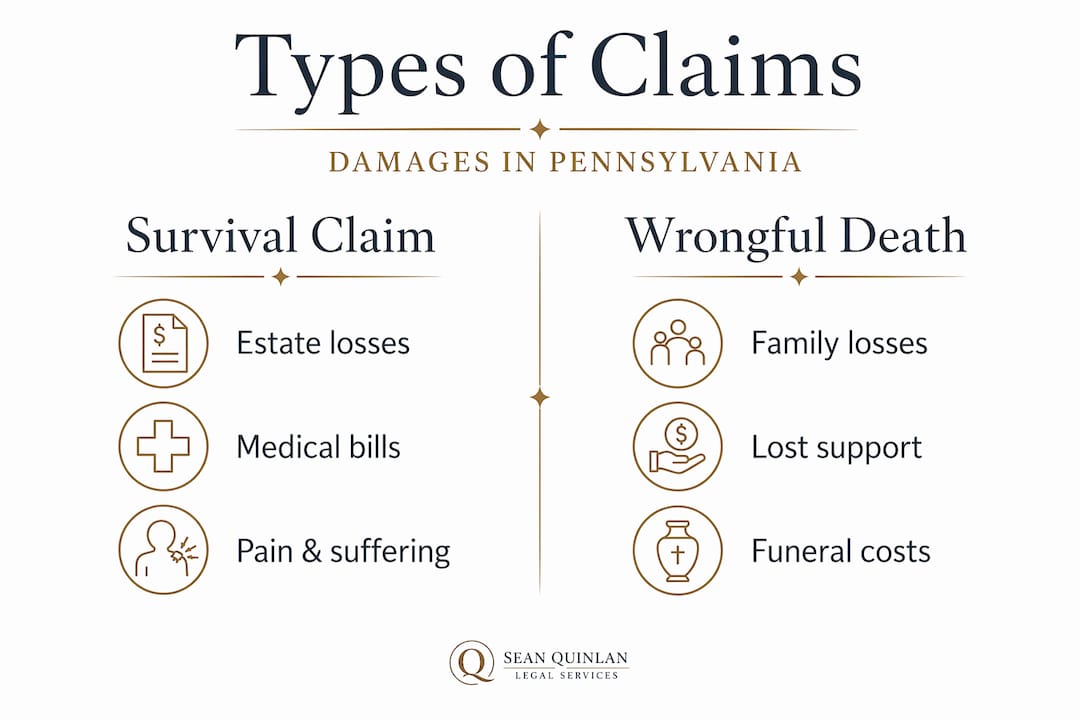
| Feature | Survival action | Wrongful death action |
|---|---|---|
| Who benefits | The decedent's estate | Surviving family members |
| Damages covered | Pain, suffering, lost earnings before death, punitive damages | Funeral costs, lost financial support, companionship |
| Who can file | Personal representative of the estate | Spouse, children, or parents of the deceased |
| Punitive damages | Yes, available | No, generally not available |
| Overlap risk | Yes, requires careful apportionment | Yes, requires careful apportionment |
Survival and wrongful death claims are usually filed together to avoid double recovery and clarify apportionment in court. Filing them separately or failing to coordinate them can result in a judge reducing your award or dismissing part of the claim.
To successfully prove and recover damages, victims and their attorneys typically rely on the following types of evidence:
- Medical records and expert testimony to establish the nature and extent of injuries
- Pay stubs and employment records to document lost income and future earning capacity
- Accident reconstruction reports to establish liability in vehicle crash cases
- Mental health evaluations to support claims for emotional distress and trauma
- Testimony from family members to support loss of companionship and consortium claims
- Financial records to document funeral costs, out-of-pocket expenses, and projected future losses
Reviewing personal injury compensation examples from Pennsylvania cases gives you a realistic picture of what courts and juries have awarded in similar situations.
Why understanding the distinction between survival and wrongful death claims matters most
Here is what most victims and even some general practice attorneys miss: treating these two claims as interchangeable is one of the most expensive mistakes you can make in a Pennsylvania personal injury case.
A wrongful death claim belongs to the family. A survival claim belongs to the estate. They run on overlapping but legally distinct timelines, they cover different damages, and they require different evidence. Confusing them even slightly can cause your attorney to undervalue one claim while over-relying on the other.
Practitioners track parallel timelines for wrongful death and survival damages to ensure accurate compensation and timely action. That kind of precision is not incidental. It is what separates a full recovery from a partial one.
The real-world impact is significant. Imagine a tractor trailer accident victim who survives for three weeks in intensive care before dying. During those three weeks, that person suffered physically, lost income, and experienced profound emotional distress. All of that generates survival damages. But the family's grief, their lost financial support, and the funeral costs come from a separate legal action entirely. An attorney who captures both tells the complete story of what was lost.
The practical lesson: do not wait to consult an attorney and do not hire one who treats these claims as a single event. Early advice, coordinated filing, and a deliberate evidentiary strategy are what protect your right to the full range of victim compensation options.
Knowing how to choose the right accident attorney in Pennsylvania is not just a matter of convenience. It directly affects what you recover.
How Attorney Sean Quinlan can help with your Pennsylvania personal injury claim
If you've been injured in an auto accident or lost a family member in a tractor trailer crash, the legal path forward involves more moving parts than most victims expect. Understanding what damages can victims claim is only the first step.

Attorney Sean Quinlan provides experienced representation for personal injury claims throughout Pennsylvania, including wrongful death and survival actions. He understands the filing deadlines, the evidentiary requirements, and the strategies that maximize compensation for victims and their families. Whether you need help with an auto accident claim or a related legal matter, Attorney Quinlan offers personalized guidance from the first consultation through resolution. If you also face DUI-related legal issues connected to your case, that support is available too. Contact the office today to protect your rights and recover what you're owed.
Frequently asked questions
What is the difference between wrongful death and survival claims in Pennsylvania?
Wrongful death focuses on family losses like financial support and companionship, while survival claims address the decedent's own damages such as pain, suffering, and lost earnings before death.
How long do victims have to file wrongful death claims in Pennsylvania?
Pennsylvania applies a 2-year limitations period for wrongful death and survival actions, running from the date of death, so prompt legal action is essential.
Can victims claim punitive damages in personal injury cases?
Yes. Punitive damages are typically pursued under the survival claim when the defendant's conduct was particularly egregious or outrageous, such as when a trucking company willfully violated safety regulations.
What types of economic damages can victims recover after an auto accident?
Economic damages include medical bills, lost wages, funeral costs, property damage, and other out-of-pocket expenses directly caused by the accident.