

Most people assume a DUI only applies if you're visibly drunk and caught driving. That assumption leads to some of the costliest legal mistakes Pennsylvanians make. A DUI, which stands for Driving Under the Influence, can be charged against someone whose blood alcohol concentration (BAC) is below the standard 0.08% limit, or who is impaired by a legally prescribed medication. Impaired driving causes roughly 12,000 deaths annually in the United States, which explains why Pennsylvania law is written broadly enough to catch more than just the obviously intoxicated driver.
Table of Contents
- Key takeaways
- What a DUI means under Pennsylvania law
- What happens immediately after a DUI arrest
- DUI penalties in Pennsylvania: what you are really facing
- Legal defenses and your rights after a DUI charge
- My perspective on what people get wrong about DUI charges
- Facing a DUI charge? Here is where to start
- FAQ
Key takeaways
| Point | Details |
|---|---|
| DUI definition is broader than BAC | Pennsylvania law covers impairment by alcohol, drugs, or any substance affecting driving ability. |
| "Actual physical control" matters | You can face a DUI charge even if the car is parked and you never drove. |
| Two separate legal tracks | Criminal prosecution and administrative license suspension run independently of each other. |
| First offense costs add up fast | Total financial exposure for a first DUI often reaches $5,000 to $15,000 or more. |
| Defense has real options | Challenging the traffic stop, test procedures, and calibration logs can significantly affect the outcome. |
What a DUI means under Pennsylvania law
The DUI definition under Pennsylvania's Vehicle Code, specifically Section 3802, is deliberately broad. It does not simply say "driving with a BAC of 0.08% or higher." It covers anyone who drives, operates, or is in actual physical control of a vehicle while unable to safely do so because of alcohol, a controlled substance, or any other drug. That last phrase is where a lot of drivers get surprised.
How impairment is determined beyond a BAC number
Pennsylvania law uses an "impairment to the slightest degree" standard, meaning an officer does not need to prove you were falling-down drunk. Officers can charge DUI at BAC levels as low as 0.04% or 0.05% if observable impairment is present. That includes slurred speech, difficulty following instructions, bloodshot eyes, or poor performance on standardized field sobriety tests.
Drugs add another layer of complexity. Medical prescriptions do not exempt drivers from DUI charges. If a validly prescribed medication impairs your ability to drive, Pennsylvania law treats that identically to alcohol impairment. This catches many drivers completely off guard.
Pennsylvania also penalizes what the law calls "actual physical control" of a vehicle. Being in the driver's seat with keys nearby can result in DUI charges even when the vehicle is not moving. So "sleeping it off" in the front seat of your car is not a safe legal strategy. It can get you charged just as if you had been driving.
Key factors officers evaluate during a DUI stop include:
- Odor of alcohol or marijuana in the vehicle
- Physical coordination during field sobriety tests
- Response time and coherence during questioning
- Results of a preliminary breath test at the scene
- Driving behavior observed before the stop (swerving, erratic speed)
Pro Tip: If you take any medication, prescription or over-the-counter, that carries a warning about operating heavy machinery, Pennsylvania law may treat you as impaired if an officer observes any sign of diminished capacity while you are driving.
What happens immediately after a DUI arrest
The minutes and hours after a DUI arrest in Pennsylvania set two separate legal processes in motion. Most people only think about the criminal case. The administrative license suspension is just as consequential, and it moves faster.

| Process | Authority | Timeline | Key Action Required |
|---|---|---|---|
| Criminal prosecution | District court or Court of Common Pleas | Months, depending on county | Appear at all hearings; secure legal counsel |
| Administrative license suspension | PennDOT | Often within 30 days of arrest | Request an appeal hearing promptly |
| Ignition interlock requirement | PennDOT / court order | After license restoration | Install certified IID device on vehicle |
| DUI education / treatment | Court ordered | 3 to 12 months typically | Complete assigned program on schedule |
Criminal and administrative tracks operate independently. Winning your criminal case does not automatically restore your driving privileges. Losing the administrative hearing does not mean you will be convicted criminally. Each requires its own focused strategy.
Pennsylvania's implied consent law requires that licensed drivers submit to chemical testing (breath, blood, or urine) after a lawful arrest. Refusing post-arrest chemical tests triggers an automatic license suspension that typically exceeds the suspension you would receive for a failed test, and that refusal can be introduced against you at trial. Many drivers refuse thinking it helps them. It usually does not.
Pro Tip: The clock on your PennDOT administrative appeal is short. Missing that deadline forfeits your right to contest the license suspension, regardless of what happens in criminal court. Contact an attorney on the day of your arrest if at all possible.
DUI penalties in Pennsylvania: what you are really facing
Pennsylvania structures DUI penalties across three tiers based on BAC level and prior offenses, not simply on whether you were "over the limit." Understanding the tiers is how you understand your actual exposure.
For a first offense DUI, penalties vary by BAC tier:
- General impairment (0.08% to 0.099% BAC): No mandatory minimum jail time, fines from $300, 12-month probation, license suspension possible depending on circumstances
- High BAC (0.10% to 0.159%): Mandatory 48 hours in jail, fines from $500 to $5,000, 12-month license suspension, ignition interlock device required
- Highest BAC (0.16% and above, or drug-related DUI): Mandatory 72 hours in jail, fines from $1,000 to $5,000, 12-month license suspension, ignition interlock required
DUI penalties extend well beyond fines and jail time. Total costs for a first offense, including attorney fees, education programs, ignition interlock installation and monitoring, increased insurance premiums, and court costs, frequently reach $5,000 to $15,000. For a second or third offense, those numbers climb sharply. You can find a detailed breakdown of second offense penalties and what the mandatory minimums look like for repeat offenders.
Second DUI offenses in Pennsylvania trigger mandatory jail time starting at 5 days, fines from $750 to $5,000, and an 18-month license suspension at the high BAC tier. Third offenses are classified as third-degree felonies at higher BAC levels, which means potential prison sentences, not just county jail. The professional and personal consequences compound. A felony conviction affects professional licenses, housing applications, firearm rights, and in some fields, the ability to maintain employment at all.
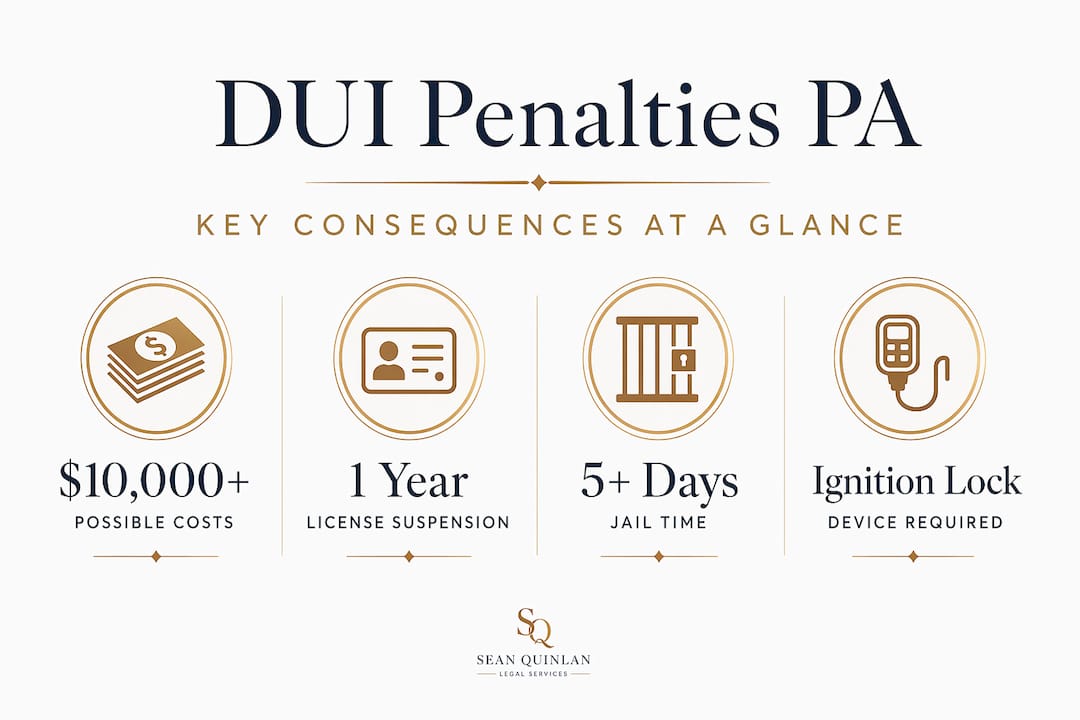
Ignition interlock devices are required in over 30 states for first-time offenders, and Pennsylvania is among them for higher BAC tiers. The device requires a clean breath sample before the car will start, and the data is reported to PennDOT. Any violation extends the requirement. The learning curve is real and the costs are ongoing. For a full picture of what a conviction means beyond the courtroom, Pennsylvaniadui has published a detailed resource on DUI conviction consequences that covers what most people overlook until it is too late.
Legal defenses and your rights after a DUI charge
A DUI charge is not a conviction. The quality of your defense often determines the outcome more than the facts of the arrest itself.
Effective DUI defense in Pennsylvania follows a structured process:
- Review the legality of the traffic stop. An officer must have reasonable suspicion or probable cause to pull you over. If the stop was unlawful, evidence obtained afterward may be suppressed.
- Examine field sobriety test administration. These tests follow strict protocols. Improper administration, poor lighting, uneven pavement, or instructions given in a confusing manner can all undermine the results.
- Challenge breathalyzer and blood test procedures. Breathalyzer machines require regular calibration. Forensic review of DUI cases includes examining calibration logs, maintenance records, and the officer's certification to operate the device.
- Assess the chain of custody for blood samples. Blood draws must be performed by qualified personnel, stored properly, and analyzed by accredited labs. Breaks in that chain can be grounds to challenge the result.
- Construct a detailed timeline. The sequence of events from the initial stop to the chemical test matters. Delays between the stop and the test, for example, can affect the reliability of the BAC reading.
Separating the criminal prosecution track from the administrative license suspension process is critical for a complete defense. An attorney who handles only the criminal side may leave you without representation at a PennDOT hearing that could have been won. Many drivers also benefit from reviewing their legal rights checklist specific to Pennsylvania before their first court date.
Pro Tip: Write down everything you remember about the stop as soon as you can, including the time, location, what the officer said, and the sequence of any tests. That record becomes useful when your attorney builds a timeline to challenge the prosecution's narrative.
My perspective on what people get wrong about DUI charges
In my experience defending clients across Pennsylvania, the biggest mistake I see is not the arrest itself. It is what happens in the days right after. People either panic and say too much, or they assume the charge will "work itself out" and do nothing until the court date is close.
I have seen cases where the underlying stop was clearly unlawful, but the client never mentioned the circumstances that would have revealed that. I have also watched clients forfeit perfectly winnable administrative hearings simply because no one told them the deadline had passed. These are avoidable outcomes.
What many drivers also miss is that judicial systems struggle to balance penalties fairly between first-time mistakes and habitual offenders. That tension sometimes works in your favor, and sometimes it does not. A knowledgeable attorney understands how a specific county's court tends to handle cases, which matters more than people expect.
My honest advice: treat a DUI charge like the serious legal matter it is from day one. Understand that you have two fronts to fight on, and get someone in your corner who handles both.
— Sean
Facing a DUI charge? Here is where to start
If you or someone you care about is facing a DUI charge in Pennsylvania, the decisions made in the first 48 hours carry significant weight. Attorney Sean Quinlan and the team at Pennsylvaniadui focus specifically on DUI defense across multiple Pennsylvania counties, with direct experience handling both the criminal prosecution and PennDOT administrative proceedings that follow an arrest.

Pennsylvaniadui offers personalized case evaluations designed to give you a clear picture of your situation, your options, and your realistic outcomes. Whether this is a first DUI charge or a repeat offense, the goal is the same: mount the strongest possible defense across every legal track open to you. The firm also handles related matters including personal injury and bankruptcy, which sometimes intersect with the financial fallout of DUI charges. Reach out to schedule a consultation and get answers specific to your case.
FAQ
What does DUI mean legally in Pennsylvania?
DUI stands for Driving Under the Influence. Under Pennsylvania law, it means operating or being in physical control of a vehicle while impaired by alcohol, drugs, or any substance that affects your ability to drive safely.
Can you get a DUI if your BAC is below 0.08%?
Yes. Pennsylvania's impairment standard allows charges below 0.08% if an officer observes signs of impairment. Officers can charge DUI at BAC levels as low as 0.04% to 0.05% if driving ability appears affected.
What is the difference between DUI and DWI?
DUI (Driving Under the Influence) and DWI (Driving While Intoxicated) refer to the same category of offense. Pennsylvania uses the term DUI. Other states use DWI, or both terms, sometimes with different legal meanings depending on jurisdiction.
What happens to your license after a DUI arrest in Pennsylvania?
PennDOT initiates an administrative license suspension separately from the criminal case. The suspension period depends on your BAC level and prior offenses. You have a limited window to appeal, and missing that deadline results in automatic suspension.
Is a first offense DUI a misdemeanor in Pennsylvania?
A first offense DUI in Pennsylvania is typically classified as an ungraded misdemeanor, though higher BAC tiers carry greater penalties. Repeat offenses can escalate to felony charges, particularly at the highest BAC tier or with three or more offenses.