

If you've been involved in a truck accident in Pennsylvania, you may assume the insurance company will step in and handle the details fairly. That assumption can cost you significantly. Truck accident claims are nothing like standard car accident claims. They involve federal regulations, multiple potential defendants, and insurance carriers with experienced legal teams working to limit what they pay. Understanding why specialized legal representation matters could be the difference between a fair recovery and a settlement that doesn't begin to cover your actual losses.
Table of Contents
- Understanding the complexity of truck accidents in Pennsylvania
- Insurance company tactics and your risks
- How a truck accident attorney secures better outcomes
- Truck accident attorney vs. general personal injury lawyer: Key distinctions
- The uncomfortable truth about truck accident claims: What most Pennsylvanians miss
- Ready to protect your interests after a truck accident?
- Frequently asked questions
Key Takeaways
| Point | Details |
|---|---|
| Truck accidents are complex | Claims often involve multiple parties, specialized laws, and high damages that require expert navigation. |
| Insurance tactics can hurt your claim | Insurers may minimize or deny your settlement unless you have strong legal representation. |
| Specialized attorneys get better results | Experienced truck accident attorneys maximize compensation and handle complex negotiations in your favor. |
| Act quickly for the best outcome | Immediate legal action helps preserve evidence and counter insurance defense strategies. |
Understanding the complexity of truck accidents in Pennsylvania
Truck accidents are not simply larger versions of car accidents. They operate under an entirely different legal framework, and that distinction matters from the first moment after a crash.
Commercial trucking in Pennsylvania is governed by both state traffic laws and federal regulations issued by the Federal Motor Carrier Safety Administration (FMCSA). These rules cover everything from driver hours of service (limits on how long a trucker can drive before mandatory rest) to required maintenance schedules, cargo weight restrictions, and drug testing protocols. When a violation of any of these regulations contributes to an accident, it becomes a central element of your legal claim.
One of the most important factors that sets truck accidents apart is the presence of multiple potentially liable parties. Consider a single crash scenario: the truck driver may have been fatigued due to an unrealistic delivery schedule. The trucking company may have failed to properly vet or train the driver. The company responsible for loading the cargo may have overloaded or improperly secured the freight. The truck manufacturer may have produced faulty brake components. In a standard car accident, you typically deal with one other driver and one insurance company. In a truck accident, you may be dealing with four or five separate defendants and their respective insurers simultaneously.
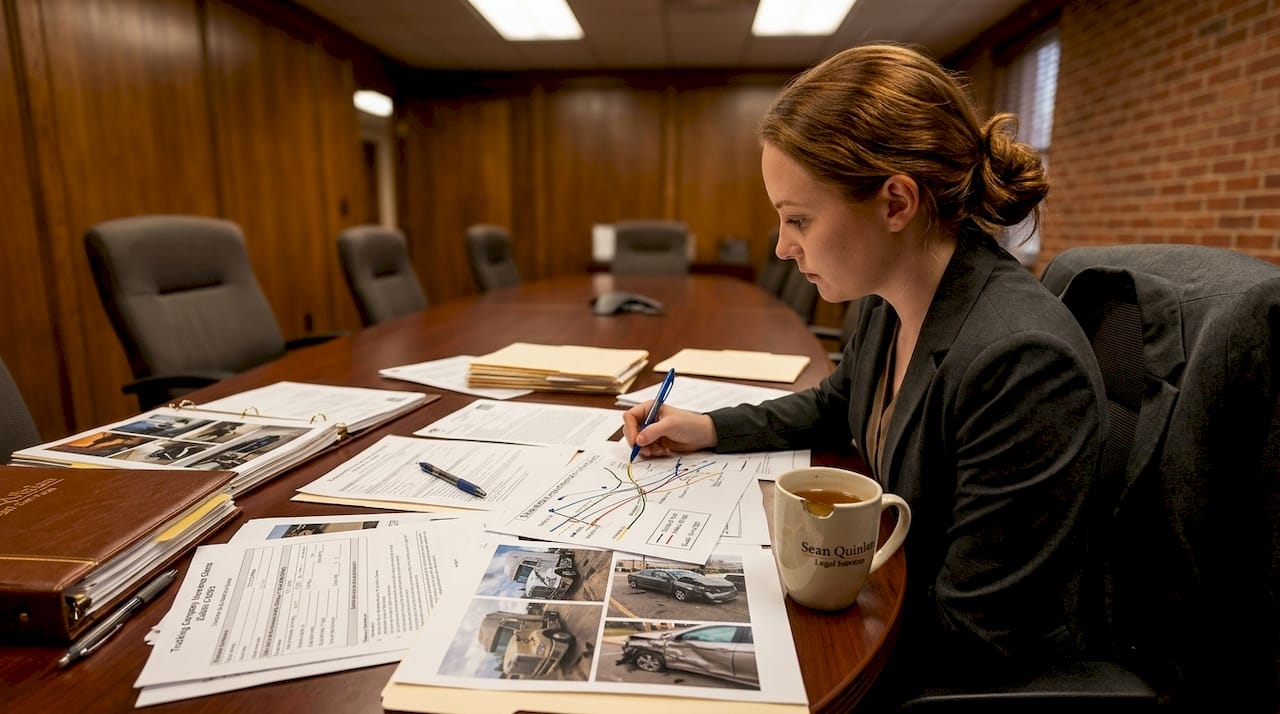
The severity of injuries in truck accidents also creates additional legal complexity. A loaded commercial truck can weigh up to 80,000 pounds. When that kind of mass collides with a passenger vehicle, the resulting injuries are frequently catastrophic: traumatic brain injuries, spinal cord damage, multiple fractures, and long-term disabilities. Calculating fair compensation for these injuries requires medical experts, life care planners, and economic analysts. As noted in guidance about truck accident complexities, truck accidents often involve multiple parties and federal regulations, making claims uniquely complex. A thorough detailed truck accident guide can help you understand exactly what you're facing.
Key distinguishing factors that separate truck accidents from other collisions include:
- Federal FMCSA regulations that create additional legal obligations for carriers
- Electronic logging device (ELD) data that can prove hours-of-service violations
- Black box data (formally called an event data recorder) that captures speed, braking, and other metrics at the time of impact
- Multiple defendants across driver, carrier, loader, and manufacturer relationships
- Higher insurance policy limits, which motivate insurers to contest claims more aggressively
"Truck accident cases require knowledge of an entirely different body of law. Attorneys who handle only standard car accidents are often unprepared for the evidentiary and regulatory dimensions of a commercial trucking claim."
This is precisely why experience with this specific type of litigation is so valuable.
Insurance company tactics and your risks
Given these distinct challenges, it's important to understand how insurance firms approach truck accident claims and why you need to be prepared from day one.
Trucking companies carry substantial liability insurance policies, sometimes in the range of $1 million or more per occurrence. These policies mean that even a single significant claim could result in a major payout. For that reason, insurers representing trucking companies deploy experienced claims adjusters and defense attorneys whose full-time job is to minimize what the company pays. They are not neutral parties. They are adversaries with significant resources.
One of the most common strategies is the early settlement offer. Within days of a crash, before you've had a chance to fully understand the extent of your injuries or calculate your long-term losses, an adjuster may contact you with what sounds like a reasonable lump-sum offer. Accepting it typically requires you to sign a release that permanently waives your right to seek additional compensation. If your injuries worsen or require additional surgeries, you will have no recourse.
Insurers also use documented delay tactics. They may request extensive documentation, claim they never received paperwork you already sent, or take weeks to respond to basic correspondence. These delays are not accidental. They create pressure on injured victims who are struggling with medical bills and lost income to accept less than they deserve.
Another critical issue involves Pennsylvania's modified comparative negligence law. Under this rule, your compensation can be reduced by the percentage of fault attributed to you. If a jury finds you 20% responsible for the accident, your award is reduced by 20%. Insurers are fully aware of this rule and frequently attempt to shift blame onto the injured party to reduce or eliminate the payout. Watch for language like "you contributed to the accident" or "our investigation shows you were partially at fault." These are strategic arguments designed to limit liability. Information on protecting your rights after an accident confirms that insurance companies often push for early, low settlements and challenge liability in truck accident cases.
Common insurer tactics to watch for:
- Requesting recorded statements (which can be used to undermine your claim)
- Downplaying the severity of injuries by questioning your medical treatment
- Arguing pre-existing conditions caused your current symptoms
- Disputing liability by pointing to multiple parties and creating confusion
- Using surveillance or social media monitoring to find contradictory evidence
Pro Tip: Do not provide a recorded statement to any insurance adjuster, including your own insurer, without first consulting an attorney. Even innocent answers to routine questions can be reframed to weaken your case.
How a truck accident attorney secures better outcomes
Knowing those risks, here's how bringing in the right attorney can fundamentally change the outcome of your claim.
A qualified truck accident attorney works systematically through each phase of your case. The process generally follows these steps:
- Immediate evidence preservation. Attorneys send spoliation letters (legal notices demanding that evidence be preserved) to the trucking company within days of the accident. This prevents the carrier from overwriting ELD data, deleting GPS records, or allowing the truck to be repaired before inspection.
- Scene and vehicle investigation. Accident reconstruction specialists examine skid marks, road conditions, point of impact, and vehicle damage to establish exactly what happened.
- Regulatory compliance review. Attorneys audit driver logs, maintenance records, and company hiring practices to identify any federal or state violations that contributed to the crash.
- Medical documentation and expert consultation. Working with medical professionals, they build a complete record of current and future medical needs to calculate accurate long-term damages.
- Negotiation with multiple insurers. With a fully documented case, the attorney negotiates from a position of strength, countering low settlement offers with substantiated evidence.
- Litigation if necessary. If insurers refuse to offer fair compensation, an experienced attorney is prepared to take the case to trial.
The difference in outcomes between represented and unrepresented claimants is significant. Truck accident attorneys use deep experience to gather evidence, reconstruct accidents, and negotiate larger settlements, a fact documented in Pennsylvania personal injury cases. Additional legal insights for truck accident victims further illustrate this pattern, and truck accident claims in PA consistently show that early legal involvement improves claim outcomes.
| Claim factor | Unrepresented claimant | Represented claimant |
|---|---|---|
| Evidence preservation | Often incomplete | Immediate, systematic |
| Settlement timeline | Faster but lower value | Thorough, appropriately timed |
| Average settlement value | Significantly lower | Substantially higher |
| Liability disputes | Often conceded | Aggressively contested |
| Access to expert witnesses | Rarely utilized | Routinely engaged |
| Likelihood of trial readiness | Minimal | Fully prepared |
Real-world Pennsylvania cases reinforce this pattern. In one anonymized case, a claimant injured in a commercial truck collision initially received an offer of $45,000. After retaining a specialized truck accident attorney who secured black box data showing the driver had exceeded hours-of-service limits and obtained expert testimony on long-term injury costs, the final settlement reached $380,000. That outcome was only possible because an attorney knew exactly where to look and how to apply pressure.
Truck accident attorney vs. general personal injury lawyer: Key distinctions
Not all attorneys are equally equipped for truck accident cases. Here's how specialization affects your case and what to ask up front.
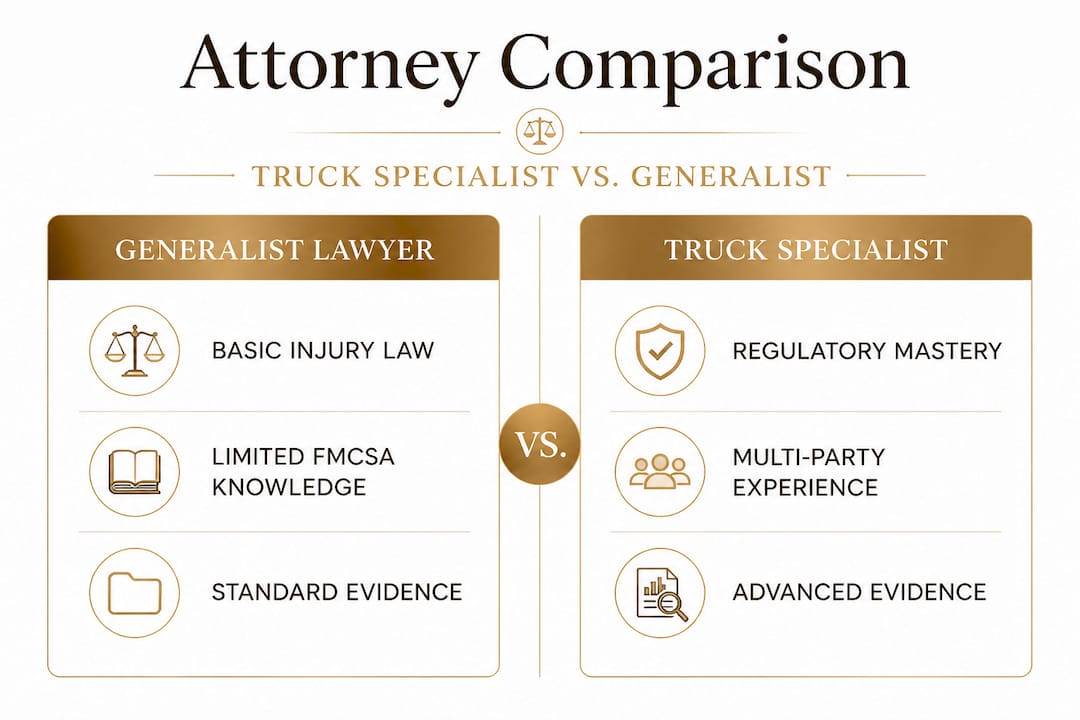
A general personal injury lawyer may competently handle slip-and-fall claims, dog bite cases, or standard car accident disputes. Truck accident litigation is a different discipline entirely. Truck accident attorneys bring specialized knowledge that general personal injury lawyers may lack, especially in areas like federal trucking regulations and evidence preservation procedures.
Understanding personal injury attorney roles is helpful, but knowing the specific questions to ask when choosing the right accident attorney is what truly protects you. Also worth reviewing are your broader auto accident legal rights under Pennsylvania law before your first consultation.
| Capability | General personal injury attorney | Truck accident specialist |
|---|---|---|
| Knowledge of FMCSA regulations | Limited | Extensive |
| Experience with ELD and black box data | Rarely utilized | Standard practice |
| Handling multiple defendants | Possible but unfamiliar | Core competency |
| Access to trucking industry experts | Uncommon | Established network |
| Track record with high-value claims | Variable | Focused |
| Familiarity with carrier liability insurance | Basic | Detailed and strategic |
Pro Tip: When interviewing attorneys, ask specifically: "How many truck or tractor-trailer accident cases have you handled? What federal trucking violations have you successfully litigated? Do you have existing relationships with accident reconstruction specialists?" Their answers will tell you quickly whether they have genuine experience or are generalizing from car accident work.
The stakes in truck accident cases are almost always higher than in standard vehicle collisions. Higher damages mean more aggressive opposition from the insurance side. You need an attorney whose background matches the demands of that fight.
The uncomfortable truth about truck accident claims: What most Pennsylvanians miss
Here is what experience in Pennsylvania truck accident litigation reveals that most victims don't hear until it's too late: the moment your accident occurs, the clock starts running for the other side, not just for you.
Trucking companies often have rapid response teams. These are investigators, attorneys, and insurance representatives who arrive at the accident scene quickly, sometimes within hours. Their job is to document evidence in a way that protects the company, interview witnesses before memories fade, and begin building a defense. While you are receiving medical treatment and trying to process what just happened, a professional team is already working against your interests.
This reality makes the "wait and see" approach to hiring an attorney genuinely harmful. Every day without legal representation is a day that evidence may be lost, altered, or legally destroyed. Federal regulations only require trucking companies to retain certain records for limited periods. Some data, like communications between the driver and dispatch, may not be preserved at all unless a legal hold demand is issued promptly.
The urgency of pursuing injury compensation is not a sales tactic. It reflects the operational reality of how these cases unfold. Waiting weeks or even days can permanently limit what evidence is available and therefore what outcome is achievable. The most successful claims are built by attorneys who get involved immediately and take control of the evidentiary record from the outset.
We've seen too many cases where a victim's hesitation gave the defense team a head start that was never fully overcome. Acting early is not about being aggressive. It's about being equal to the opposition you're actually facing.
Ready to protect your interests after a truck accident?
After a truck accident, every decision you make in the first days and weeks shapes the outcome of your claim. The trucking company's legal team is already moving. You deserve representation that's equally prepared.

Attorney Sean Quinlan and the team at pennsylvaniadui.attorney bring focused Pennsylvania experience to truck accident claims, offering case evaluations designed to help you understand your rights and options before you speak with any insurer. Whether your case involves catastrophic injuries, disputed liability, or an initial lowball offer, the team is equipped to respond. Explore dedicated personal injury support or review comprehensive resources for auto accident victims in Pennsylvania. Reach out today and make sure your interests are protected from the very start.
Frequently asked questions
How soon after a truck accident should I contact an attorney in Pennsylvania?
You should contact a truck accident attorney as soon as possible, ideally before speaking with any insurance companies, to protect your rights and preserve critical evidence. Acting quickly preserves your rights and prevents insurers from gaining an early advantage.
Will I have to pay upfront fees to hire a truck accident attorney?
Most truck accident attorneys work on a contingency fee basis, meaning you pay nothing unless your case results in a recovery. This arrangement, standard in truck accident claims, removes the financial barrier to getting experienced representation.
What's the difference between a truck accident attorney and a general personal injury lawyer?
A truck accident attorney has specialized knowledge of FMCSA regulations, evidence preservation rules specific to commercial trucking, and experience handling multi-party claims. As outlined in resources on personal injury attorney roles, that specialization makes a measurable difference in complex trucking cases.
What compensation can I seek in a truck accident claim?
You may seek compensation for medical expenses, lost income, future care costs, pain and suffering, and property damage in a Pennsylvania truck accident claim. Resources on maximizing your compensation confirm that these damages categories cover both immediate and long-term losses.
Recommended
- DUI Defense in Pennsylvania: Why You Need an Experienced Attorney — Attorney Sean Quinlan
- How to choose the right accident attorney in Pennsylvania
- Auto Accidents in Pennsylvania: Know Your Rights and How to Protect Them — Attorney Sean Quinlan
- Personal Injury Claims: How to Pursue Justice and Compensation — Attorney Sean Quinlan