

Most accident victims in Pennsylvania assume that insurance will handle everything or that the criminal justice system exists to make them whole. Neither assumption is fully correct. Insurance policies have limits, and criminal courts exist to punish offenders, not to put money in your pocket. Personal injury lawsuits fill that gap, and understanding how they work could be the single most important step you take after an accident. This guide walks through your rights as an accident victim in Pennsylvania, explains what a lawsuit actually does for you, compares your options side by side, and flags the mistakes that cost victims thousands of dollars every year.
Table of Contents
- The foundation: Your rights as an accident victim in Pennsylvania
- What personal injury lawsuits actually do for you
- Key differences: Personal injury lawsuits vs. other relief options
- Common scenarios and pitfalls: Navigating the Pennsylvania system
- Our take: Why understanding your options now is critical
- Get help asserting your rights after an accident
- Frequently asked questions
Key Takeaways
| Point | Details |
|---|---|
| Lawsuits provide compensation | Personal injury lawsuits ensure you get financial support for medical costs, lost income, and pain. |
| Legal rights often go unmet | Victim rights and insurance rarely cover all losses—lawsuits fill this critical gap. |
| Knowing your options is crucial | Understanding your civil remedies helps you make empowered, strategic choices after an accident. |
| Mistakes can cost you | Missing deadlines or skipping legal advice risks your financial recovery in Pennsylvania. |
| Expert help matters | An experienced attorney can maximize your compensation and avoid common legal pitfalls. |
The foundation: Your rights as an accident victim in Pennsylvania
Pennsylvania law gives crime victims meaningful rights. The PA Crime Victims Act grants notifications about court hearings, the right to be heard during sentencing, and access to victim advocacy services. These protections matter. But there is a critical point most people miss: victim rights under the PA Crime Victims Act provide notifications and input in criminal cases, but civil personal injury suits are needed for full financial compensation.
Criminal law is about the state prosecuting an offender. The outcome is a guilty verdict, a fine paid to the government, or jail time. None of that money flows to you. The district attorney represents the Commonwealth, not you personally. So even if the person who hurt you is convicted, you could still be left with unpaid medical bills and lost wages.
Insurance adds another layer of complexity. Your policy, the at-fault party's policy, and any underinsured motorist coverage all have dollar limits. Understanding your legal rights in the civil system is what allows you to pursue damages beyond those limits.
Here is a snapshot of what different systems can and cannot do for you:
| System | Financial compensation | Who controls it | Key limitation |
|---|---|---|---|
| PA Crime Victims Act | No | State/prosecutor | Advocacy only, no money damages |
| Insurance claim | Yes, limited | Insurer | Policy cap, insurer's interests |
| Workers' compensation | Yes, partial | Employer/insurer | No pain/suffering damages |
| Personal injury lawsuit | Yes, broad | You | Requires proof of fault |
Common gaps accident victims run into:
- Medical bills exceeding policy limits leaving victims personally responsible
- Pain and suffering losses that insurance adjusters routinely minimize or deny
- Future care costs not accounted for in an early settlement offer
- Lost earning capacity if your injury affects your ability to work long term
"The civil justice system exists precisely because victim advocacy programs and insurance settlements were never designed to make you financially whole." Knowing the difference between these systems before you act is what separates victims who recover fully from those who settle for far less.
Familiarizing yourself with common personal injury terms early in this process helps you read settlement letters, understand attorney advice, and ask sharper questions.
What personal injury lawsuits actually do for you
With those legal rights in mind, here is how personal injury lawsuits actually improve your outcome. A lawsuit is a legal action that you, the injured party, bring against the person or entity responsible for your harm. You control it. You decide whether to settle or go to trial. That is fundamentally different from every other system described above.
Financially, lawsuits are designed to address the full picture of your losses. Personal injury lawsuits are needed for full compensation because they can recover:
- Medical expenses, both past bills and future treatment costs
- Lost wages from time you missed at work
- Pain and suffering, including emotional distress and reduced quality of life
- Property damage not fully covered by insurance
- Long-term disability costs if your injury permanently limits your abilities
- Punitive damages in rare cases where the defendant's conduct was especially reckless
Pro Tip: Keep every receipt, explanation of benefits from your insurer, and any correspondence with the at-fault party's insurance company. This documentation becomes evidence in your lawsuit and strengthens your claim for damages.
Accountability is also a major factor. A civil judgment sends a direct financial signal to the responsible party. It can affect their assets, credit, and future behavior. For businesses like a trucking company or a negligent property owner, civil lawsuits often drive policy changes that prevent future injuries.
Exploring your justice and compensation options early gives you a clearer picture of what your case might be worth before you ever speak to an insurance adjuster. That knowledge is a negotiating advantage.
Insurance companies are not on your side. Their adjusters are trained to settle claims quickly and cheaply. When you file a lawsuit, you gain access to legal discovery, depositions, and court-ordered disclosure of evidence that insurers would never volunteer. Your auto accident recovery guide can walk you through the first steps after a crash to preserve that evidence.

Key differences: Personal injury lawsuits vs. other relief options
To see exactly why lawsuits are distinct, let's compare them directly to other options. Understanding when each tool applies protects you from relying on the wrong one.
| Option | Covers pain and suffering | Covers future losses | Controlled by victim | Proof required |
|---|---|---|---|---|
| Crime victim program | No | No | No | None |
| Insurance settlement | Rarely | Sometimes | No | Insurer decides |
| Workers' compensation | No | Partial | No | Work-related injury |
| Personal injury lawsuit | Yes | Yes | Yes | Fault/negligence |
Edge cases matter more than most people realize. Government claims have caps and notice requirements that victims must follow, Medicaid liens require recovery notification, and workers' compensation is a separate no-fault system with its own rules. Miss a notice deadline on a government claim and you may forfeit your right to sue entirely.
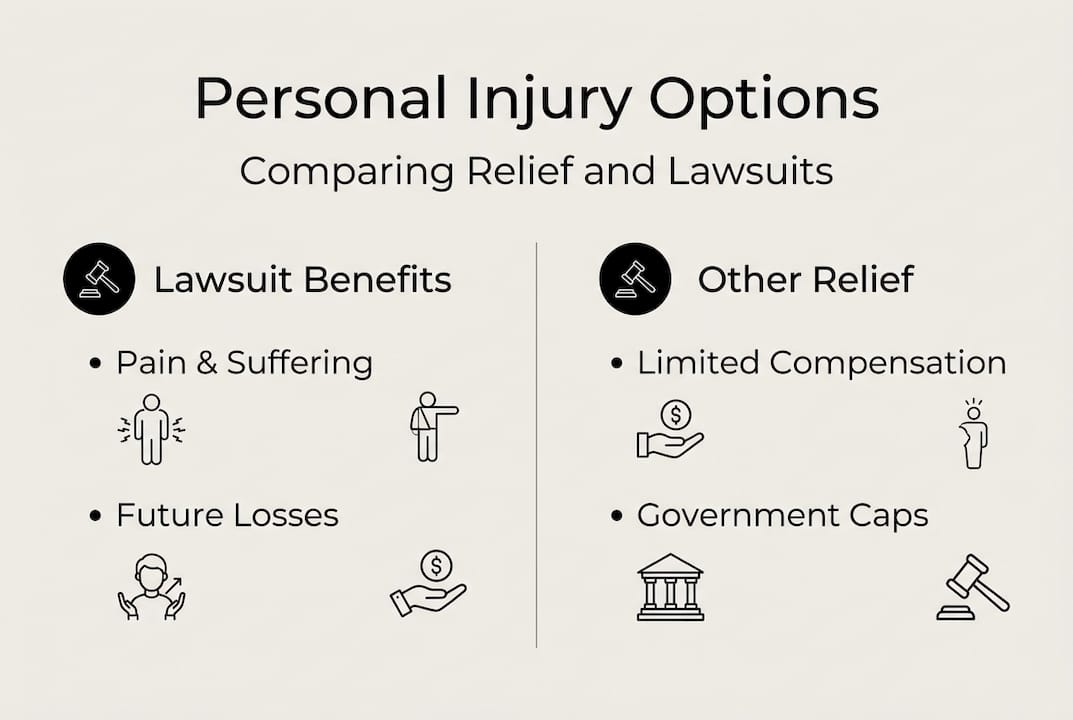
Knowing your auto accident rights in Pennsylvania helps you spot which category your case falls into quickly.
How to determine if a lawsuit is the right approach for your situation:
- Identify the source of your harm. Was it a private person, a business, or a government entity? Each has different rules.
- Review your insurance coverage. Know your policy limits and whether an underinsured motorist clause applies.
- Estimate your total damages. Include future medical care, lost wages, and non-economic losses like pain.
- Check the statute of limitations. In Pennsylvania, most personal injury claims must be filed within two years of the injury date.
- Consult an attorney before accepting any settlement. An experienced attorney can assess whether the offer reflects your true losses.
Many victims skip step five. They accept the first check and sign a release without realizing they have waived every future claim. That decision is often irreversible. PA personal injury claims involve specific procedural steps that an attorney navigates every day, while most accident victims face them once in a lifetime.
Common scenarios and pitfalls: Navigating the Pennsylvania system
Armed with this comparison, here is how these issues play out and what you should watch for in everyday cases.
Auto accidents are the most common scenario. Insurance adjusters often call within days of a crash offering quick settlements. That speed is not courtesy; it is strategy. Accepting before you know the full extent of your injuries can leave you paying out of pocket for surgery, physical therapy, or lost future income.
Slip and fall cases on someone else's property require proving the owner knew or should have known about a dangerous condition. Documenting the hazard immediately, such as photographing wet floors, broken steps, or missing handrails, is critical. Evidence disappears fast. Personal injury lawsuits are critical for making victims whole after many types of accidents, including premises liability cases that victims often underestimate.
On-the-job injuries add complexity. Workers' compensation covers you, but it does not allow you to sue your employer in most cases. However, if a third party caused the injury, such as a subcontractor or equipment manufacturer, a personal injury lawsuit against that party may still be available alongside workers' comp.
Criminal assault is another scenario where criminal prosecution and civil claims run on separate tracks. The criminal case can take years. Your civil claim operates independently, and protecting your rights after a crash or any violent incident means acting on both tracks simultaneously.
Common pitfalls to avoid:
- Missing deadlines. Pennsylvania's two-year statute of limitations is strict.
- Posting on social media. Defense attorneys and insurance adjusters monitor social media to find posts that contradict your injury claims.
- Failing to follow medical advice. Gaps in treatment are used to argue that your injuries are not serious.
- Talking to the other party's insurer without counsel. Recorded statements can be used against you.
Pro Tip: Even a free consultation with a personal injury attorney gives you a roadmap. Most attorneys work on contingency, meaning you pay nothing unless you recover, so there is no financial risk in getting an expert opinion early. Review your Pennsylvania recovery steps to understand what to prioritize right after an accident.
Our take: Why understanding your options now is critical
Here is a frank observation from legal professionals who have seen both successes and regrets: the victims who fare worst are rarely those with the weakest cases. They are the ones who waited too long, assumed someone else was handling it, or trusted an insurance company's goodwill.
Conventional wisdom says the system protects you. In reality, every system, from insurance to victim advocacy programs, was built with competing interests in mind. Insurance companies answer to shareholders. The criminal justice system answers to the state. Only a personal injury lawsuit answers directly to you.
Victims who pursue pursuing justice after injury through civil action, and who get legal counsel before signing anything, typically recover more and experience fewer financial surprises. The uncomfortable truth is that timing matters as much as the merits of your case. Evidence fades, witnesses move, and deadlines pass. Acting now, even just by getting informed, is the most protective thing you can do.
Get help asserting your rights after an accident
Understanding your rights is step one. Acting on them is step two, and that second step is much easier with experienced legal guidance behind you.

At pennsylvaniadui.attorney, Attorney Sean Quinlan and the team provide personal injury legal support tailored to Pennsylvania accident victims. Whether you were hurt in a car crash, a slip and fall, or another type of incident, a consultation costs you nothing upfront. The team also handles complex auto accident help cases where insurance disputes and liability questions make recovery harder. You do not have to navigate this alone, and you do not have to accept the first number an insurer puts on your suffering.
Frequently asked questions
Do I need to file a lawsuit if the other driver's insurance offers a settlement in Pennsylvania?
You are not required to file a lawsuit, but settlements often fall short of covering long-term damages or losses, and filing a lawsuit may be necessary to recover everything you are owed.
How are personal injury lawsuits different from workers' compensation in Pennsylvania?
Workers' compensation is a no-fault workplace system that limits recovery to medical costs and partial wages, while personal injury lawsuits seek full damages from at-fault parties but require proof of negligence.
What if my injuries were caused by a government employee or agency?
Government claims carry caps and strict notice requirements in Pennsylvania, meaning you must file timely notifications or risk losing your right to sue altogether.
Can a personal injury lawsuit help if I have medical bills paid by Medicaid?
Yes, but Medicaid liens require notification when you reach a settlement, and Medicaid may claim a portion of your recovery as reimbursement for benefits paid on your behalf.
Recommended
- Personal Injury Claims: How to Pursue Justice and Compensation — Attorney Sean Quinlan
- Understand personal injury claims in PA: your rights
- Auto Accidents in Pennsylvania: Know Your Rights and How to Protect Them — Attorney Sean Quinlan
- Personal Injury Claims: How to Maximize Your Compensation — Attorney Sean Quinlan
- Why pursue an injury case? Key reasons for Colorado victims
- Why Hire a Personal Injury Lawyer in Georgia